50 heller Amstetten
“prison money”
About This Note
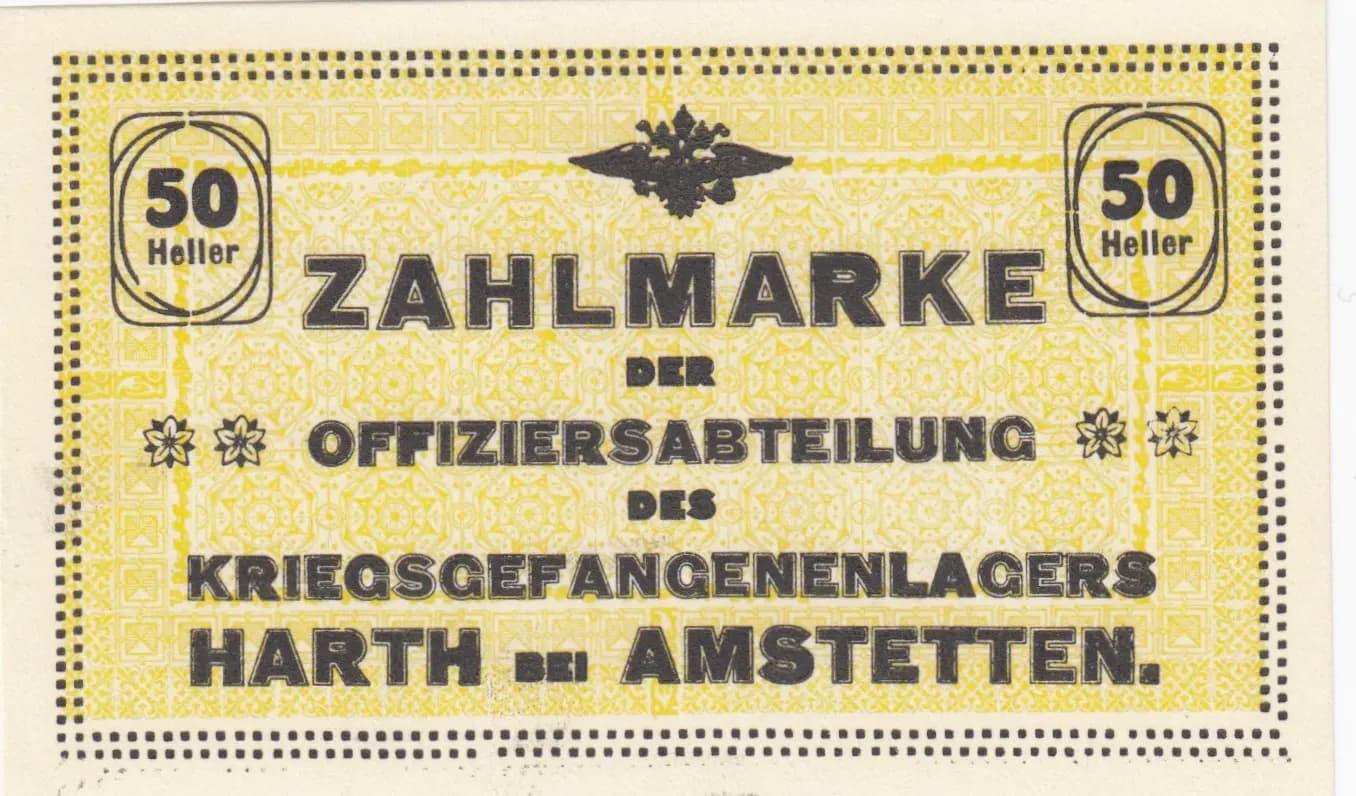
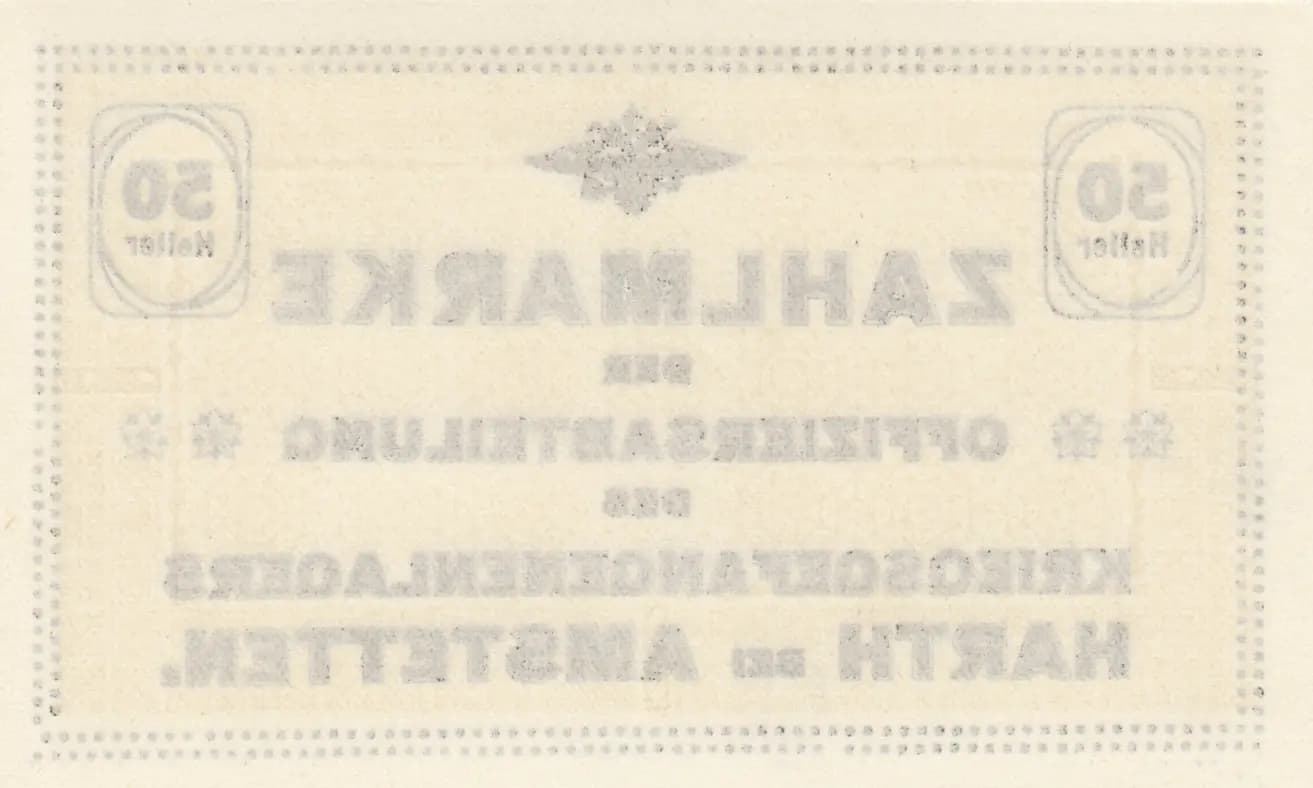
This 50 Heller note from the Amstetten Prison Camp represents a fascinating piece of World War I monetary history, issued by the officers' department of the Harth war prisoners' camp near Amstetten, Austria. The front side displays excellent condition with crisp printing, yellow coloring, and ornamental geometric patterns framing the denomination and issuing authority text. The reverse side shows significant fading, likely from age and light exposure over the past century, yet remains physically intact without tears or creasing, supporting the UNC grade assessment.
Scarce. Prison camp scrip from World War I, particularly from specific camps and denominations, was produced in limited quantities for restricted circulation within the camp population. The Amstetten camp notes are not commonly encountered in the numismatic market. The fact that this note remains unrecorded in the Pick catalog (major reference for European emergency money) suggests limited documentation and availability. UNC examples are particularly scarce, as most surviving examples show evidence of extended handling or storage deterioration. The significant fading on the reverse indicates these notes were vulnerable to environmental conditions, and well-preserved examples are uncommon.
This emergency scrip was issued by the Austro-Hungarian military as payment token for officers held in the Harth internment camp near Amstetten during World War I. The formal German designation 'ZAHLMARKE DER OFFIZIERSABTEILUNG DES KRIEGSGEFANGENENLAGERS' (payment mark of the officers' department of the war prisoners' camp) reflects the structured but desperate economic conditions within prison camps, where standard currency was restricted and camp-issued tokens became the primary medium of exchange. The ornamental design and official emblem suggest an attempt to create legitimacy and prevent counterfeiting of these internally-circulated notes.
The note features a yellow/cream colored field with black text and decorative elements. The front displays a formal layout typical of Austro-Hungarian military documents, with an unidentified dark emblem or coat of arms at the top center (likely representing either the Austrian military or the specific camp administration). Denomination markers reading '50' in decorative corner frames anchor the four corners of the note. Star-like or ornamental flourishes flank the main central text block. An ornamental border pattern with geometric designs frames the entire note, and a perforated edge pattern runs along the margins—typical security features for prison camp scrip to prevent alterations. The back side mirrors this layout but has faded considerably, suggesting the reverse may have contained duplicate security information or identical text.
FRONT: '50 Heller' (denomination of 50 heller), 'ZAHLMARKE' (payment mark/token), 'DER OFFIZIERSABTEILUNG' (of the officers' department), 'DES KRIEGSGEFANGENENLAGERS' (of the war prisoners' camp), 'HARTH BEI AMSTETTEN' (Harth near Amstetten). BACK: '50 Heller' and 'ZAHLMARKE' visible but remaining inscriptions too faded to read with certainty; likely mirrors the front side text.
Letterpress printing, evidenced by the crisp, uniform impression visible on the front side and the characteristic sharp serif typography of the German text. The fine ornamental border work and geometric patterns are consistent with early 20th-century letterpress security printing. The perforated edge pattern appears to have been die-cut or perforated during a finishing stage. The printer is not identified in the visible inscriptions and is unknown for this Pick-unlisted issue.
As a Pick-unlisted issue, no formal varieties have been cataloged. However, this specific example is identifiable as from the Officers' Department (Offiziersabteilung) of the Harth camp near Amstetten. Other denominations (10, 20 heller, etc.) and/or issues from the enlisted ranks or different departments of the same camp may exist. The lack of visible serial numbers or signatures on this example is typical for camp scrip, though other varieties might feature such markings. Documentation of the printing date and printer would be necessary to establish formal variety distinctions for cataloging purposes.