20 kronen 1914 Eisenerz
“prison money”
About This Note
This is a fascinating 20 kronen prison camp voucher issued by the Eisenerz Mining Company in Austria during World War I, printed in distinctive pink/rose with ornamental border designs and dual-language text in German and Russian. The note is in AU condition with expected age-related wear including creases, fold marks, and light foxing, presenting as an authentic circulated example of this specialized wartime currency. This bilingual format reflects the multinational composition of prisoners of war held at the mining operation, making it a particularly interesting artifact of the Great War's human and economic dimensions.
Scarce. This note is unlisted in the Pick catalog, indicating it falls outside the standard numismatic reference framework for collected currency. Eisenerz prison camp vouchers have limited documentation and small surviving populations compared to major Austrian banknote issues. The specific bilingual (German/Russian) format adds to its rarity, as most camp scrip was single-language. The AU condition grade suggests this example has above-average preservation for wartime camp money, which typically circulated heavily and survives in lower grades. Prison camp scrip from Austria-Hungary generally commands collector interest but appears in the market with moderate frequency, placing this issue in the scarce rather than rare category.
The Eisenerz (Iron Ore) mining district in Austria was converted into a prisoner of war camp during World War I, with the Austrian Alpine Mining Company issuing this scrip to compensate captured soldiers for labor. The presence of Russian-language text on the reverse indicates this voucher was specifically designed for use by Russian prisoners of war, reflecting the large number of Eastern Front captives held at mining and industrial sites across Austria-Hungary. This bilingual voucher represents an attempt to manage the complex logistics of feeding, housing, and compensating a diverse prisoner population while maintaining operational continuity at critical wartime industrial facilities.
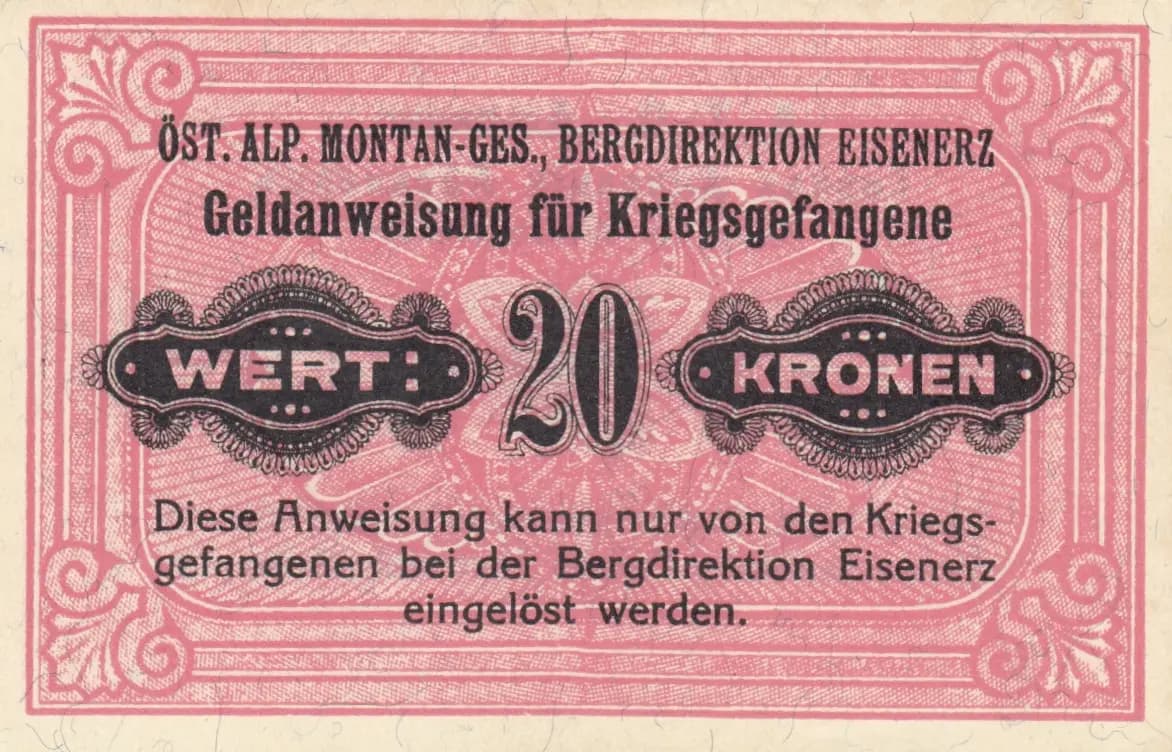
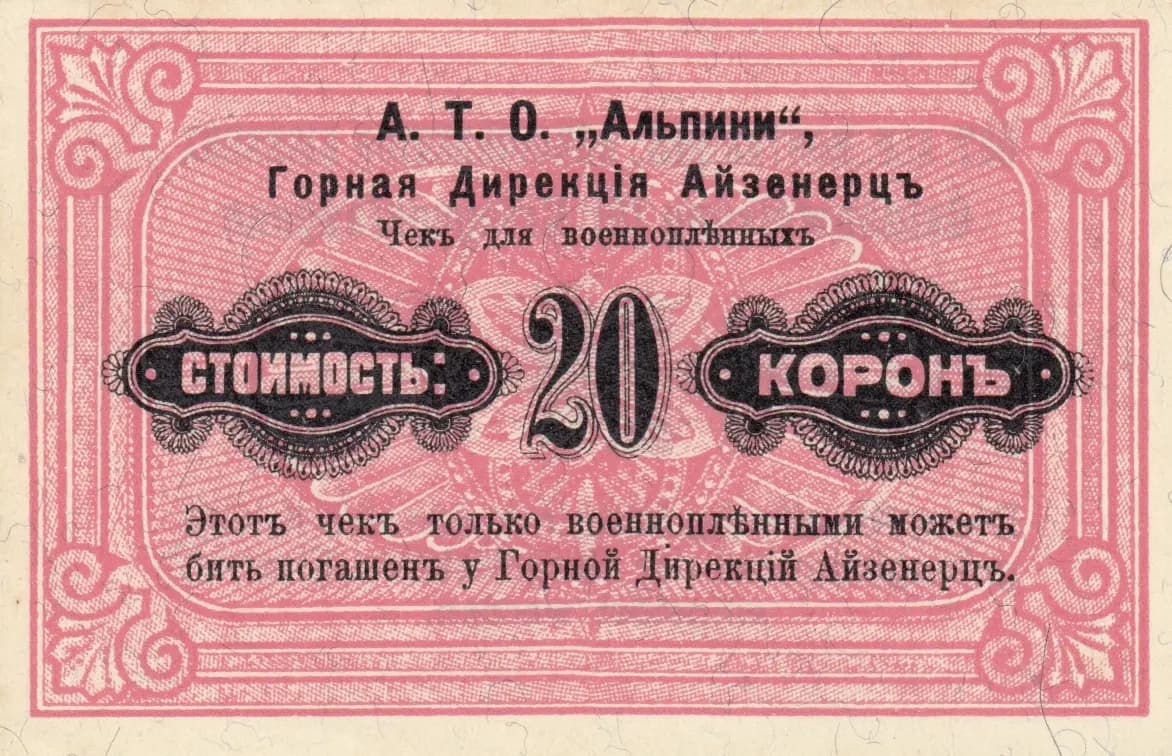
This bilingual voucher features a symmetrical design with ornamental scrollwork in all four corners and a continuous decorative border frame surrounding the entire note. The central composition is dominated by two decorative black oval frames with fine dot patterns flanking the large denomination numerals '20', creating a balanced composition typical of early 20th-century security printing. The pink/rose coloration provides visual distinction from standard currency, appropriate for restricted-use prison scrip. The absence of portraits or traditional landmarks emphasizes the functional, utilitarian nature of this prisoner camp money, while the dual German and Russian language versions indicate intentional design to serve the bilingual prisoner population at the mining operation.
FRONT (German): 'ÖST. ALP. MONTAN-GES., BERGDIREKTION EISENERZ' (Austrian Alpine Mining Company, Berg Direction Eisenerz) | 'Geldanweisung für Kriegsgefangene' (Money voucher for prisoners of war) | 'WERT: 20 KRONEN' (VALUE: 20 CROWNS) | 'Diese Anweisung kann nur von den Kriegsgefangenen bei der Bergdirektion Eisenerz eingelöst werden.' (This voucher can only be redeemed by prisoners of war at the Berg Direction Eisenerz.) | BACK (Russian Cyrillic): 'А.І.О. "Альпіны"' (A.I.O. 'Alpini') | 'Горная Дирекція Айзенерцъ' (Mountain Direction Eisenerz) | 'Чекъ для военнопльнныхъ' (Check for prisoners of war) | 'СТОЙНОСТЬ: 20 КОРОНА' (VALUE: 20 CROWN) | 'Этотъ чекъ только военнопльнными может оиъ погашен у Горной Дирекціи Айзенерцъ.' (This check can only be redeemed by prisoners of war at the Mountain Direction Eisenerz.)
This note was produced using lithographic printing, evidenced by the fine ornamental borders, decorative oval frames with dot-pattern details, and the characteristic rendering of the scrollwork elements visible in the visual analysis. The consistent registration between the pink color field and black text/ornamental elements suggests a multi-pass lithographic process. The printer for Eisenerz camp notes is not definitively documented in standard references, though Austrian camp scrip from this period was typically produced by local or regional printing houses under military administration rather than the national Austro-Hungarian banknote printers.
No signatures, dates, or serial numbers are visible in the visual analysis of this example, limiting variety identification. The bilingual German/Russian format is the primary variety identifier for this issue. Without documentation of different printer marks, date variants, or overprints, specific variety cataloging is not possible from the observed specimen. Collectors should note any variations in printing quality, color shade intensity (the pink/rose tone may vary between printings), or ornamental border details as potential variety indicators for future cataloging of Eisenerz camp scrip.