10 kronen Amstetten
“prison money”
About This Note
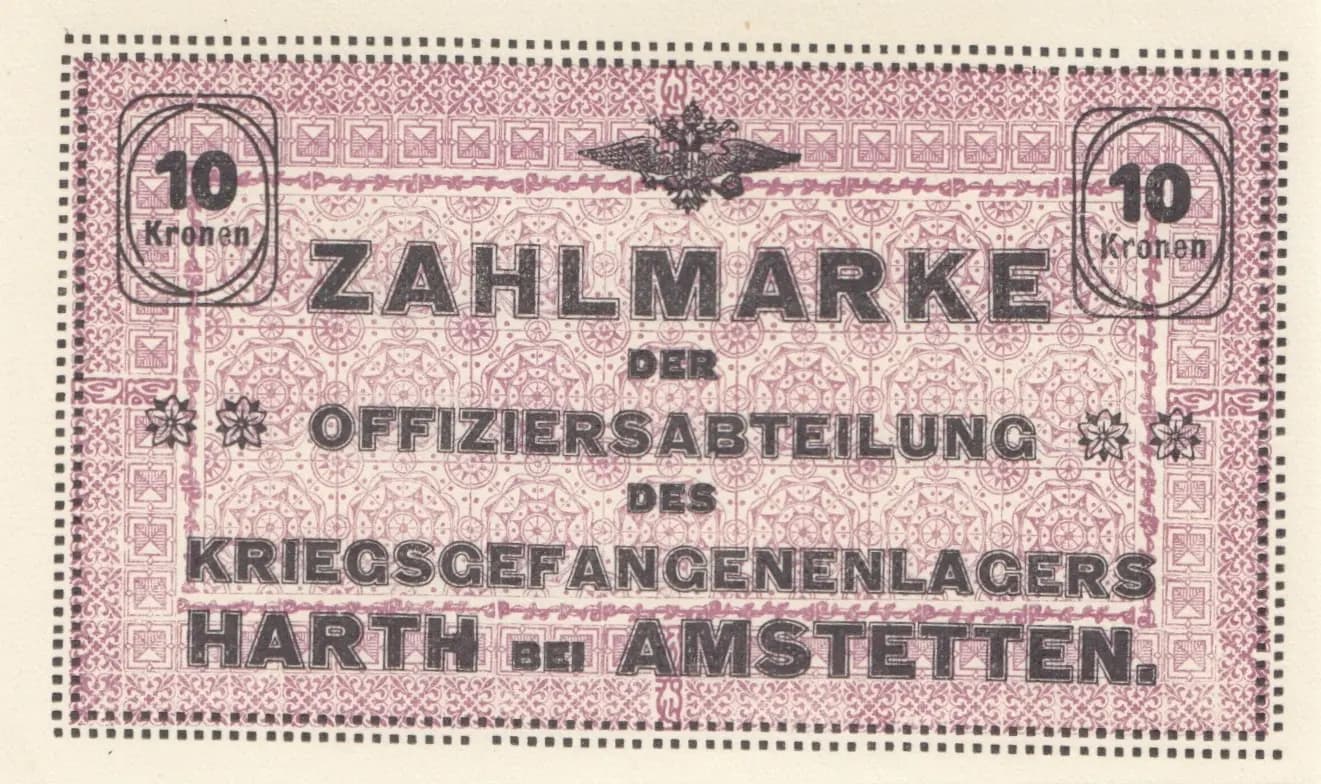
A scarce 10 Kronen denomination note issued by the Amstetten Prison Camp (Kriegsgefangenenlager Harth bei Amstetten) during World War I, featuring an ornate design in pink/mauve and cream tones with an Imperial double-headed eagle and elaborate geometric and floral patterns. The note is presented in exceptional UNC condition with sharp printing, vibrant colors, and no visible wear, making it a desirable example of WWI-era prisoner-of-war camp scrip. This specific prison camp currency represents an important artifact of Austrian military history and the conditions of imprisoned officers during the Great War.
Scarce. Prison camp scrip from WWI is significantly rarer than regular banknote issues due to the limited circulation within individual camps, smaller print runs, and the high likelihood of destruction or loss of specimens over more than a century. The Amstetten camp's officer scrip is not commonly encountered in the market. While not 'very rare,' this specific Pick-unlisted note would be considered scarce in any grade, with UNC examples being particularly desirable to serious WWI ephemera and prison camp currency collectors.
This note was issued by the Officers' Division (Offiziersabteilung) of the War Prisoners' Camp near Amstetten in Austria, serving as internal currency for Allied officers held captive during World War I. The prominent Imperial double-headed eagle symbolizes the Austro-Hungarian Empire's authority over the camp administration. Prison camp scrip like this was used to regulate the internal economy of the camp, allowing officers limited purchasing power for canteen goods and services while maintaining strict control over the prisoner population.
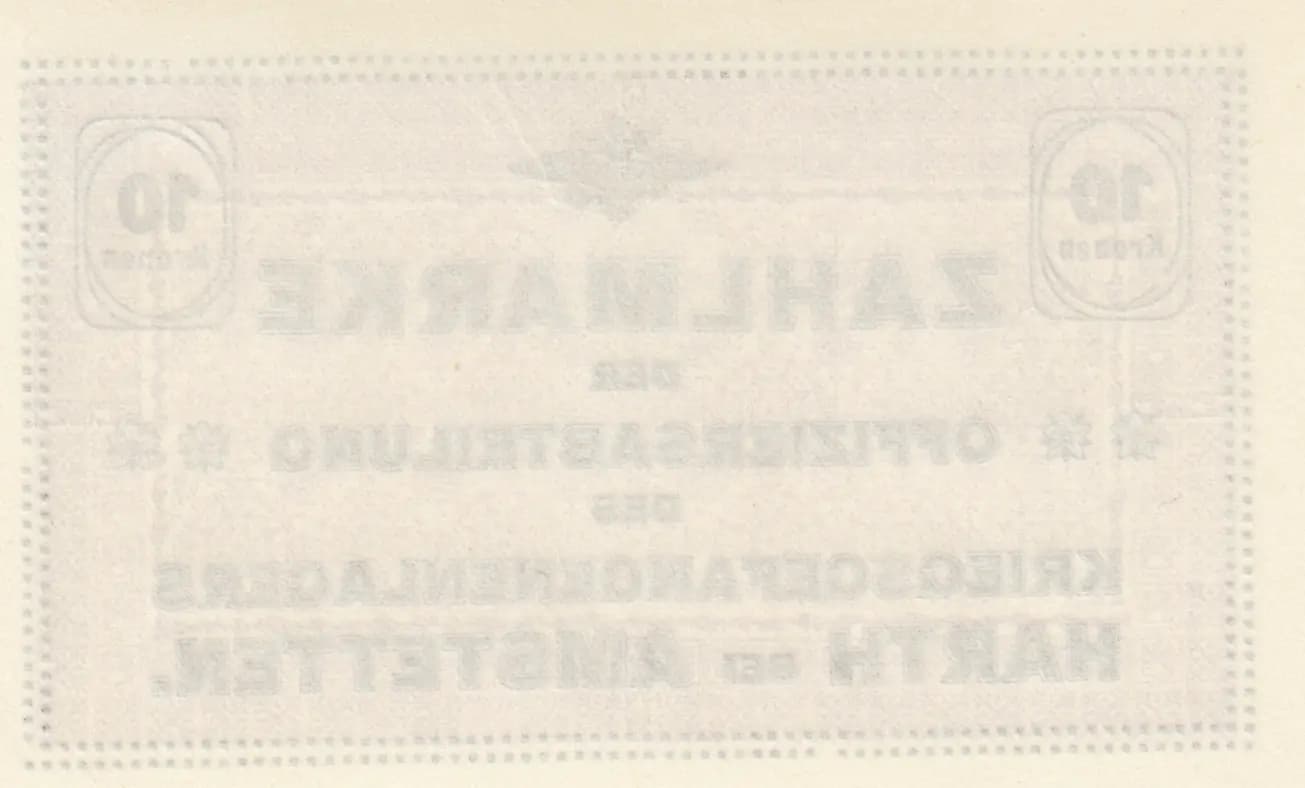
The obverse features a formal, highly ornamented design characteristic of Austro-Hungarian official documents of the WWI era. The Imperial double-headed eagle, rendered in black at the top center, serves as the primary heraldic symbol authenticating the note's official status. The denomination '10 Kronen' appears in ornamental corner frames with rounded baroque-style borders, rendered in black on the cream background. The entire field is filled with fine geometric patterns (including what appear to be interlocking geometric motifs) and delicate floral designs in light pink/mauve, creating a sophisticated security pattern typical of period banknote design. The reverse appears to contain complementary design elements, though visibility in the provided image is insufficient for detailed description.
Front side: '10 Kronen' (Ten Kronen); 'ZAHLMARKE' (Payment Token/Certificate); 'DER OFFIZIERSABTEILUNG' (of the Officers' Division); 'DES KRIEGSGEFANGENENLAGERS' (of the War Prisoners' Camp); 'HARTH BEI AMSTETTEN' (Harth near Amstetten). Back side: Text content too faint to accurately transcribe from the provided image.
The note exhibits characteristics of letterpress or intaglio printing with fine line work and precise registration of multiple colors, typical of Austro-Hungarian official securities printing during the WWI period. The crisp, well-defined geometric patterns and fine floral ornaments suggest skilled engraving and professional printing by an established security printer, likely an official Austro-Hungarian state printer or contracted security printing firm. The two-color printing (pink/mauve and black on cream stock) was economical yet sophisticated for the period.
This note is cataloged as Pick-unlisted, indicating it is not yet formally recognized in the standard Pick catalog of world banknotes. It represents an Officers' Division issue from the Harth camp near Amstetten. Without visible serial numbers or signatures clearly readable in the provided images, specific variety distinctions cannot be definitively established. Future cataloging may reveal different denominations, dates, or issuing authority variations from the same camp. Researchers specializing in WWI Austrian camp scrip should be consulted for definitive variety information.