1 krone 1914 Eisenerz
“prison money”
About This Note
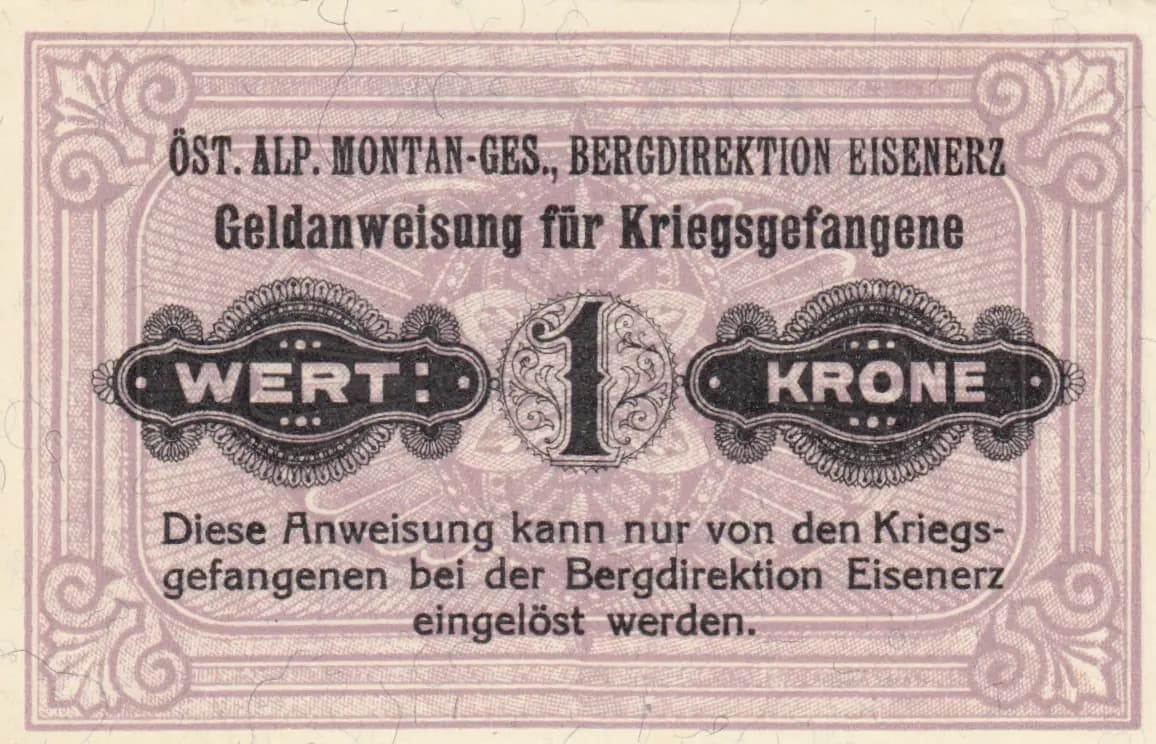
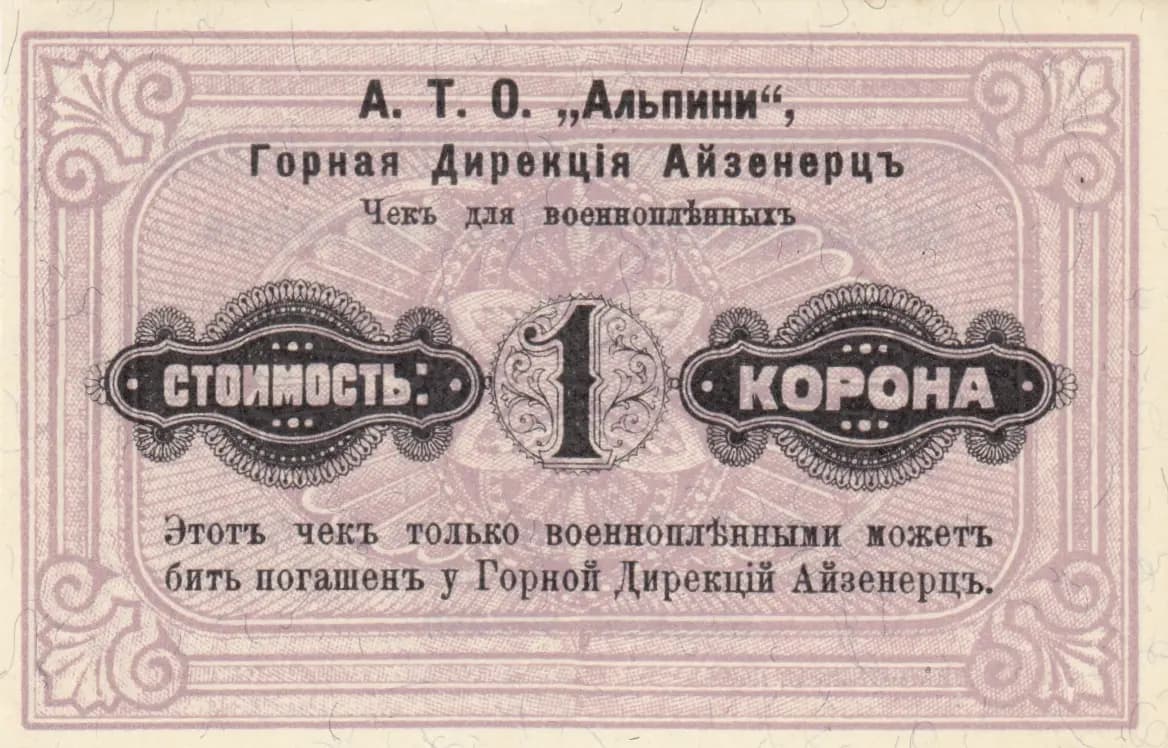
This fascinating 1914 Austrian 1 Krone prison camp note from Eisenerz represents a rare bilingual monetary instrument issued for German and Russian prisoners of war during World War I. The note exhibits UNC condition with excellent clarity despite visible age-appropriate creasing and foxing, featuring an ornate light purple/mauve design with Victorian-style decorative borders, scrollwork, and fine security line-work throughout. The dual-language format (German and Russian) and its specific function as redeemable currency only within the Eisenerz mining operation make it a significant artifact of Great War prisoner economics.
Rare. This note is unlisted in the Pick catalog and represents a highly specialized category of World War I prisoner-of-war scrip from a specific mining operation. The bilingual design, limited circulation within a single camp facility, and the post-war destruction or loss of most camp currency notes makes surviving examples uncommon. The UNC condition grade further enhances its rarity, as camp scrip typically saw heavy circulation and wear among the prisoner population.
The Eisenerz Prison Camp operated during World War I at Austria's Alpine Mining Company (Österreichische Alpen Montangesellschaft) in the Styrian mining region. This bilingual note—printed in both German and Russian—directly reflects the multinational character of the Austro-Hungarian prisoner population, with Russian text indicating the significant number of captured Russian soldiers held in the camp. The redemption restriction ('can only be redeemed by prisoners of war at the Mining Direction Eisenerz') reveals how camp authorities used this scrip to regulate prisoner labor and control economic activity within the facility.
The 1 Krone note features a symmetrical Victorian-influenced design centered on the prominent numeral '1' in the middle of the composition. The dominant light purple/mauve background is framed by an elaborate decorative border with black line-work consisting of ornate scrollwork flourishes positioned in all four corners. Oval decorative cartouches frame the value designations ('WERT'/'СТОИМОСТЬ' and 'KRONE'/'КОРОНА') in both German and Russian. Fine cross-hatching and linear security patterns fill the background areas, serving both aesthetic and anti-counterfeiting purposes. The note displays no portraits or specific landmarks, instead relying on classical ornamental typography and geometric patterns typical of early 20th-century institutional scrip design.
GERMAN SIDE: 'Österreichische Alpen Montangesellschaft, Bergdirektion Eisenerz' (East Alpine Mining Company, Mining Direction Eisenerz) / 'Geldanweisung für Kriegsgefangene' (Monetary Assignment for Prisoners of War) / 'WERT' (Value) / 'KRONE' (Crown) / 'Diese Anweisung kann nur von den Kriegsgefangenen bei der Bergdirektion Eisenerz eingelöst werden.' (This assignment can only be redeemed by prisoners of war at the Mining Direction Eisenerz.) // RUSSIAN SIDE: 'А.Т.О. "Альпини"' (A.T.O. 'Alpini') / 'Горная Дирекция Айзенорцъ' (Mountain Direction Aizenortz) / 'Чек для военнопленных' (Check for Prisoners of War) / 'СТОИМОСТЬ' (Value) / 'КОРОНА' (Crown) / 'Этотъ чек только военнопленными может быть погашен у Горной Дирекцій Айзенорцъ.' (This check can only be cashed by prisoners of war at the Mountain Direction Aizenortz.)
The note was produced using intaglio letterpress printing, evidenced by the fine line-work, cross-hatching patterns, and clearly impressed text visible throughout the design. The security features—including the fine line patterns and decorative border frames—are characteristic of professional security printing typical of Austro-Hungarian government and institutional printers of the WWI era. The dual-language capability suggests a single master plate with both German and Russian text produced simultaneously, rather than separate printings.
This note is identified as a bilingual variety with German text on one side and Russian Cyrillic text on the reverse, reflecting the dual-language requirements of the Eisenerz camp population. No serial numbers or signatures are evident in the visual analysis, suggesting this may have been a standardized issue without individual tracking. The note's unlisted status in Pick catalog indicates it represents a cataloging gap in prisoner-of-war money references, potentially with only one or a few examples documented in specialist collections. Further research may reveal additional denominations or printing variants from the same issuer.