5000 francs 1955
Market Prices
5 salesAbout This Note
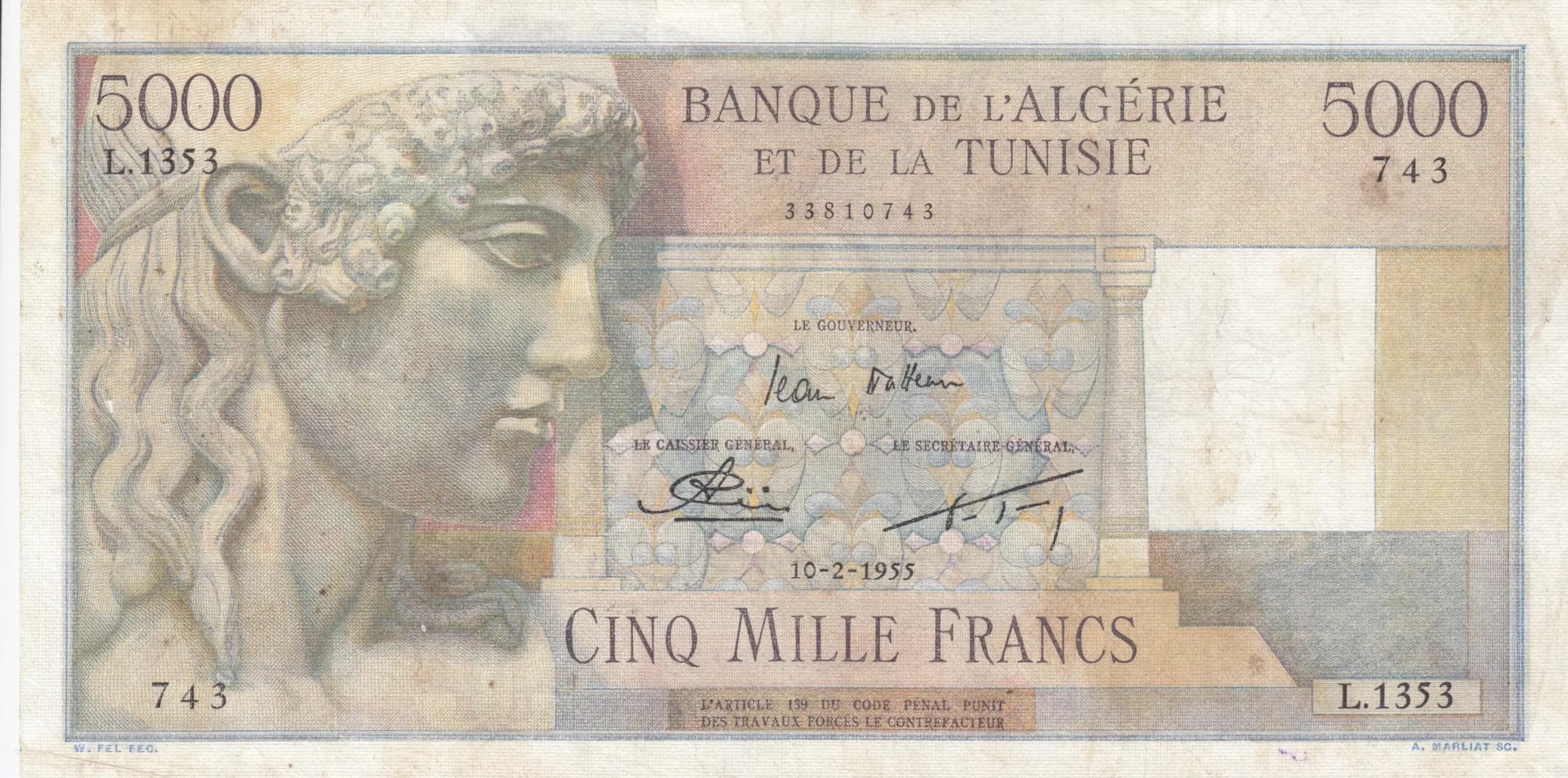
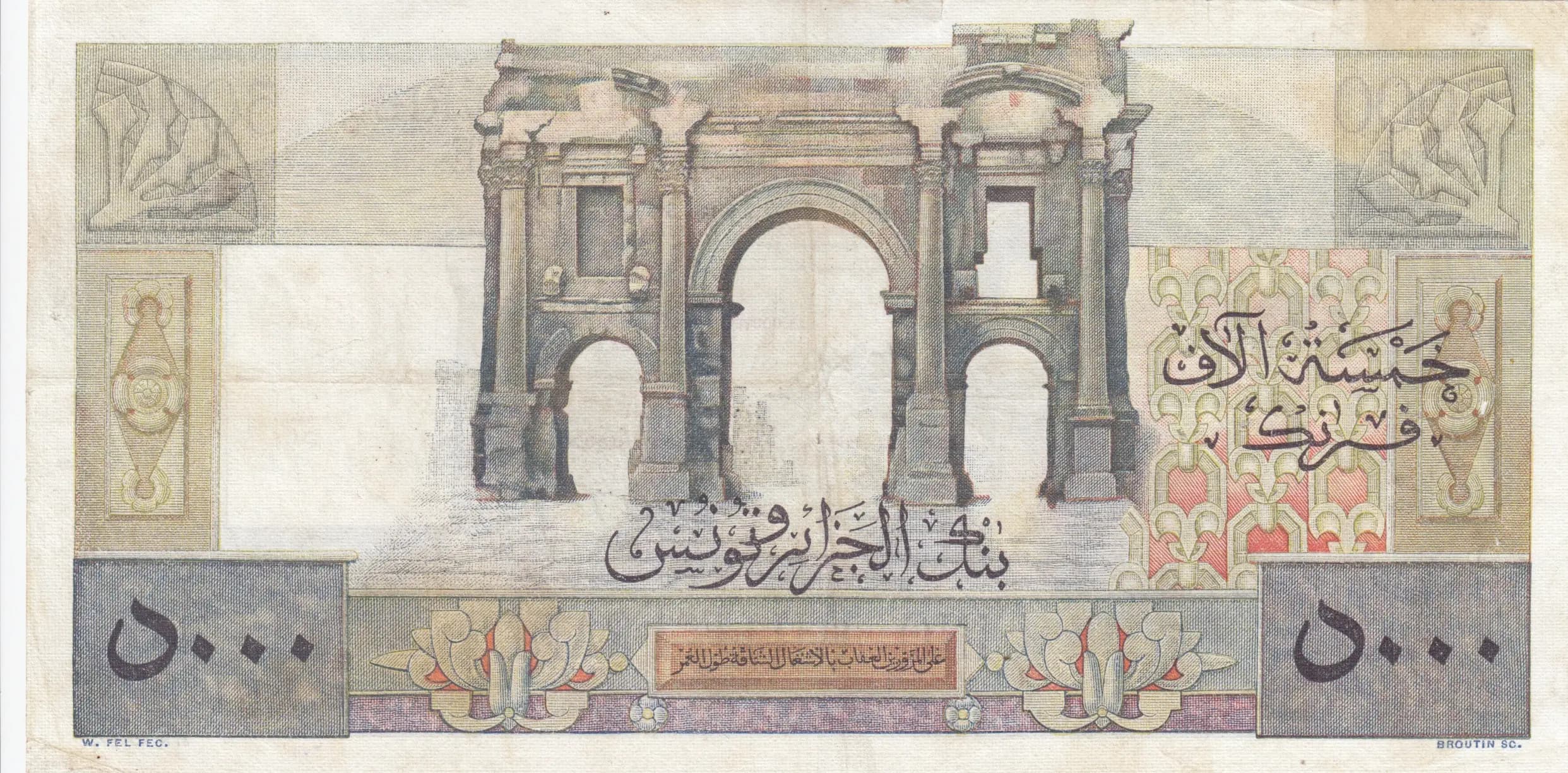
This VF-graded 5000 Francs note from 1955 represents an important transitional piece from French colonial North Africa, issued by the Banque de l'Algérie et de la Tunisie. The note displays the classical engraving technique characteristic of mid-20th century French colonial currency, with a well-preserved portrait of Pythian Apollo on the obverse and the iconic three-arched Roman monument (Trajan's Arch at Timgad) dominating the reverse. Despite moderate circulation wear including creasing and foxing typical of notes from this period, the fine engraving detail remains clearly visible, and with recent comparable VF examples selling for $62-$152 on the secondary market, this represents an affordable entry point for collectors of North African numismatics.
Common. eBay transaction data shows regular sales activity across multiple condition grades (F, VF, UNC), with VF examples selling consistently between $62-$152 from 2009-2020, indicating robust supply in the collector market. The catalog values (VF: $100 per 2016 SCWPM data) further support common classification. While this is a desirable note from the final years of French colonial North Africa, it was issued in substantial quantities and remains readily obtainable for collectors. The lack of any rarity notes or short print run data in the Pick catalog confirms standard production volume. VF condition represents solid preservation without premium rarity.
Issued on February 10, 1955, this note was produced during a critical moment in French North African colonial history, just months before the Algerian War of Independence (1954-1962) and at the eve of Tunisia's independence in March 1956. The dual-nation issuer (Banque de l'Algérie et de la Tunisie) reflects the administrative unity of French colonial territories, while the monumental imagery—Apollo representing classical civilization and Trajan's Arch symbolizing Roman imperial permanence—conveys France's claim to cultural and historical legitimacy in the region. This would be among the last notes issued under this institutional structure, as both territories would achieve independence within the following year, making this a poignant numismatic artifact of the dying colonial era.
The obverse features a classical male portrait identified as Pythian Apollo, rendered in profile facing left with detailed curled hair and full beard, demonstrating the fine engraving work characteristic of French colonial banknote production. The portrait occupies the left portion while the right side features ornamental architectural borders with scrollwork and decorative motifs in period style. The reverse is dominated by Trajan's Arch (Arch of Timgad/Thamugadi), a prominent Roman monument located in present-day Algeria, depicted with three prominent arches supported by fluted columns with classical capitals, surrounded by intricate geometric and floral border patterns. The note employs a warm, muted color palette of beige, tan, gray, and brown tones with accent areas in pink-red, typical of intaglio printing from this era. Both sides feature dual denomination indicators and comprehensive bilingual French-Arabic inscriptions reflecting the colonial administrative structure. The inclusion of a penal code warning and official signatures reinforces the note's legal authority and anti-counterfeiting measures.
FRONT SIDE: 'BANQUE DE L'ALGÉRIE ET DE LA TUNISIE' (Bank of Algeria and Tunisia); 'CINQ MILLE FRANCS' (Five Thousand Francs); 'L.1353' (series designation); '33810743' (serial number); '10-2-1955' (February 10, 1955 issue date); 'LE GOUVERNEUR' (The Governor); 'LE CAISSIER GÉNÉRAL' (The General Cashier); 'LE SECRÉTAIRE GÉNÉRAL' (The General Secretary); 'L'ARTICLE 139 DU CODE PÉNAL PUNIT DES TRAVAUX FORCÉS LE CONTREFACTEUR' (Article 139 of the Penal Code punishes the counterfeiter with forced labor); 'W. FELICE.' (engraver/artist signature). BACK SIDE: '5000' (denomination); 'بنك الجزائر وتونس' (Bank of Algeria and Tunisia in Arabic); '5000' (denomination repeated).
Intaglio (engraved) printing, the standard security printing method for high-denomination banknotes of this period. The fine linear detail visible in both the portrait and architectural rendering, the sharp edges of text, and the dimensional quality characteristic of intaglio work are evident throughout. The printer is not definitively identified in available catalog data, but French colonial banknotes of this period were typically produced by established French security printers such as Banque de France or specialist firms working under French government contract. The signature 'W. FELICE.' indicates the engraver responsible for the design work.
Identified as Pick 109b variant. The PMG population report indicates three catalogued variants (109a, 109b, 109s) for this base Pick number. This example carries the date 10-2-1955 with series designation 'L.1353' and serial number '33810743'. The visual analysis confirms the presence of the penal code text at lower center on back ('L'ARTICLE 139 DU CODE PÉNAL...'), which is noted in external catalog references as a distinguishing feature. The Arabic text below the arch is confirmed as 'بنك الجزائر وتونس' (Bank al-Djazair wa Tunus), consistent with the 109b identification per banknote.ws reference material. No overprints or secondary features indicating rarer sub-varieties are evident.