50 francs 1941
Market Prices
28 salesAbout This Note
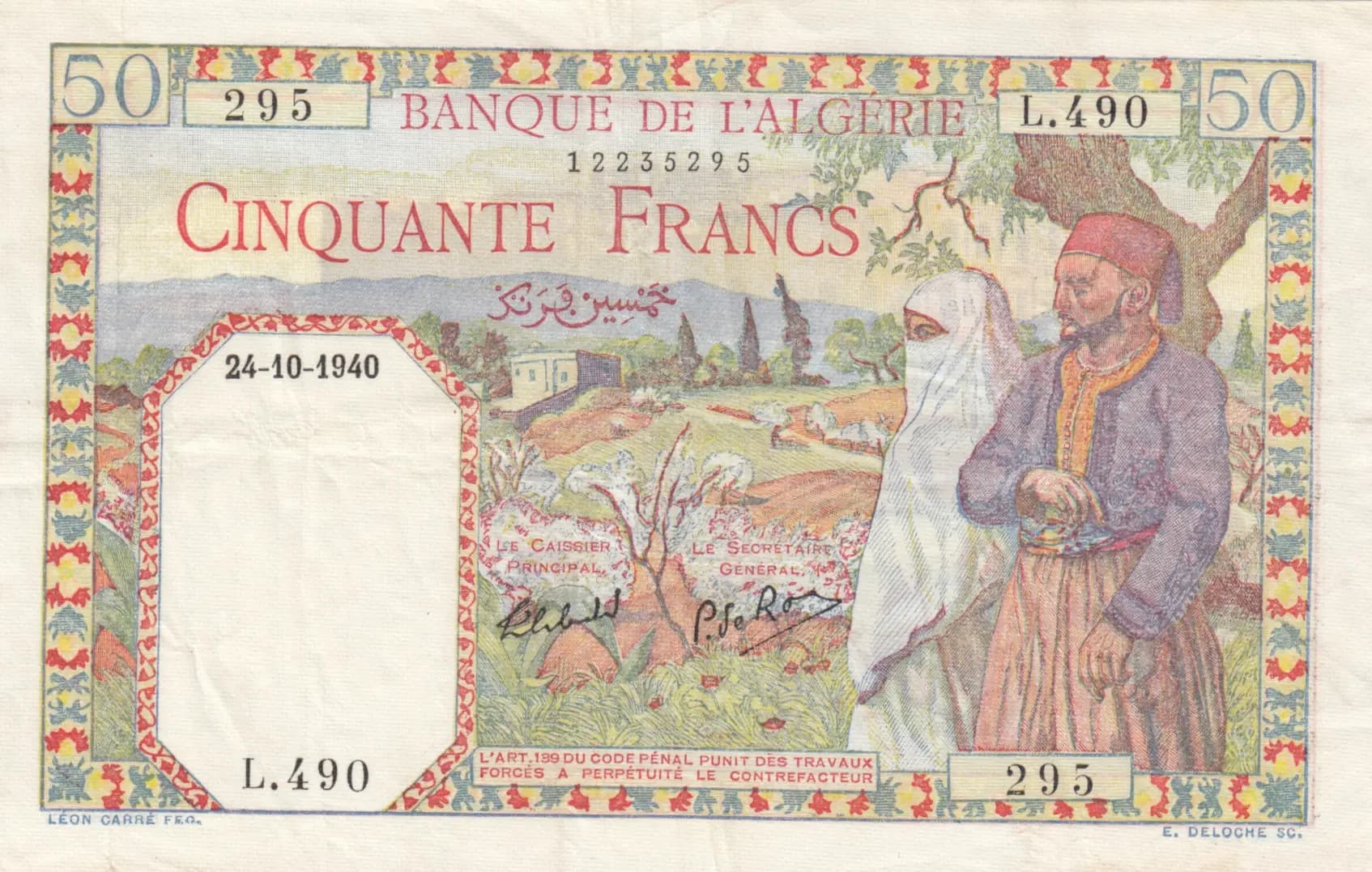
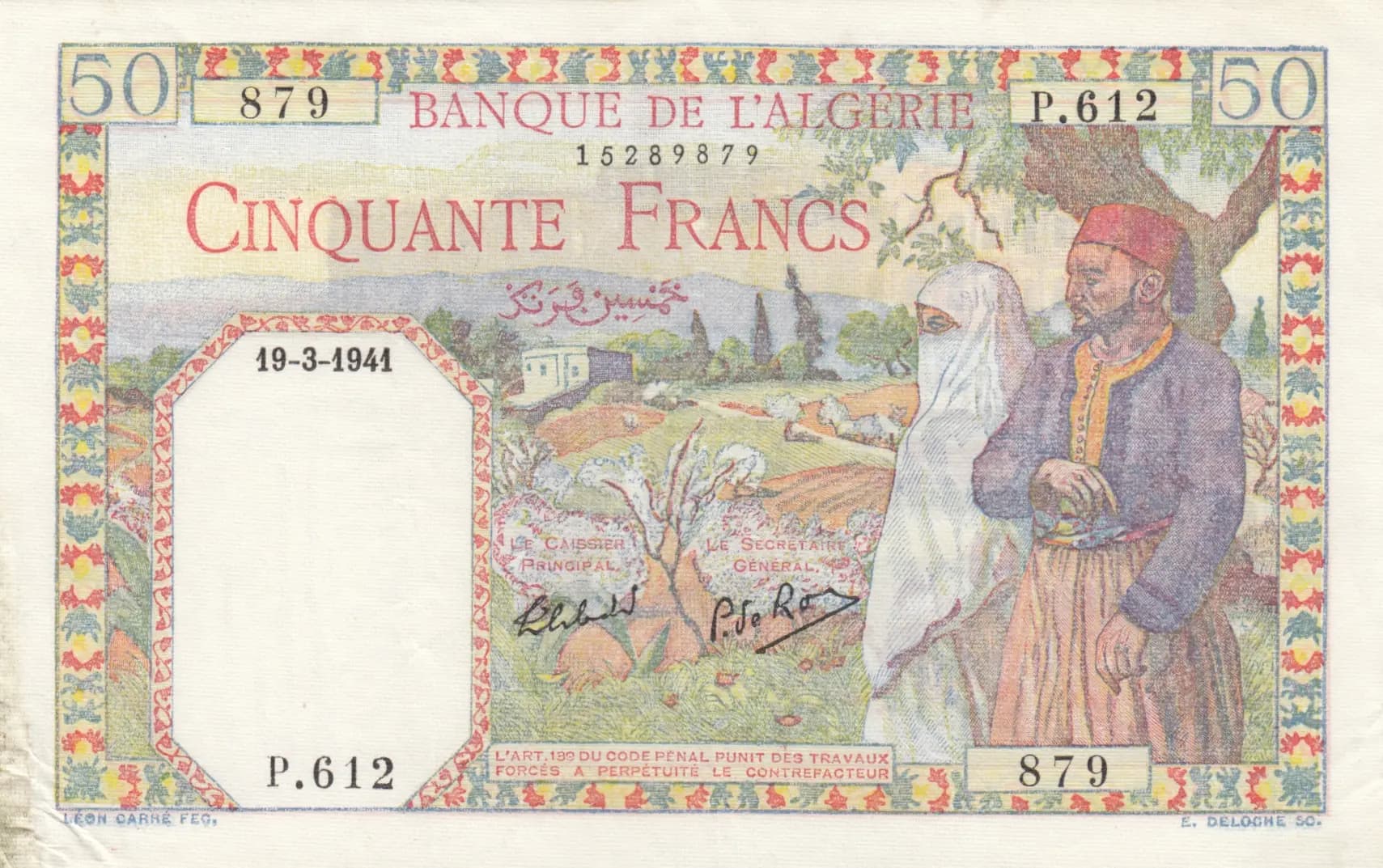
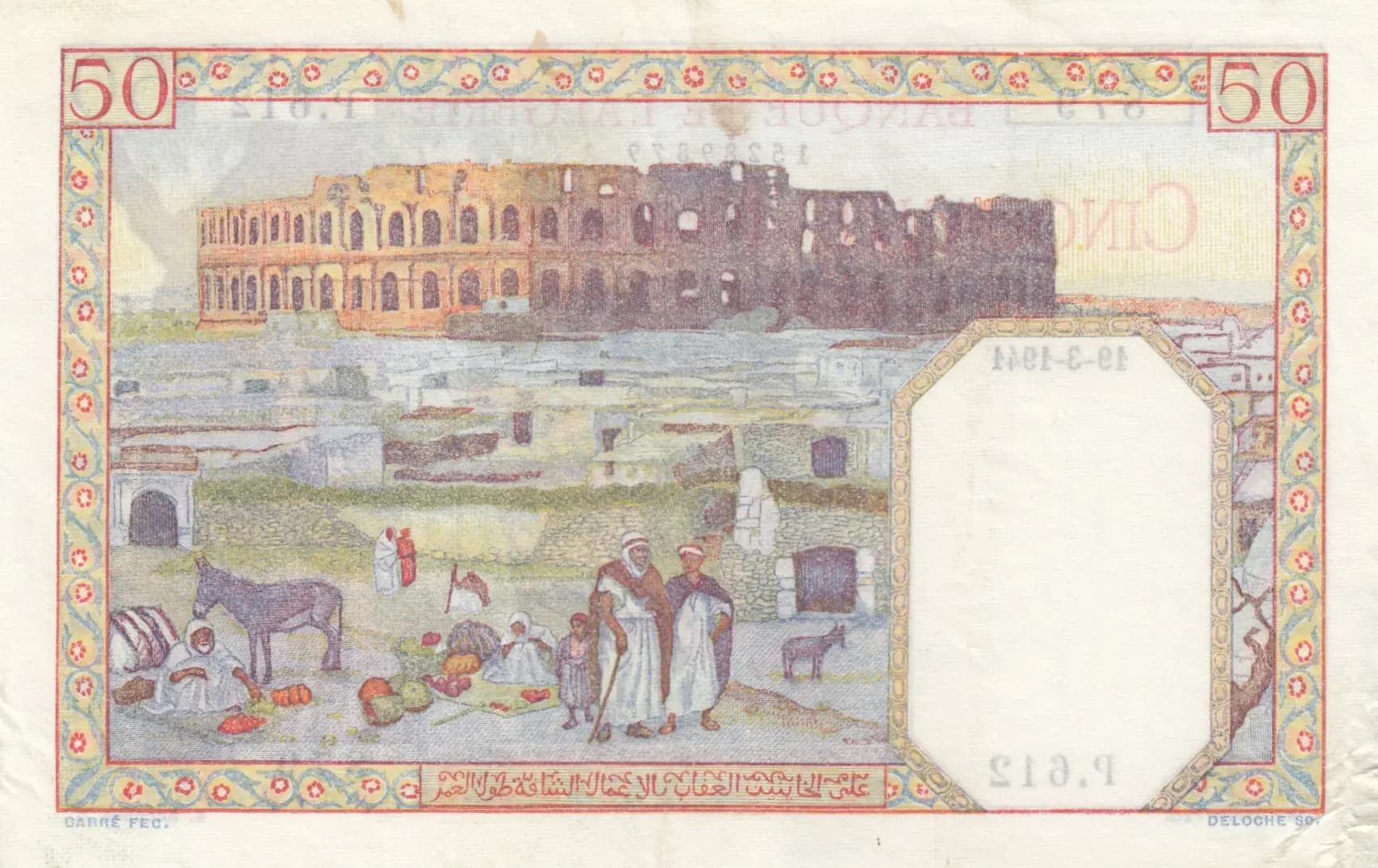
This is a VF-grade 50 Francs note from the Banque de l'Algérie, issued during the 1938-1942 period but specifically signed and dated 19-3-1944, representing a later use of the plate during the transitional WWII/post-war period in Algeria. The note displays the characteristic multicolor design with a veiled North African woman and a man in traditional dress with red fez on the obverse, coupled with an evocative reverse depicting a fortified North African structure (likely representing El-Djem or a similar regional kasbah) with marketplace activity below. The note shows expected circulation wear with creasing and aging patina, consistent with VF grading, and features hand-signed authorities and the artist attribution to Léon Carré.
Common. This note is a standard regular-issue banknote from the Banque de l'Algérie with no evidence of limited print run or recall status. The eBay market data shows consistent availability across multiple grades over a 14-year period, with VF examples regularly selling in the $11-$62 range (most clustering $15-$35), indicating healthy collector supply. The 2016 catalog valuation of $10 VF further confirms common status. No PMG population restrictions or rarity indicators are evident.
This banknote was issued during a critical period in Algerian history, straddling the Vichy French administration and the transitional post-Liberation period. The imagery—featuring traditional North African figures and architectural landmarks like fortified kasbahs—reflects the colonial-era presentation of Algerian culture through a French institutional lens. The 1944 signature date on a note from the 1938-issued plate indicates continued circulation and use of this design well into the post-war period, documenting the Banque de l'Algérie's operations during Algeria's transition from Vichy to Free French control.
The obverse depicts a romanticized North African scene with two figures in traditional dress positioned against a landscape backdrop featuring cypress trees, mountains, and a domed/minareted building. The male figure wears a distinctive red fez with purple-blue embroidered clothing trimmed in gold, while the female figure is depicted in a white head covering and traditional robes, representing the 'veiled woman' noted in catalog references. An ornamental border in repeating floral patterns (red, yellow, and green) frames the entire note. The reverse showcases a fortified structure with crenellated walls and multiple arches—consistent with El-Djem Amphitheatre or similar North African Berber/Roman-era architectural landmarks—with a marketplace scene below featuring figures in traditional dress, livestock, and produce, emphasizing regional commerce and daily life. The '50' denomination appears in all four corners. Both sides feature artist and printer attributions, indicating production by Léon Carré (design) and E. Deloche company (printing).
FRONT: 'BANQUE DE L'ALGÉRIE' (Bank of Algeria); 'CINQUANTE FRANCS' (Fifty Francs); 'LE CAISSIER PRINCIPAL' (The Principal Cashier); 'LE SECRÉTAIRE GÉNÉRAL' (The General Secretary); 'L'ART.199 DU CODE PÉNAL PUNIT DES TRAVAUX FORCÉS À PERPÉTUITÉ LE CONTREFACTEUR' (Article 199 of the Penal Code punishes counterfeiting with perpetual forced labor); 'LÉON CARRÉ FEC.' (Léon Carré made [designed] it); 'E. DELOCHE SOc.' (E. Deloche [printing] company); Date: '19-3-1944' (19 March 1944); Series: 'P.612'; Serial: '15289879'. BACK: '50' (denomination); Artist attribution: 'CARRÉ FEC.' and 'DELOCHE SOc.' (repeated); Arabic script text (specific translation not fully legible in analysis but consistent with denomination and issuer identification in Arabic).
Multicolor lithographic printing, typical of French-era Banque de l'Algérie production. The note exhibits the characteristic color separation and registration visible in high-quality lithographic banknote production of the 1938-1944 period. E. Deloche was a recognized French security printer, and the printing demonstrates the refined multicolor application (cream/beige base with red, green, yellow, purple, blue, orange, and brown layers) standard for this issuer's output. The ornamental borders and intricate floral motifs are consistent with lithographic security printing techniques employed to deter counterfeiting.
This specific example is marked as series P.612 with serial number 15289879, dated 19-3-1944 (19 March 1944). The date is significant as it reflects use of the 1938-issued plate extending well into 1944, during the Liberation period. While the catalog range is listed as 1938-1942, this note's signature date indicates continued official use of the design. Varieties for P-84 primarily distinguish by signature blocks and dates; the 1944 date places this in the later printing period. No overprints or emergency issue modifications are evident on this example.