50 francs 1937
Market Prices
19 salesAbout This Note
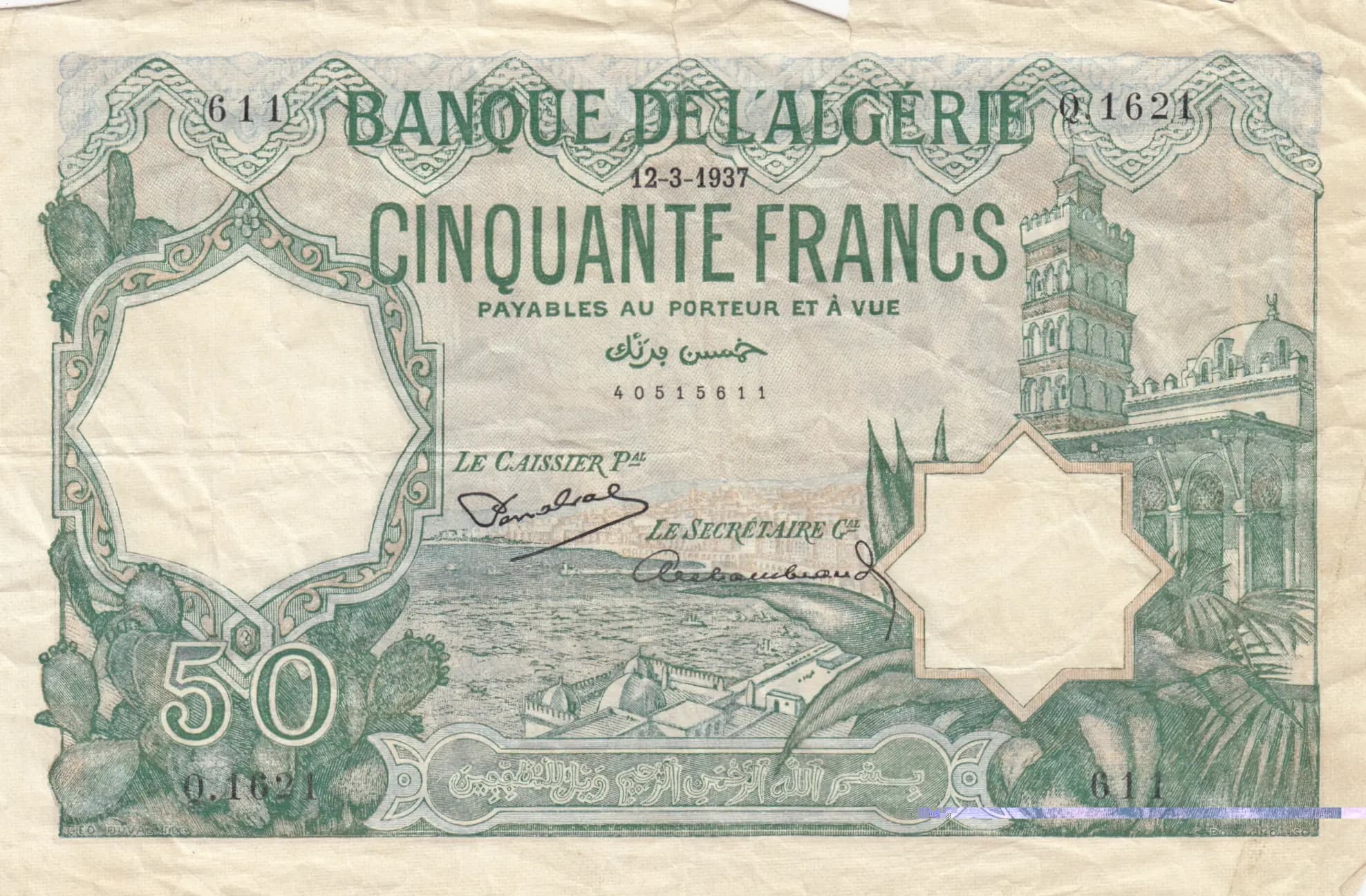
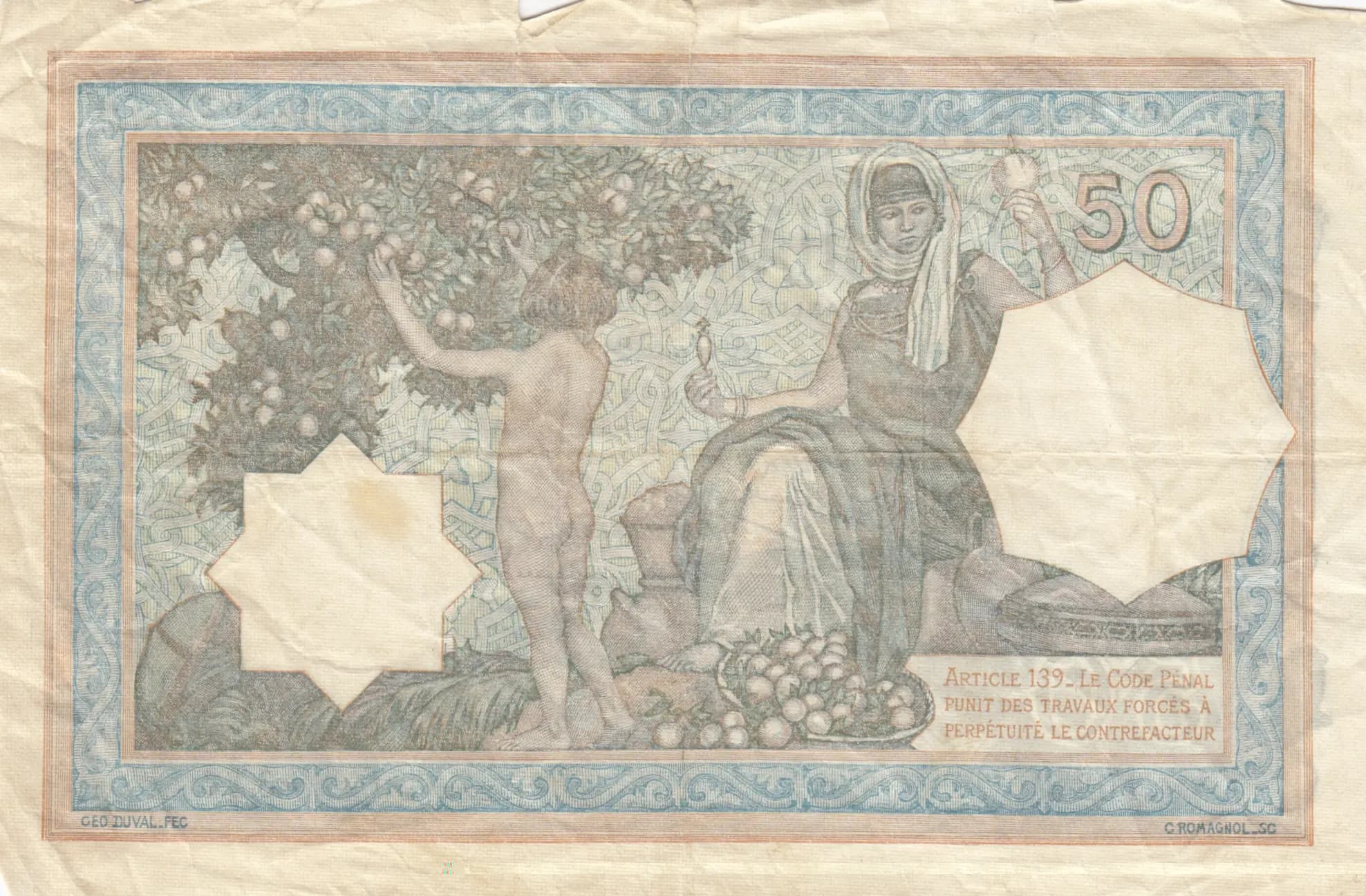
This is a 1937 example of the Banque de l'Algérie 50 francs (Pick P-80), dated March 12, 1937, printed in the characteristic green color of the series. The note displays significant wear consistent with its F (Fine) grade, showing creases, folds, and aged yellowing throughout. The front features architectural elements of Algiers including a minaret and colonial-era buildings alongside regional flora, while the reverse depicts an allegorical harvesting scene with classical figures and fruit-bearing trees, exemplifying the decorative engraved style typical of French colonial currency.
Common. The eBay price history provided shows consistent market pricing for this Pick number across multiple condition grades, with F-grade specimens regularly selling in the $18-51 range with modest bidding activity (7-26 bids typical), and catalogue valuations listing F grade at approximately $18-42 equivalent. The series was issued continuously from 1920-1938 across multiple date varieties and signature combinations, indicating substantial production runs. The absence of any notation of rarity in major catalogs and the regular appearance of circulation examples in the secondary market confirm this is a widely available note for collectors.
This banknote was issued during the final years of French colonial administration in Algeria, specifically during the interwar period when the Banque de l'Algérie maintained the colony's monetary system. The imagery reflects the colonial perspective on Algeria—the minaret and Islamic architecture on the obverse acknowledge local identity, while the allegorical harvest scene on the reverse emphasizes agricultural prosperity and romanticized labor, themes consistent with French colonial narrative of the era. The bilingual French-Arabic inscriptions demonstrate the administrative duality of colonial governance.
The obverse features a composite Algerian scene framed by ornate geometric and floral borders in green: on the left, characteristic Mediterranean flora including palm trees and prickly pear cacti; on the right, Algerian architecture including a prominent minaret tower and multi-story Moorish-style buildings representative of Algiers' urban landscape. The reverse presents a classical allegorical composition depicting harvest and labor—a semi-nude male figure (representing masculine labor) reaches toward fruit-laden branches on the left, while a female figure wearing traditional North African dress (hijab) sits on the right, with mountainous terrain in the background. This dual-figure composition was a common motif in French colonial currency symbolizing prosperous colonial enterprise. The engraved detail work by Duval and Romagnol demonstrates the fine craftsmanship typical of Banque de l'Algérie issues.
FRONT: 'BANQUE DE L'ALGERIE' (Bank of Algeria) / 'CINQUANTE FRANCS' (Fifty Francs) / 'PAYABLES AU PORTEUR ET A VUE' (Payable to Bearer and on Sight) / Date: '12-3-1937' (March 12, 1937) / 'LE CAISSIER' (The Cashier) / 'LE SECRETAIRE' (The Secretary) / Serial number: '40515611' / Arabic text 'جنسن برك' (Bank of Algeria). BACK: Denomination '50' / 'ARTICLE 139- LE CODE PENAL PUNIT DES TRAVAUX FORCES A PERPETUITE LE CONTREFACTEUR' (Article 139 - The Penal Code punishes with perpetual forced labor the counterfeiter) / Engraver signatures: 'GEO DUVAL, FEC' (Geo Duval made it) and 'C.ROMAGNOL, SC' (C. Romagnol engraved it).
Intaglio engraving (line engraving), the standard high-security printing method for French colonial banknotes. The fine detail visible in the border patterns, architectural elements, and portrait work, combined with the engraver signatures 'GEO DUVAL, FEC' and 'C. ROMAGNOL, SC,' confirms production by professional security printers. The note was likely printed by Banque de France's affiliated security printer, as was standard practice for colonial currency during this period. The ornate borders and fine line work throughout are characteristic of 1920s-1930s French banknote security printing standards.
This specific note is dated 12-3-1937 (March 12, 1937) and carries serial number 40515611. The Pick catalog notes 3 signature varieties exist for this denomination. PMG records indicate variant designations P-80a and P-80s exist, suggesting differences in signatures or special issue status. Without direct comparison to known signature combinations, the exact variety cannot be definitively determined from the visual analysis alone, but the standard signature positions shown ('LE CAISSIER' and 'LE SECRETAIRE') indicate this is likely a standard circulation variety rather than a specimen (P-80s) issue, despite the blank rectangular areas visible in the images which may be printing artifacts or damage rather than deliberate specimen markings.