5 francs 1944
Market Prices
18 salesAbout This Note
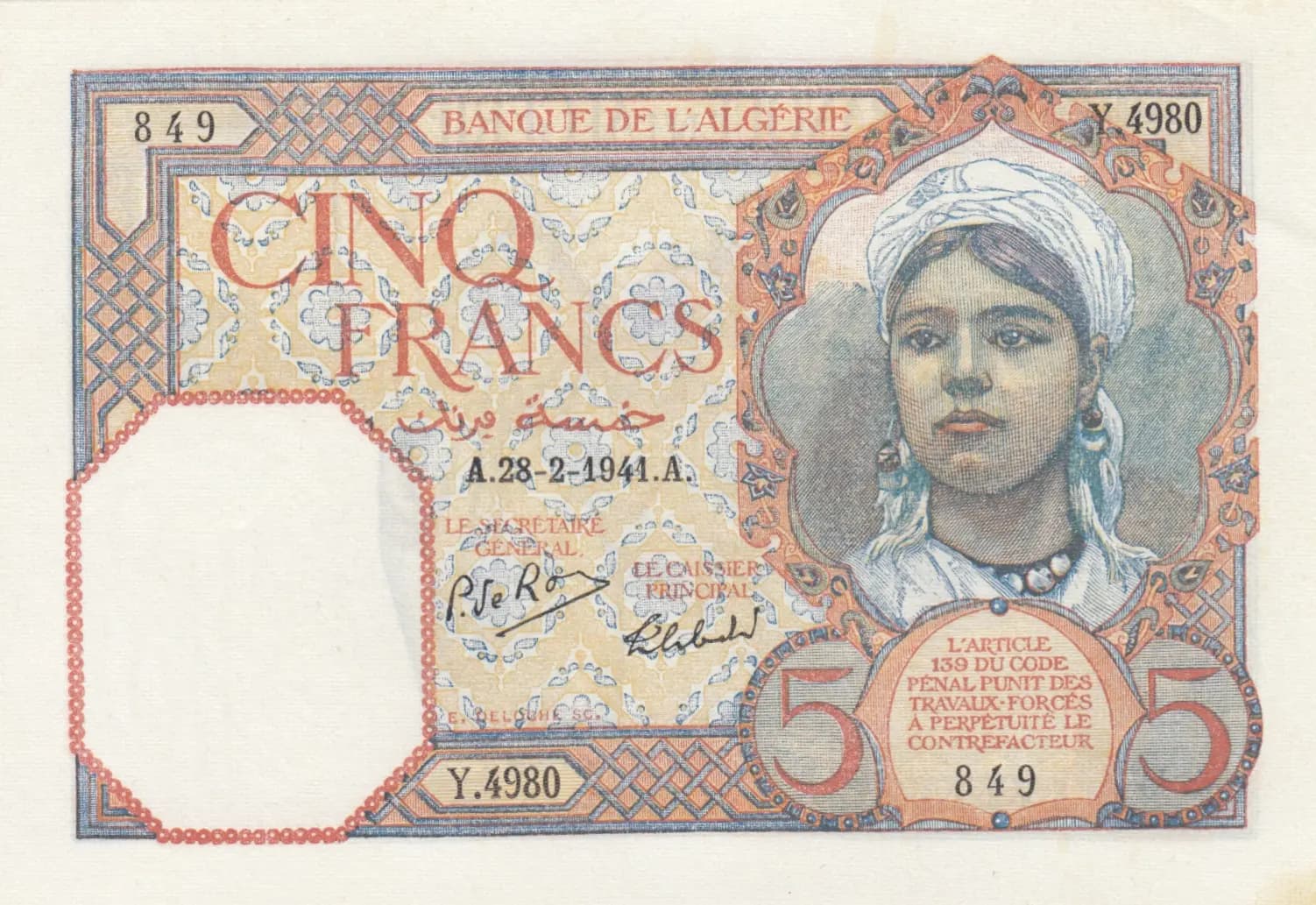
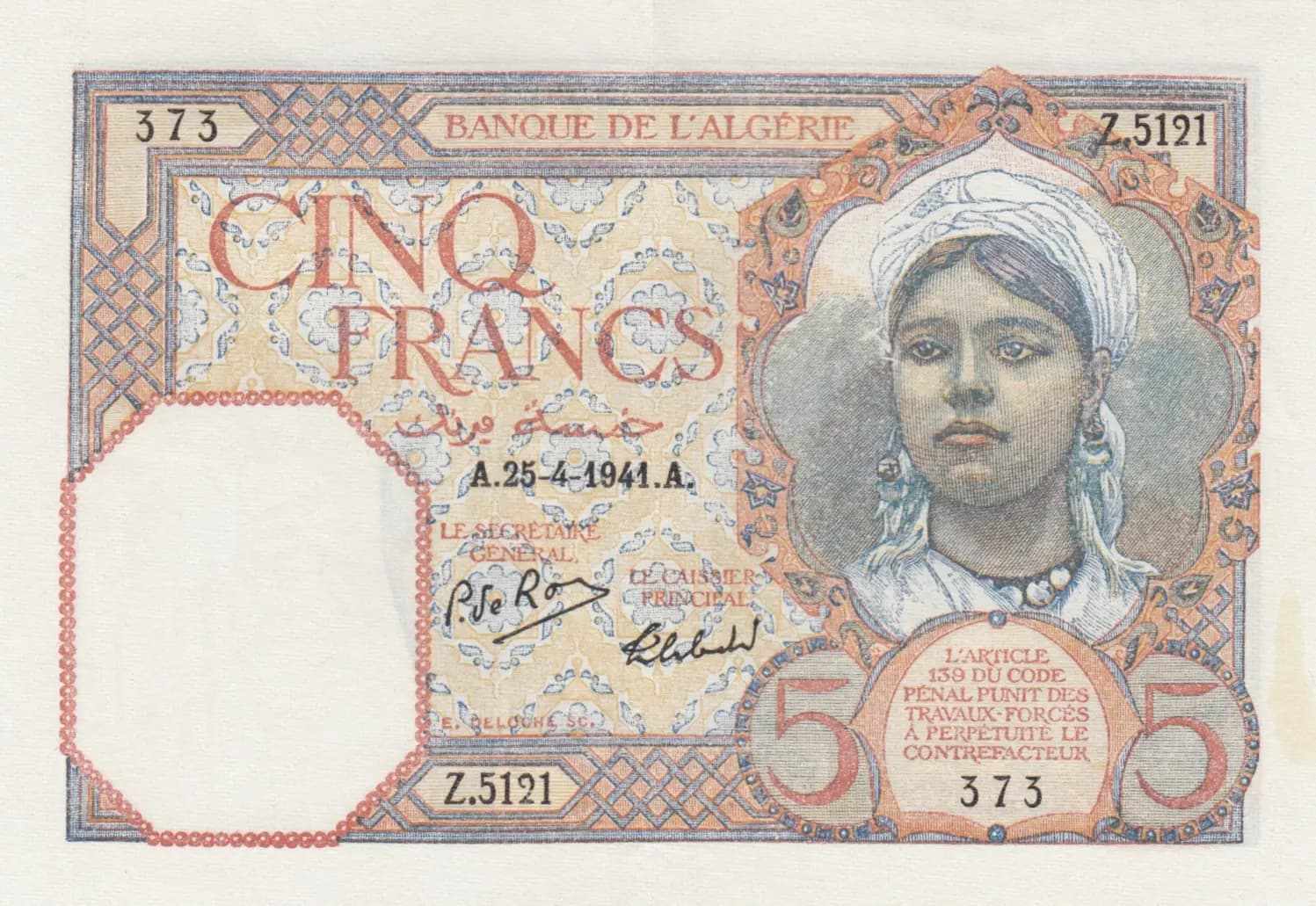
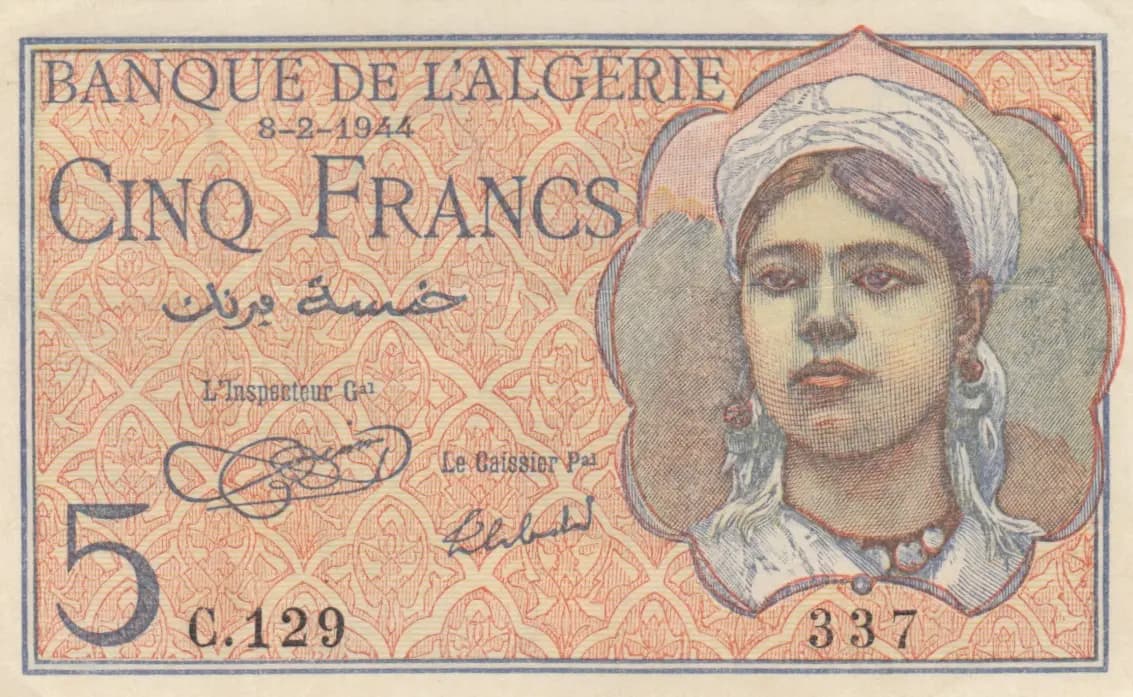
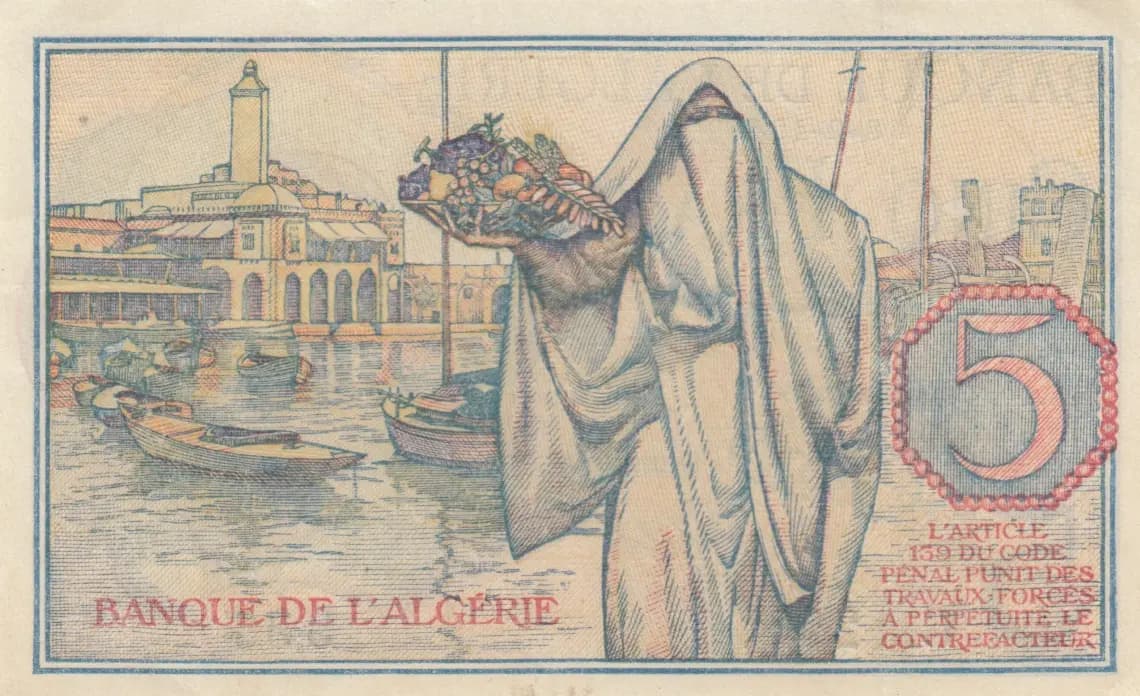
An exceptional example of the 1944 Banque de l'Algerie 5 Francs (Pick P-94a) in EF condition, featuring a striking peach-orange decorative geometric background on the obverse with a portrait of a woman in traditional North African dress, complemented by a reverse depicting a robed figure with a fruit basket overlooking a fortified Mediterranean coastal town. This note represents a historically significant issue from the post-liberation period of French Algeria, with vibrant, well-preserved colors and crisp printing throughout, showing minimal circulation wear.
Common. This note appears in the eBay sales record spanning from 2010 to 2025 with numerous transactions across all condition grades, consistently selling for modest prices well under $20 for circulated examples (typically $3-12 for F-VF condition). The EF-graded examples in the record sold for $4.76 to $23.73, indicating ready availability even in higher grades. The 2016 catalogue values ($0.25 VG, $1 VF, $7 UNC) reflect widespread availability. The Banque de l'Algerie operated continuously throughout and after WWII with substantial print runs; there is no evidence of a short-lived issue, recall, or restricted circulation.
This 1944 issue marks the post-World War II stabilization period for French Algeria under the Banque de l'Algerie. The reverse imagery depicting a coastal town, lighthouse, and harbor activity reflects Algeria's economic role as a Mediterranean trading center and agricultural region under French colonial administration. The bilingual inscriptions in French and Arabic underscore the cultural composition and official linguistic framework of Algeria during this transitional post-war period.
The obverse features a portrait of an Algerian woman wearing a white traditional head covering (possibly a haik or similar North African garment) with visible dark hair, earrings, and period clothing, framed within an ornamental cartouche. The background is dominated by a repeating geometric pattern in peach and orange tones with cream and blue accents, serving both decorative and anti-counterfeiting purposes. The denomination and issuing bank name are prominently positioned on the left in French and Arabic. The reverse depicts an allegorical scene representing colonial prosperity: a robed figure (likely representing North African commerce or abundance) carrying a basket of fruits and produce, set against a detailed Mediterranean coastal landscape with a fortified town, lighthouse, harbor with sailing vessels, and waterfront buildings in muted greens, blues, and browns. A red circular frame highlights the numeral '5' on the right side of the reverse.
FRONT: 'BANQUE DE L'ALGERIE' (Bank of Algeria); '8-2-1944' (issue date, 8 February 1944); 'CINQ FRANCS' (Five Francs); 'خمسة فرنك' (Arabic: Five Francs); 'L'Inspecteur Gal' (The General Inspector); 'Ce Caissier Pa' (The Cashier [signature line]); 'C.129' (series/block designation); '337' (serial number component); 'Cahier' (Ledger/Register). BACK: 'BANQUE-DE L'ALGÉRIE' (Bank of Algeria); '5' (denomination); 'L'ARTICLE 15 DU CODE PÉNAL PUNIT DES TRAVAUX FORCÉS À PERPÉTUITÉ LE CONTREFACTEUR' (Article 15 of the Penal Code punishes counterfeiting with forced labor for life).
Intaglio (copperplate engraving) printing, evidenced by the sharp, crisp detail in the portrait, fine line work in the geometric patterns, and precise registration of the multi-color design. The technique combines primary intaglio printing with careful color registration typical of high-security banknote production from this era. The note was likely produced by a French security printer such as Banque de France's printing facilities or a contracted banknote manufacturer serving the colonial administration.
The PMG population report indicates this Pick catalog recognizes variant P-94b and specimen note P-94s in addition to the base P-94a. This note is catalogued as P-94a, the standard circulation variety. Differences between P-94a and P-94b are likely minor (possibly signature variations, date variants, or color shade differences). The specific serial number prefix 'C.129' and serial element '337' visible on this note may be useful for distinguishing individual printing blocks or runs within the P-94a category, though standard variety classification focuses on larger design or security feature differences rather than individual serial number ranges.