5 francs 1942
Market Prices
108 salesAbout This Note
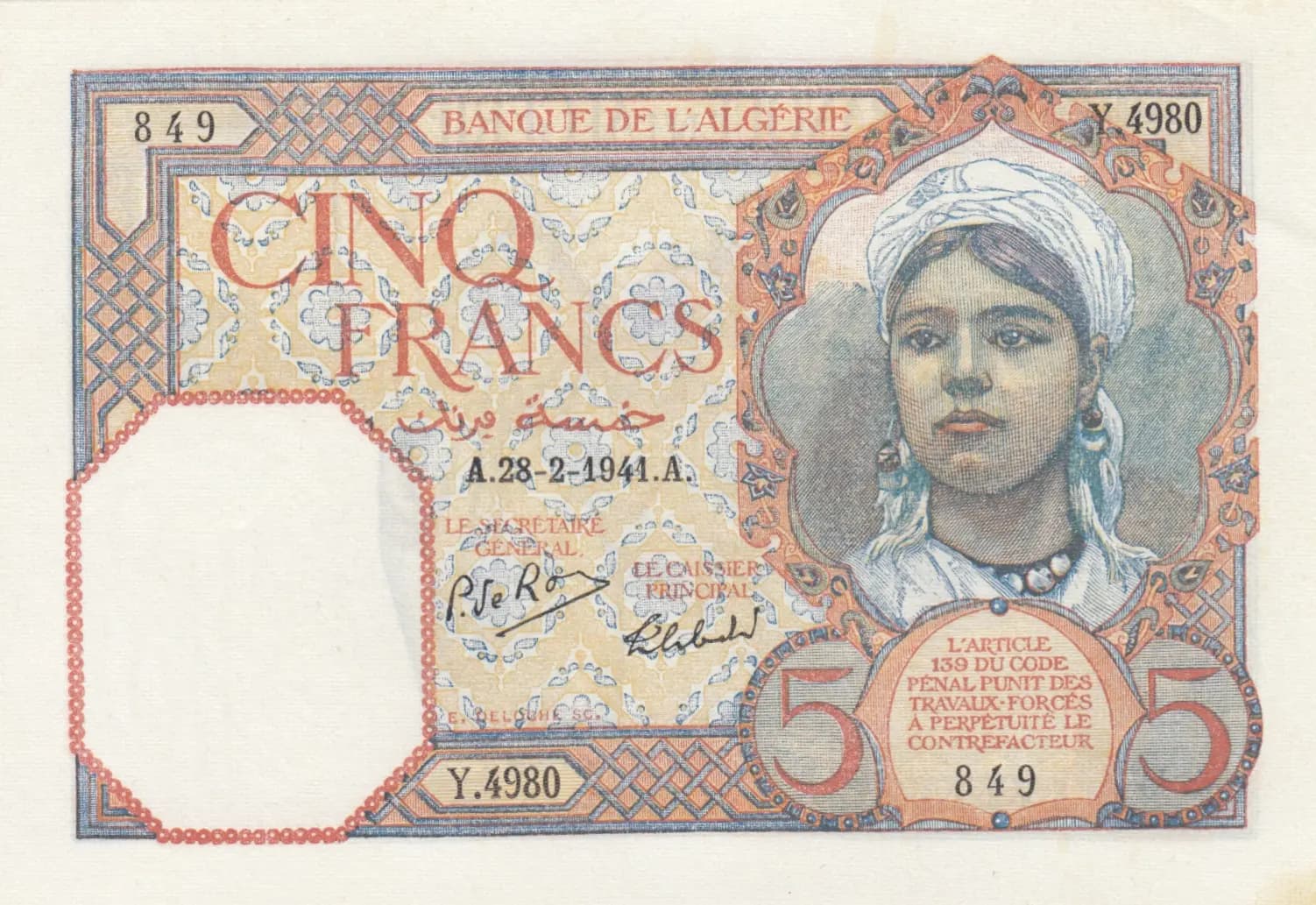
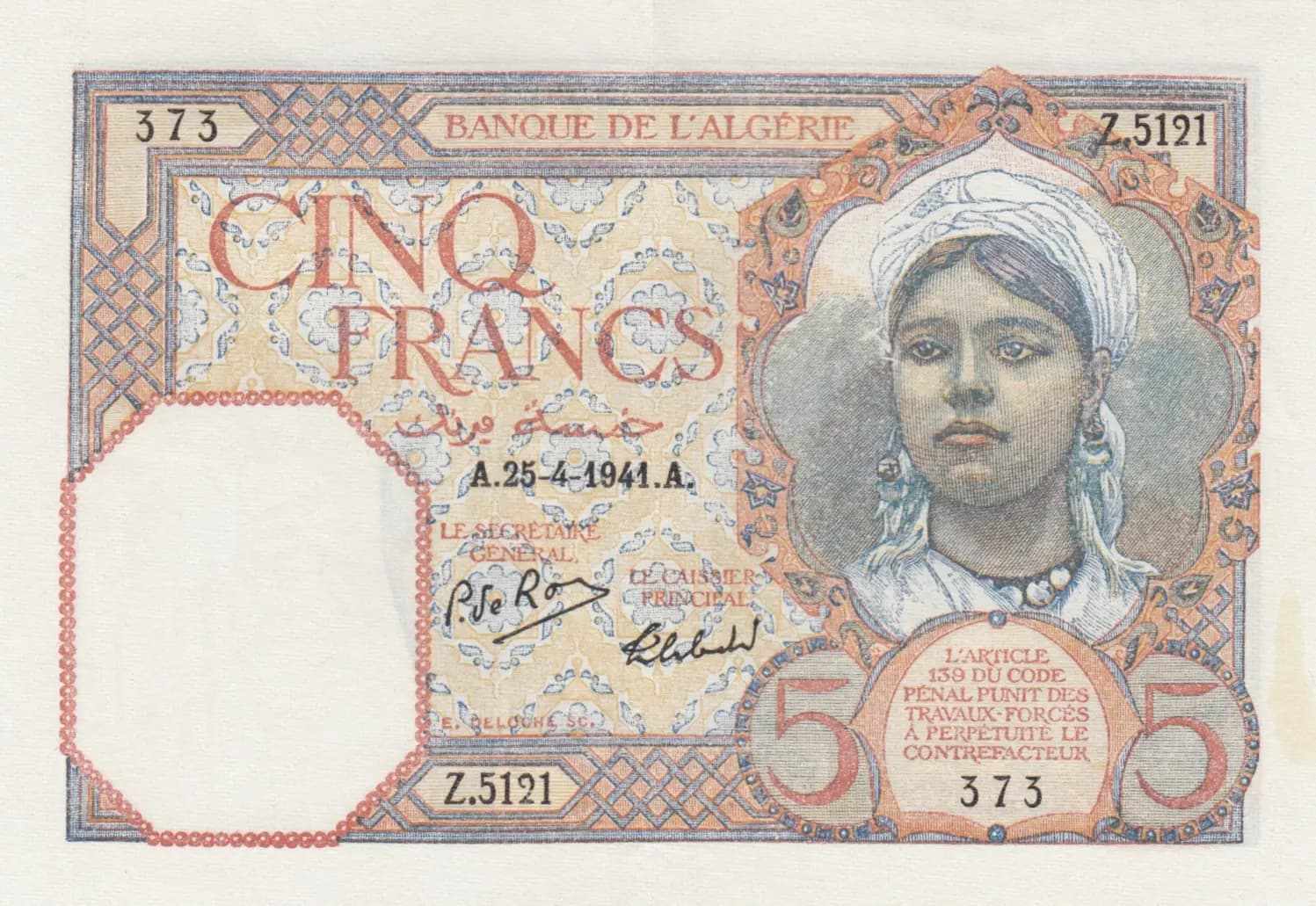
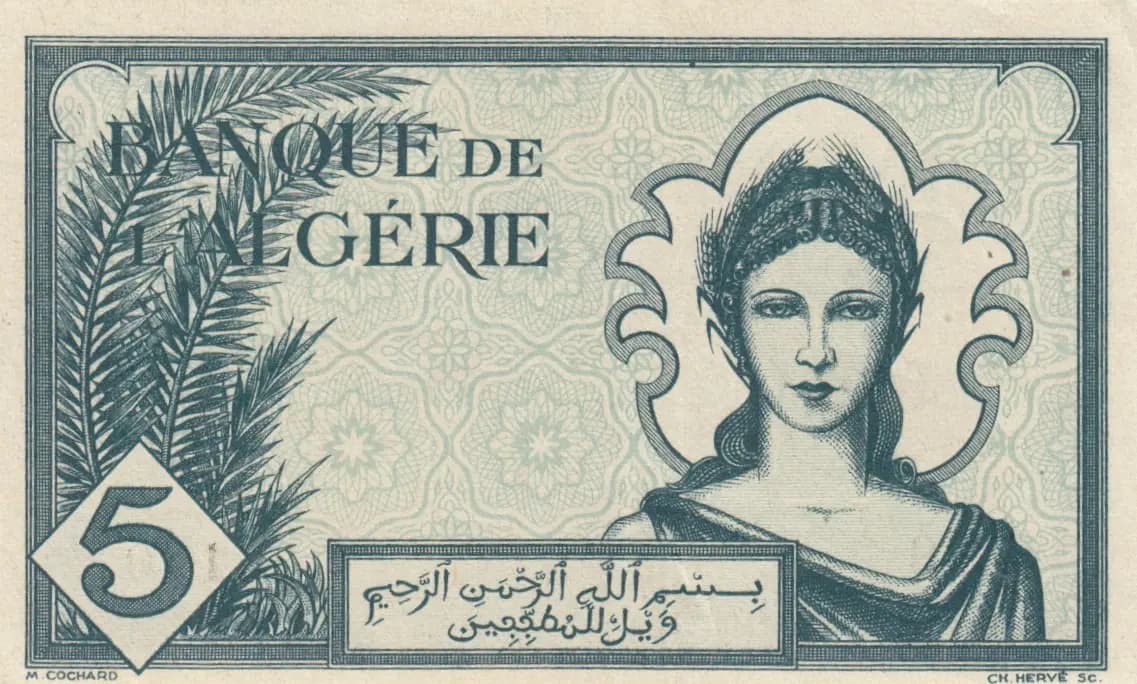
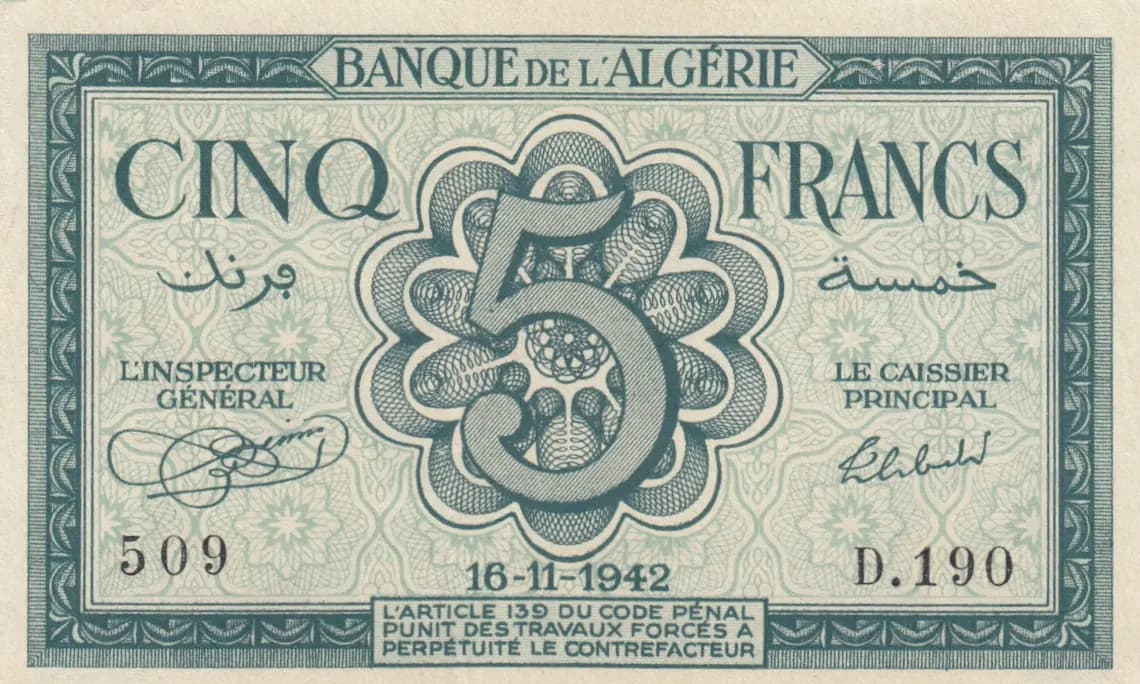
This Algeria 5 Francs note from 1942 (Pick P-91) is presented in excellent condition with minimal wear and light age-related patina typical of notes from this era. The note showcases fine classical engraving with a dignified female portrait in ornate headdress on the obverse and a striking central pomegranate emblem on the reverse, both rendered in teal and cream tones. An attractive mid-20th century colonial-era note that remains affordable and accessible to collectors.
Common. This note trades regularly in the secondary market with consistent eBay auction activity spanning over a decade. Price data shows most examples in F to VF condition sell in the $2-$7 range, with EF examples typically realizing $4-$9, well below the $20 threshold that would suggest scarcity. The 1942 issue date and standard French colonial production run indicate substantial circulation. While condition-dependent in pricing, no evidence suggests restricted print runs or recall that would elevate rarity status.
Issued on November 16, 1942, during the critical year of World War II when Algeria was under French colonial administration and facing significant geopolitical changes, this banknote reflects the Banque de l'Algérie's continued operation during wartime. The classical female portrait and pomegranate symbolism connect to Mediterranean and French colonial artistic traditions, while the dual French-Arabic inscriptions demonstrate Algeria's bicultural monetary context under colonial rule. This period marks a transitional moment in Algerian monetary history, as such francs-denominated notes would be replaced following independence in 1962.
The obverse features a classical female portrait wearing an ornate, jeweled headdress, positioned on the right side and representing an allegorical personification of France or colonial authority. A decorative palm frond occupies the left side, symbolizing North African geography and the colonial context. The intricate repeating background pattern and fine cross-hatching provide security depth and artistic sophistication. The reverse displays a prominent circular emblem containing a pomegranate with visible seeds, a symbol of abundance and fertility commonly associated with Mediterranean regions and French colonial iconography. The denomination and bilingual text (French-Arabic) frame this central design, with administrative signature lines and a serial number visible in the lower portion. The color scheme of teal/dark cyan and cream creates a distinctive aesthetic characteristic of 1940s French colonial currency.
FRONT: 'BANQUE DE L'ALGÉRIE' (Bank of Algeria) appears at top left; '5' in diamond frame indicates denomination; 'M COCHARD' and 'CH. HERVÉ SC.' are artist and engraver signatures; Arabic text includes Islamic invocation. REVERSE: 'BANQUE DE L'ALGÉRIE' at top; 'CINQ FRANCS' (Five Francs) with Arabic equivalent 'خمسة فرنك' (Five Francs); signature lines for 'L'INSPECTEUR GÉNÉRAL' (The Inspector General) and 'LE CAISSIER PRINCIPAL' (The Principal Cashier); serial number '509 D.190'; date '16-11-1942' (November 16, 1942); counterfeiting warning 'L'ARTICLE 139 DU CODE PÉNAL PUNIT DES TRAVAUX FORCÉS À PERPÉTUITÉ LE CONTREFACTEUR' (Article 139 of the Penal Code punishes counterfeiting with perpetual forced labor).
Intaglio engraving (line engraving), characteristic of high-security banknote production of the era. The fine detail work, including the cross-hatching, ornate borders, and portrait rendering, is typical of steel plate engraving. The security printers for Banque de l'Algérie notes during this period were typically French security printing firms, though specific printer attribution for this Pick number would require manufacturer research. The presence of engraver signatures ('M COCHARD' and 'CH. HERVÉ SC.') indicates multi-artisan involvement in the design and engraving process.
The observed specimen shows serial number '509 D.190' and carries the specific issue date of 16-11-1942. The PMG Population Report indicates two variants exist for this Pick number: P-91 and P-91s (likely a specimen variety). The note exhibits signatures of the Inspector General and Principal Cashier positions, with handwritten signatures visible on the reverse. Collectors should note serial number prefixes and signatures as distinguishing features; the 'D' prefix in the serial number may indicate a specific print series within the 1942 issue.