20 francs 1942
Market Prices
33 salesAbout This Note
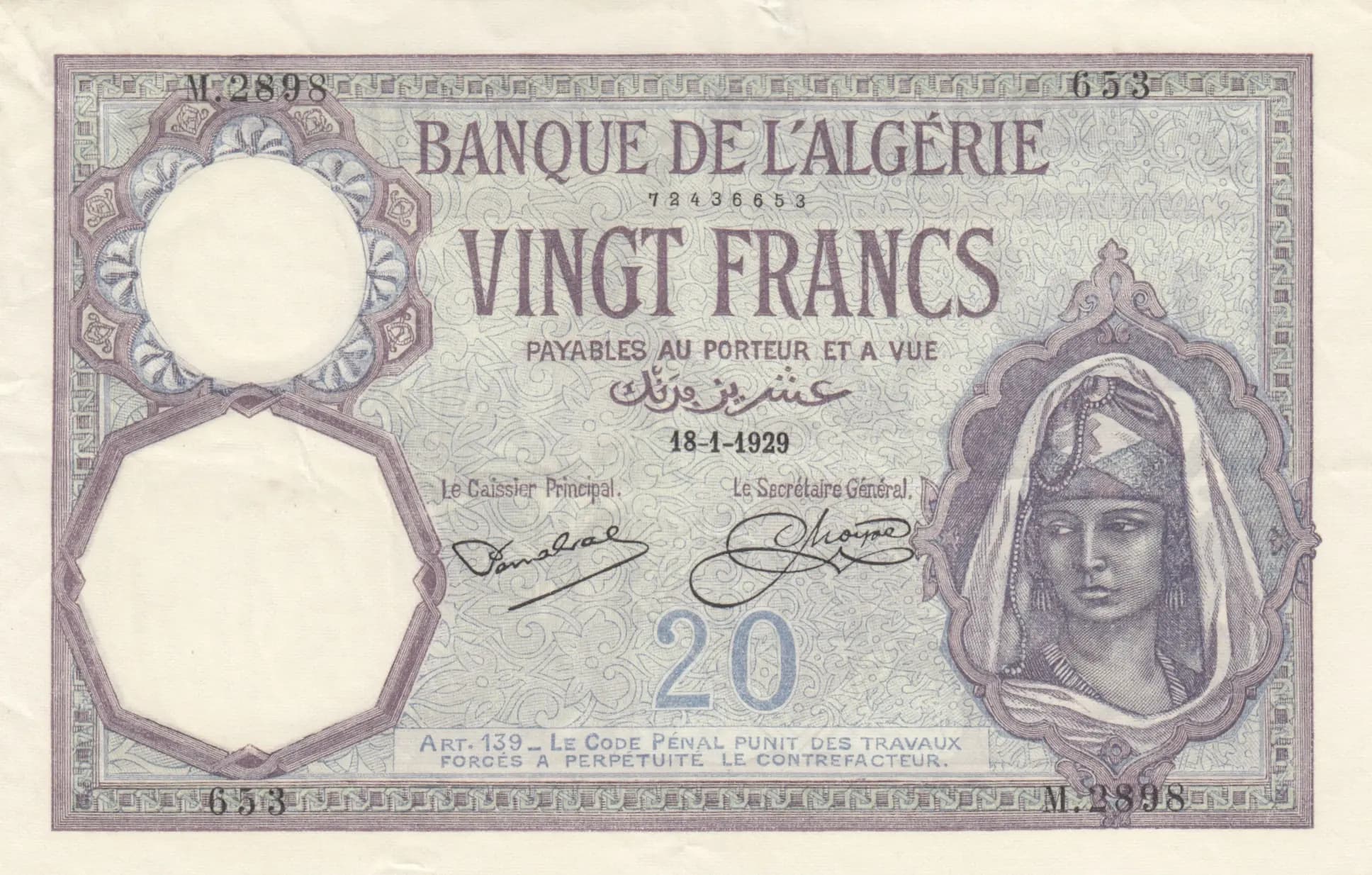
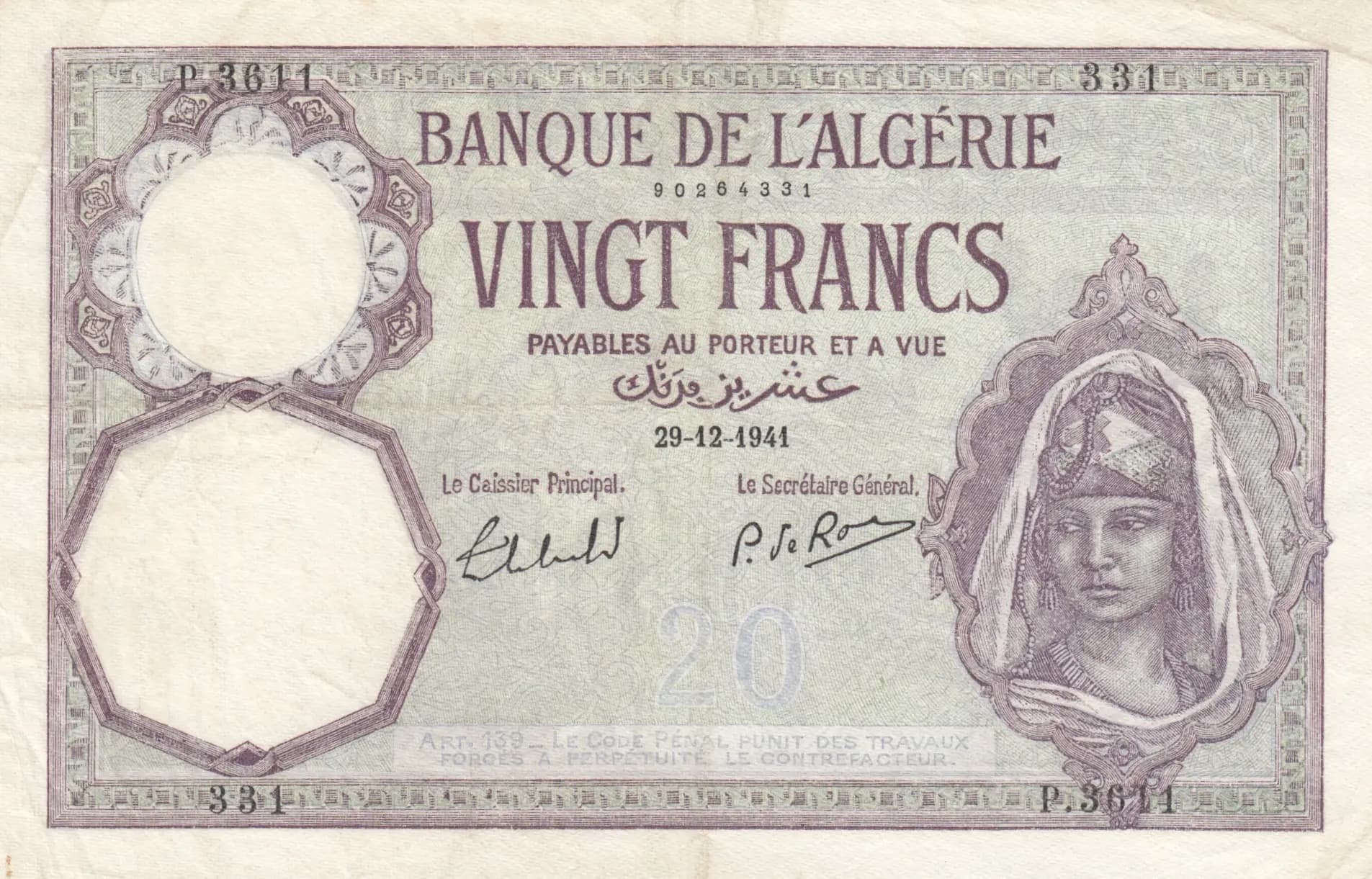
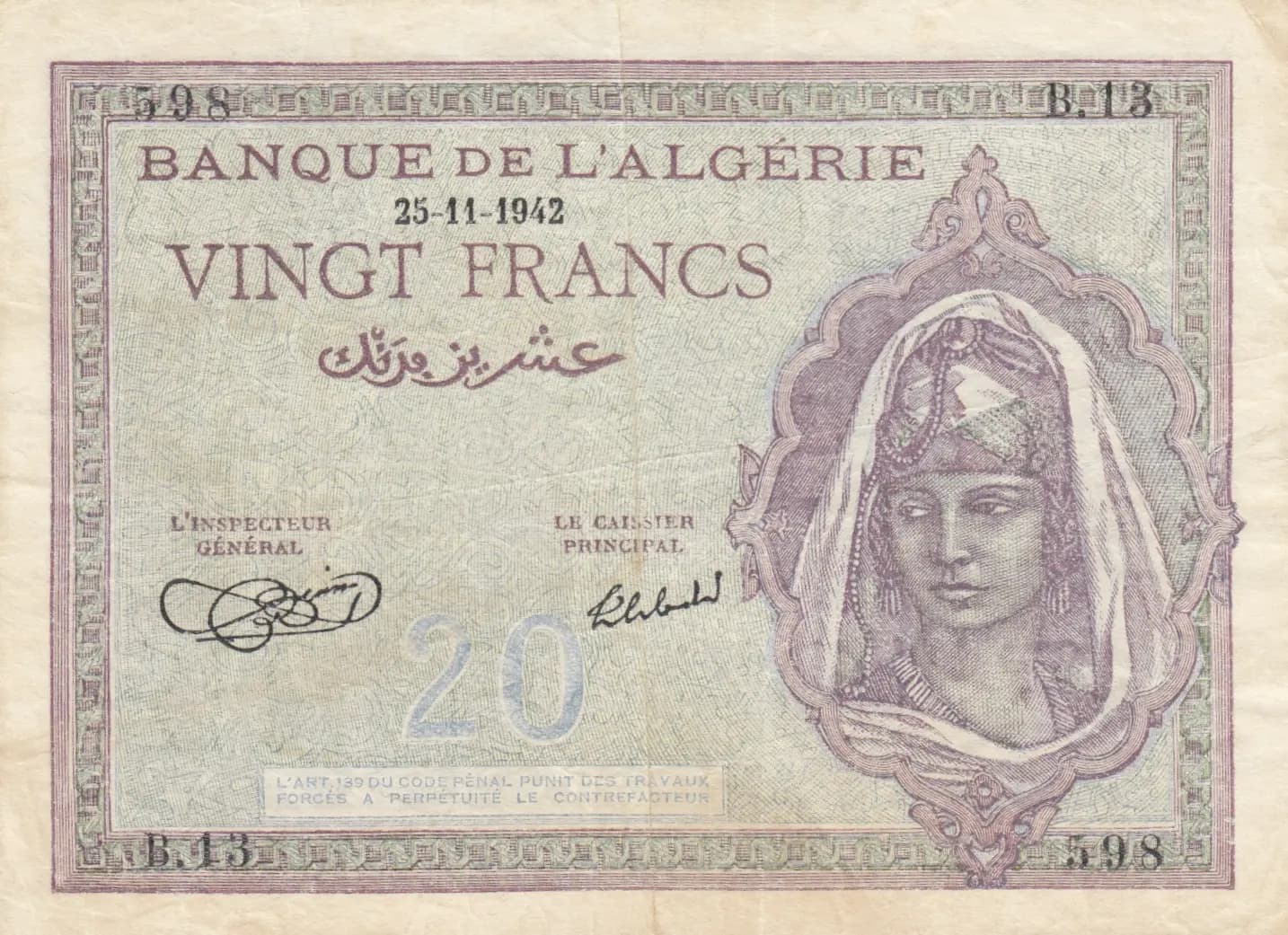
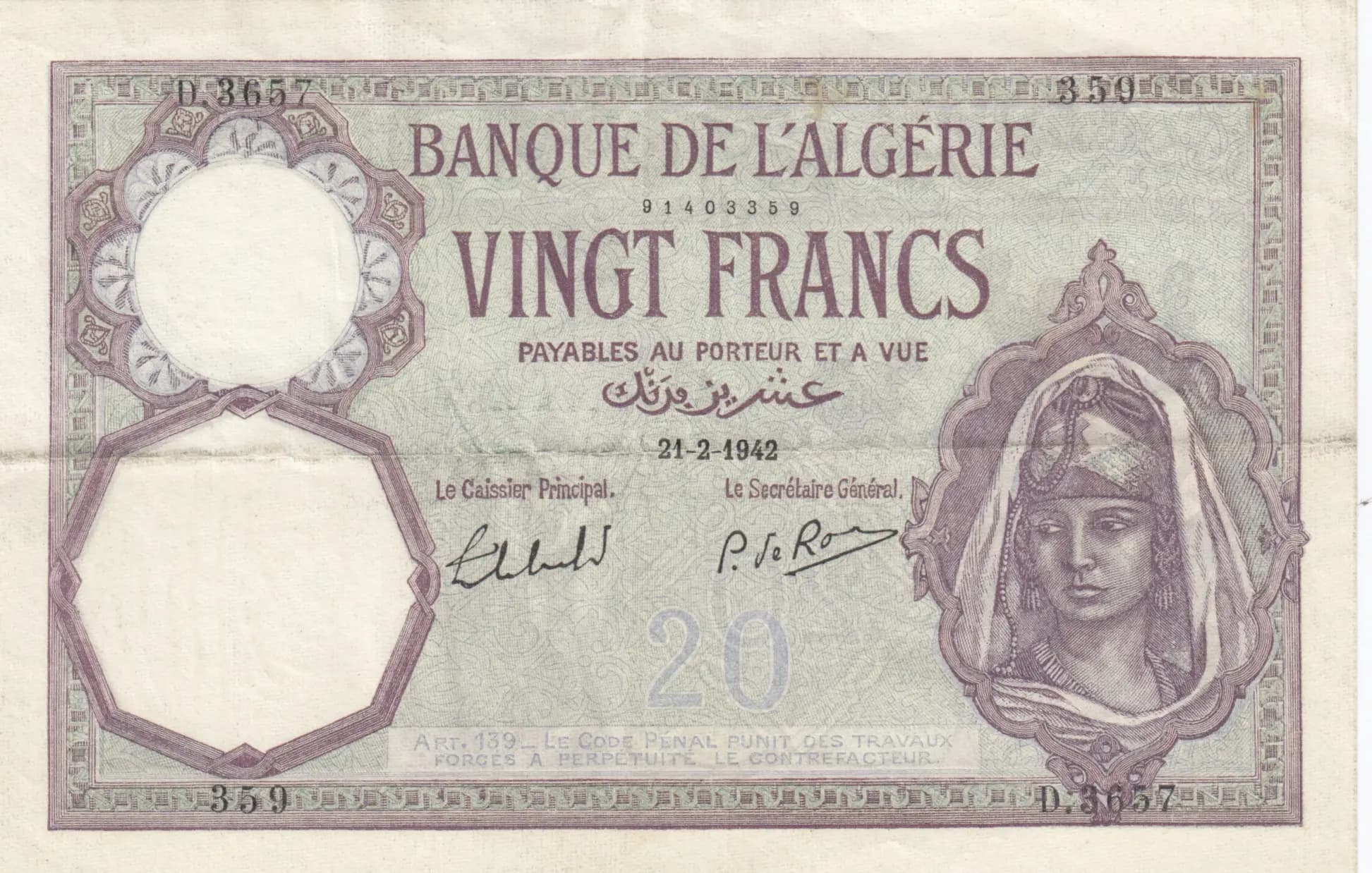
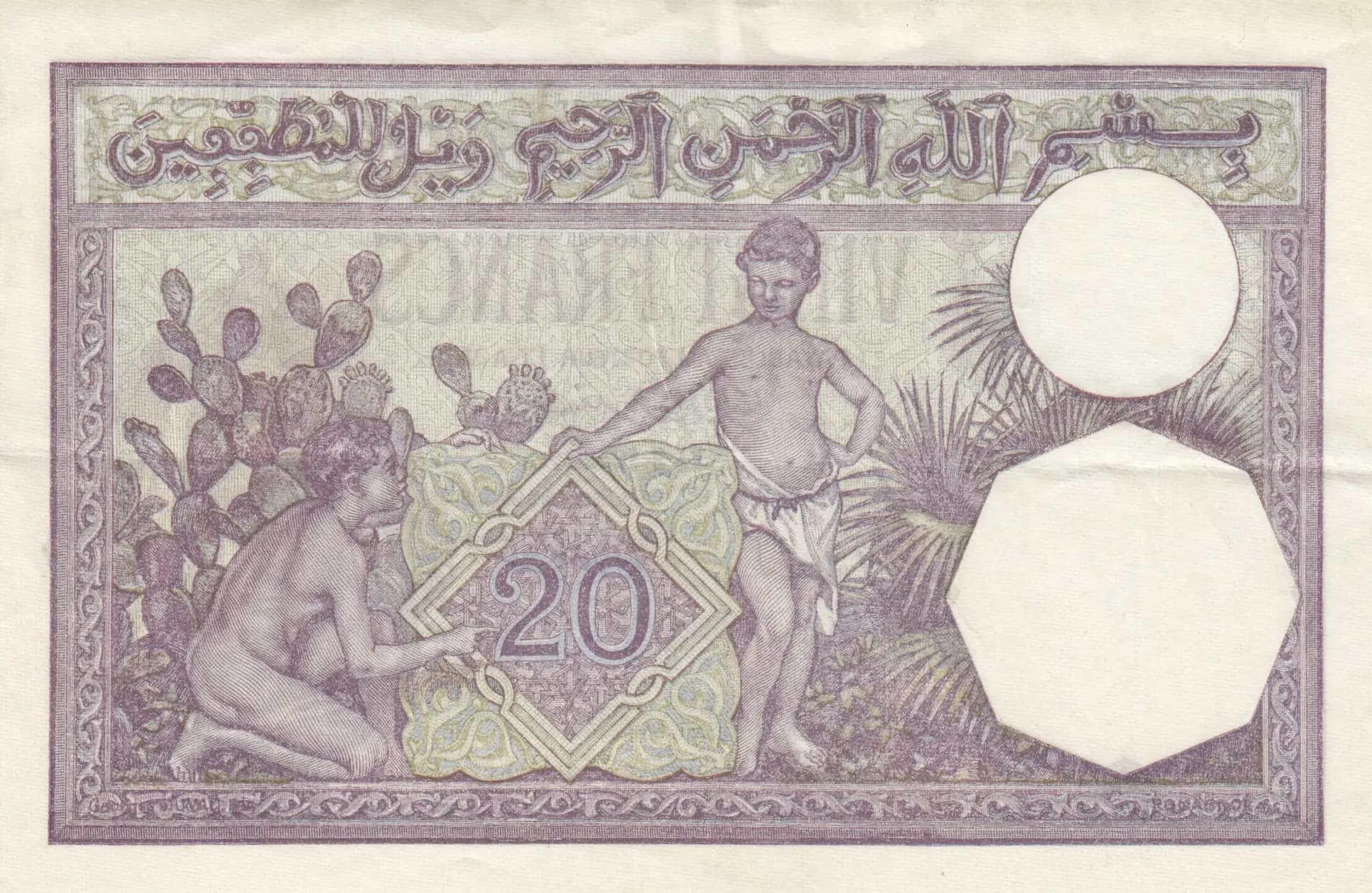
This is a visually striking 20 Francs banknote from Banque de l'Algérie, dated 21 February 1942, catalogued as Pick P-78c. The note exhibits excellent condition with vibrant purple and mauve coloring, ornate classical engraving featuring a portrait of a veiled woman on the obverse and allegorical cherub figures flanking tropical plants (cactus and palms) on the reverse. The combination of French and Arabic inscriptions reflects Algeria's colonial-era bilingual currency design, making this a historically significant example of French North African numismatic art.
Common. eBay market data shows consistent trading activity over more than a decade, with VF-graded examples selling in the $6–$26 range (with most ungraded VF sales under $10), and even professionally graded PMG notes (PMG 63–64) selling for $82–$156. The 2016 catalogue valuation of $6 for VF condition aligns with observed market prices. Multiple variants (P-78b, P-78c, P-78s) were catalogued by PMG, indicating reasonable production quantities. This is a regularly circulated note from a well-established colonial issuer with no evidence of short production runs or rarity factors.
This banknote was issued during World War II by the Banque de l'Algérie, when Algeria remained under French colonial administration. The February 1942 date places it within the period of the French Vichy regime's currency circulation in French North Africa, prior to the Allied landings in November 1942. The deliberate incorporation of regional botanical imagery—the prickly pear cactus and palm fronds—served to emphasize Algerian identity while maintaining French colonial control, with dual French-Arabic inscriptions reflecting the administration's recognition of the Arabic-speaking population.
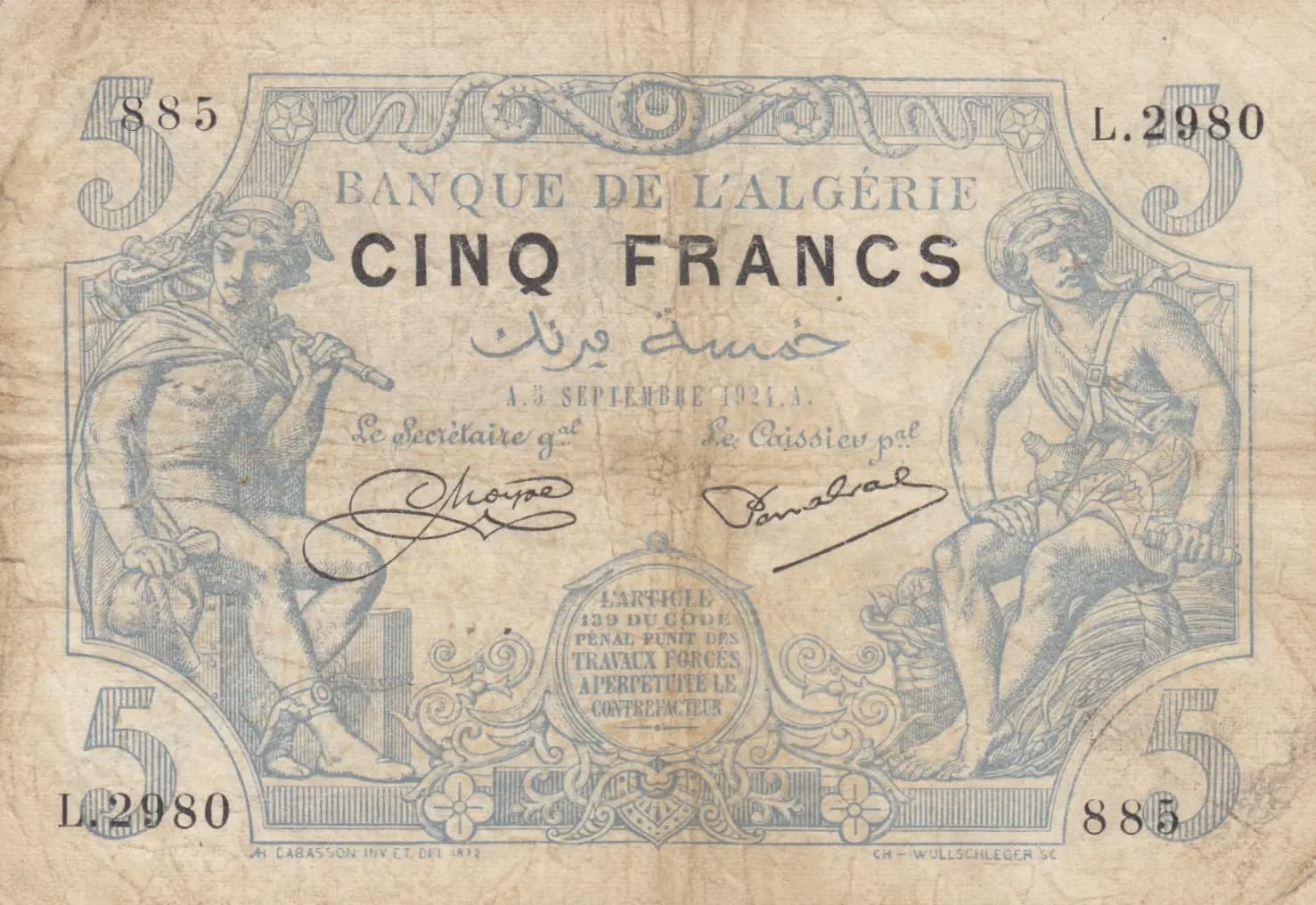
The obverse features a portrait of a young woman wearing traditional North African veiling or headdress, positioned within an ornate engraved frame on the right side of the note. Two large circular medallion spaces frame the composition symmetrically. The reverse depicts two classical putti (cherub figures) in allegorical style flanking a central '20' cartouche, with the left cherub positioned near a Opuntia (prickly pear cactus) plant characteristic of Maghrebi flora, and the right cherub near palm fronds. Both sides are framed by ornate borders featuring geometric and scrollwork patterns typical of Beaux-Arts banknote design. The overall color palette—purple and mauve with cream underprints and subtle green tints—creates a sophisticated, aged appearance. The inclusion of Islamic invocation ('Bismillah') on the reverse reflects the Muslim majority population of Algeria.
OBVERSE: 'Banque de l'Algérie' (Bank of Algeria), 'Vingt Francs' (Twenty Francs), 'Payables au Porteur et à Vue' (Payable to Bearer on Demand), 'عشرون فرنك' (Arabic: Twenty Francs), '21-2-1942' (Date: 21 February 1942), 'Le Caissier Principal' (Principal Cashier), 'Le Secrétaire Général' (General Secretary), 'D.3657 / 359 / 91403359' (Serial number), 'ART. 139 - LE CODE PÉNAL PUNIT DES TRAVAUX FORCÉS À PERPÉTUITÉ LE CONTREFACTEUR' (Article 139 - The Penal Code punishes counterfeiting with perpetual forced labor). REVERSE: 'بسم الله الرحمن الرحيم' (In the name of God, the Merciful, the Compassionate—Islamic invocation), '20' (Denomination numeral).
This note was produced using fine-line steel engraving, evidenced by the detailed hatching, ornate borders with repeating geometric patterns, and the precision of the portraits and allegorical figures. The method is characteristic of high-security banknote production of the 1940s era. The Banque de l'Algérie typically employed the Banque de France's security printing facilities or internationally recognized banknote printers for this denomination. The multi-color printing (purple, mauve, green undertones on cream base) suggests intaglio printing with multiple plate passes.
This note is catalogued as Pick P-78c, one of three documented variants under the base Pick number P-78 (variants: P-78b, P-78c, P-78s). The specific variety classification likely relates to signature combinations, date variations, or serial number series. The visual analysis shows this example dated 21-2-1942 with serial number 91403359 and signatures for 'Le Caissier Principal' and 'Le Secrétaire Général'. To definitively confirm P-78c classification, comparison of signature types and serial prefixes against the Pick catalog's detailed specifications would be required; however, the 1942 date and dual-signature format are consistent with known P-78c characteristics.