2 francs 1944
Market Prices
18 salesAbout This Note
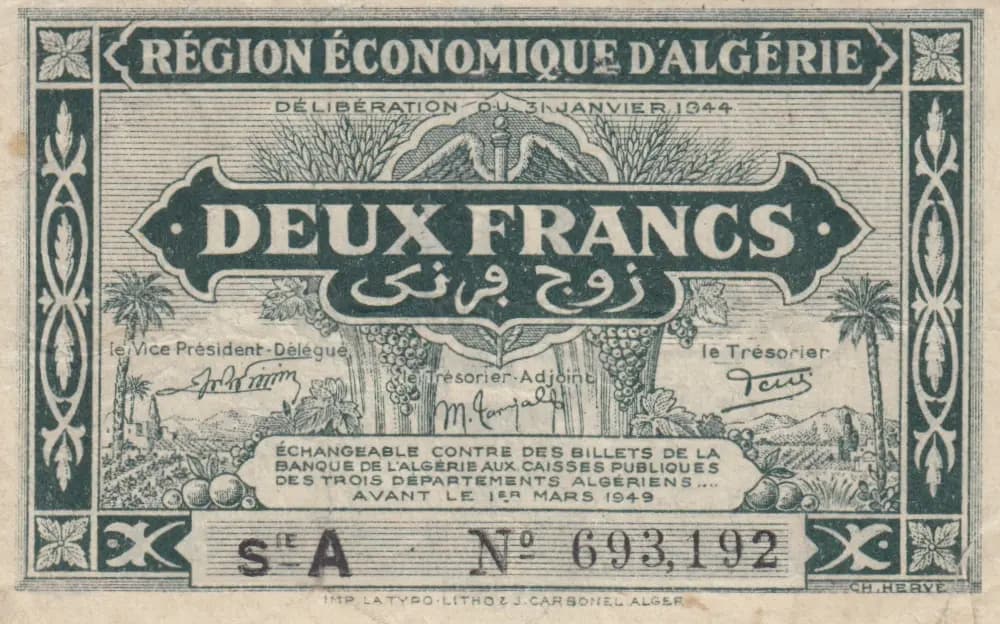
This is a VF-grade 2 Francs note from Algeria issued in 1944 by the Trésorerie - Région Économique d'Algérie, displaying the characteristic ornate design typical of WWII-era French colonial currency. The note exhibits significant aging with visible foxing, yellowing, and creasing throughout, yet maintains structural integrity without tears. The bilingual French-Arabic inscriptions and elaborate heraldic eagle emblem reflect Algeria's status during this transitional wartime period.
Common. This note is readily available in the collector market with consistent sales activity spanning multiple decades. Secondary market data shows VF-graded examples regularly selling in the $7–$12 range (2015–2024), with catalogue values listing VF at $2 and UNC at $10. The frequent appearance of multiple sales per year across various grades, combined with relatively modest prices even for professionally graded examples (PMG 55 at $31 being exceptional rather than typical), indicates substantial surviving circulation. The note was part of a standard wartime emergency issue and shows no characteristics of limited production or high attrition rates.
Issued on January 3, 1944, during the final year of World War II when Algeria was under the Provisional Government of the French Republic (GPRF), this note represents emergency currency produced by the regional economic administration rather than the Banque de l'Algérie itself. The bilingual design with Arabic script below 'DEUX FRANCS' and the prominent heraldic eagle symbol demonstrate France's efforts to maintain administrative control and cultural presence in North Africa during the post-Liberation period. The note's exchange deadline of March 1, 1949, reflects the transitional nature of this emergency issue, which was meant to be withdrawn from circulation as normal Banque de l'Algérie notes were reintroduced.
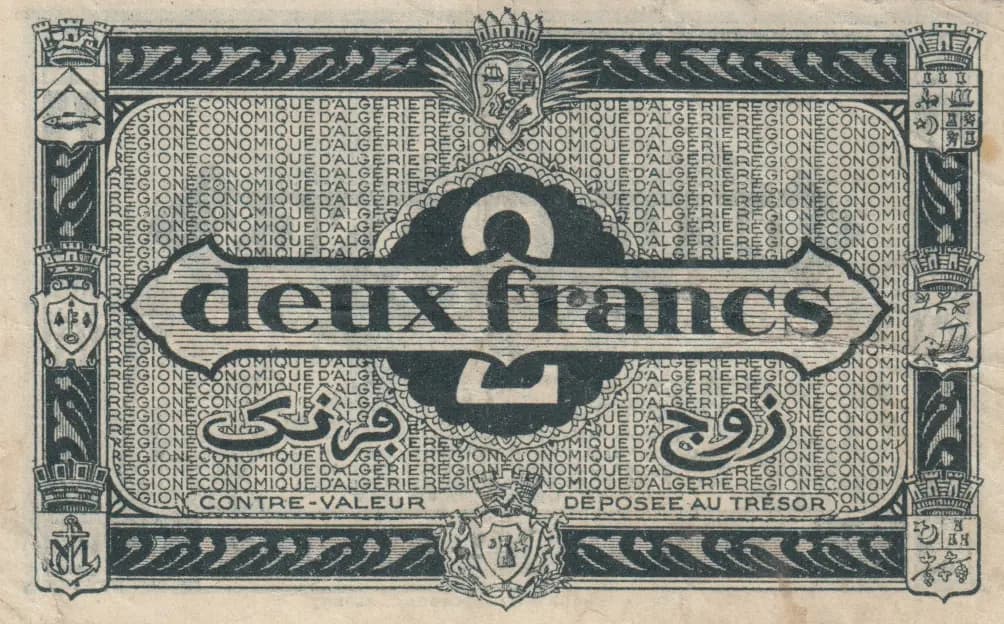
This banknote features an entirely allegorical design without individual portraits, reflecting the institutional rather than personalist nature of the issuer. The obverse (front) displays a central heraldic eagle with spread wings—a symbol of French authority and governance—positioned prominently in the upper portion. Flanking this are ornamental botanical elements including stylized palm trees on both sides and grape clusters with tropical fruits in the lower section, representing the agricultural wealth and Mediterranean character of Algeria. The reverse presents a symmetrical heraldic composition with crowned shields positioned in all four corners, surrounding a large central numeral '2' within a decorative cartouche, with the denomination repeated as 'deux francs' below. The background of the reverse features densely repeating text reading 'RÉGION ÉCONOMIQUE D'ALGÉRIE,' creating a microprint-like security effect. Both sides employ elaborate geometric border patterns in teal/dark blue and cream/beige, with black engraved line work throughout.
FRONT SIDE: 'RÉGION ÉCONOMIQUE D'ALGÉRIE' (Economic Region of Algeria); 'DÉLIBÉRATION DU 3 JANVIER 1944' (Resolution of January 3, 1944); 'DEUX FRANCS' (Two Francs); 'فرنك اثنين' (Two Francs in Arabic); 'Vice Président-Délégué' (Vice President-Delegate); 'Trésorier-Adjoint' (Assistant Treasurer); 'le Trésorier' (the Treasurer); 'ÉCHANGEABLE CONTRE DES BILLETS DE LA BANQUE DE L'ALGÉRIE AUX CAISSES PUBLIQUES DES TROIS DÉPARTEMENTS ALGÉRIENS... AVANT LE 1ER MARS 1949' (Exchangeable for banknotes of the Bank of Algeria at the public cashiers of the three Algerian departments... before March 1, 1949); 'S.A N° 693,192' (Patent No. 693,192); 'IMPRIMERIE TYPO LITHO J. CARBONEL ALGER' (Typolithographic Printing Works J. Carbonel Algiers); 'CH. HERVE' (signature of Ch. Hervé). BACK SIDE: 'RÉGION ÉCONOMIQUE D'ALGÉRIE' (Economic Region of Algeria); 'deux francs' (two francs); 'CONTRE-VALEUR' (Counter-value); 'DÉPOSÉE AU TRÉSOR' (Deposited with the Treasury); '2' (denomination numeral).
This note was produced using typolithographic printing (Typo-Litho), as credited to J. Carbonel's printing works in Algiers. The fine line engraving patterns visible throughout, the intricate border designs with repeating geometric elements, the repeating text background creating a microprint-like security feature, and the overall high-quality reproduction of ornamental patterns are consistent with professional typolithographic production combined with engraved security elements—a standard technique for banknote production during the 1940s.
Pick catalog P-99a is identified as the first issue (1ère Tranche). The PMG population report confirms one catalogued variant (P-99b), which represents the second issue (2e Tranche) of the same denomination. This specimen, graded as VF and catalogued as P-99a, belongs to the earlier emission. Specific variety identification would require examination of series letters (noted as D, D1, or D2 in PMG records for P-99b), serial number prefix patterns, and comparison of signature combinations, which are not fully detailed in the available visual analysis. The serial number 'S.A N° 693,192' visible on the note may indicate a specific printing block or series designation within the 1ère Tranche.