100 dinars 1964
Market Prices
48 salesAbout This Note
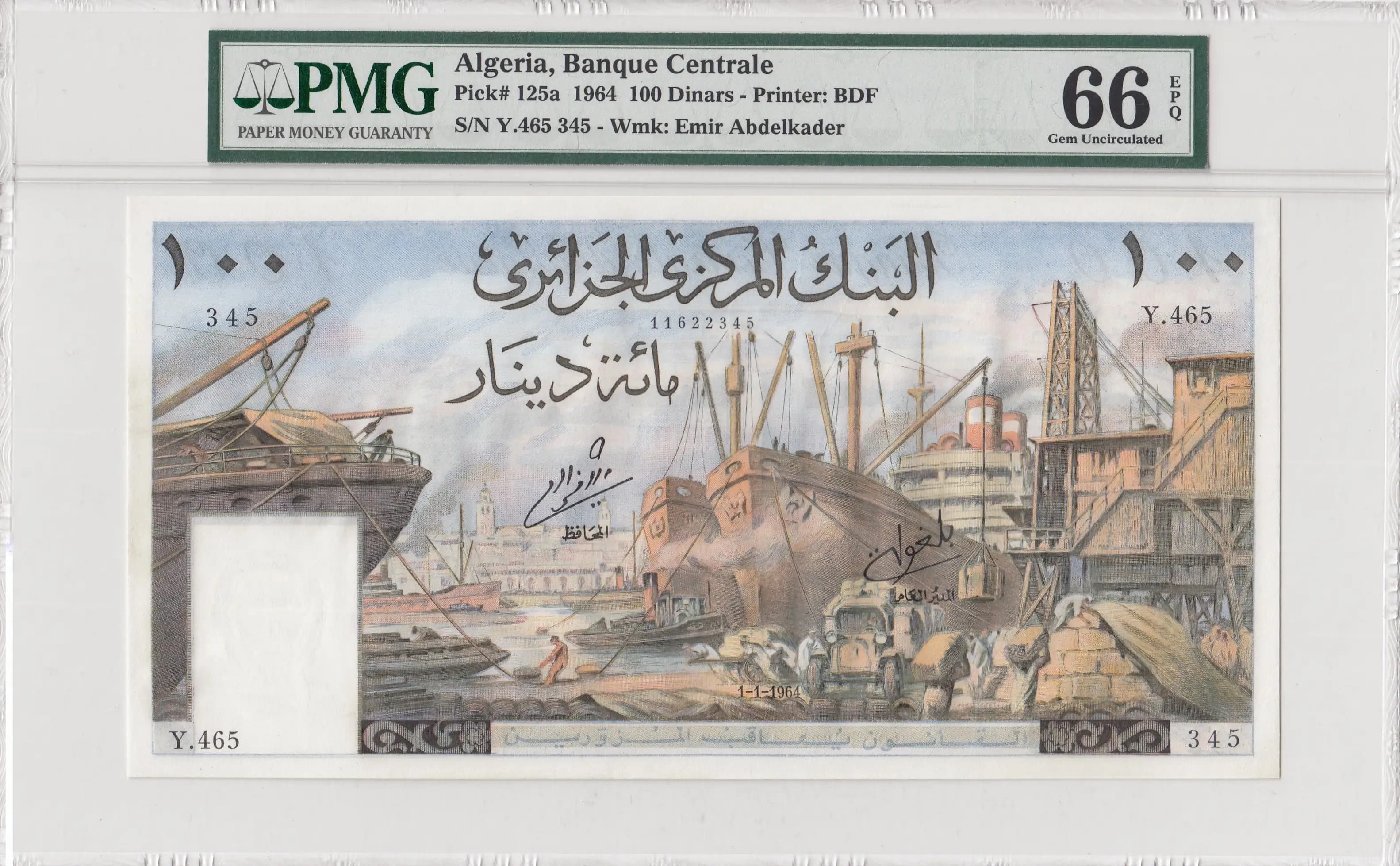
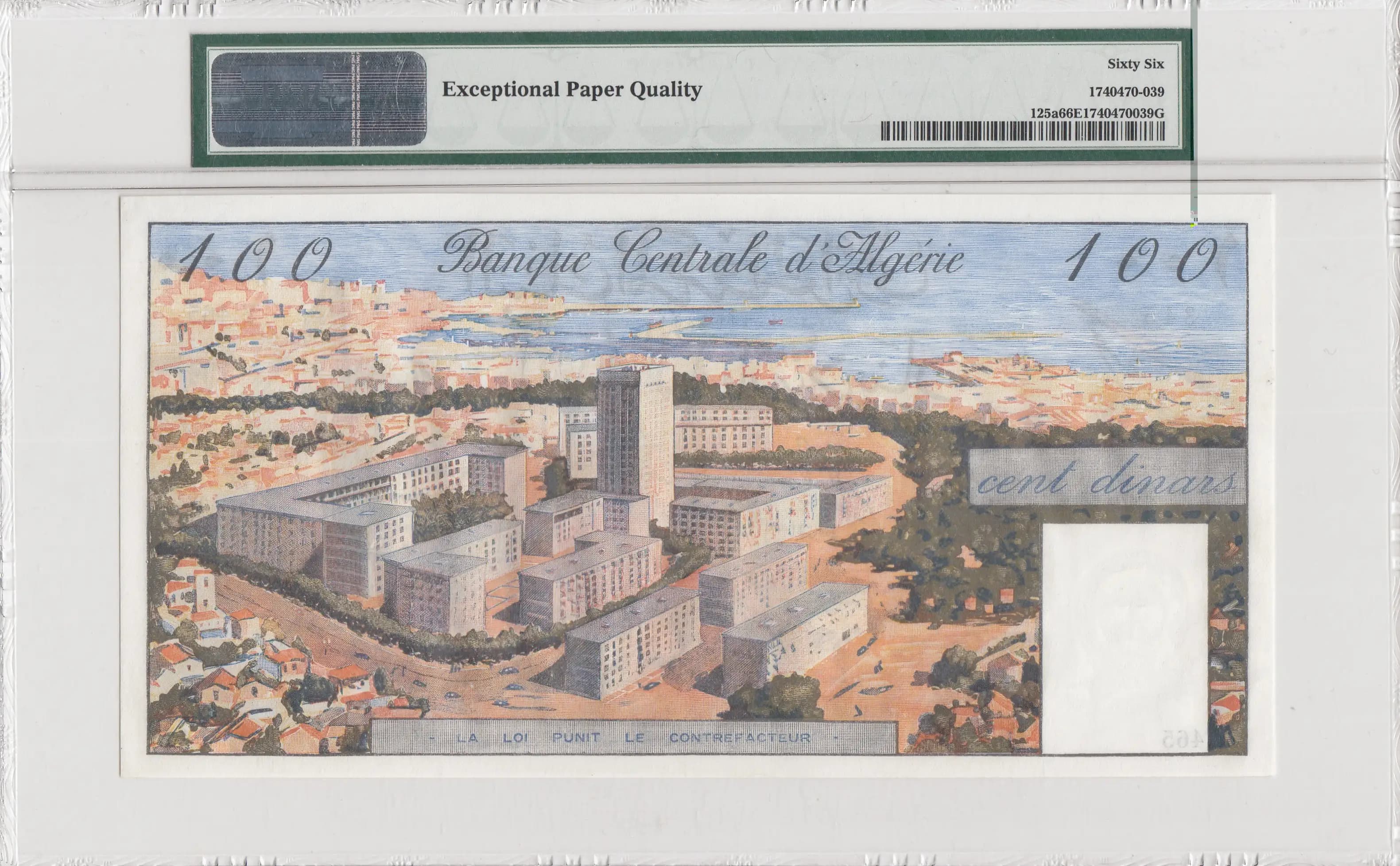
This is an exceptional example of Algeria's first post-independence banknote, the 100 Dinars issued in 1964 by the Banque Centrale d'Algérie. Graded PMG 66 EPQ (Gem Uncirculated), the note displays pristine condition with no wear, creases, or discoloration, showcasing vibrant multicolored printing depicting the Port of Algiers on the obverse and a modernist urban development on the reverse. As an early commemorative issue marking Algeria's sovereignty following independence, this note represents significant historical and numismatic value, with market data showing PMG 66 examples consistently commanding premium prices ($122–$558) relative to lower grades.
Common. While this is the first independent banknote of Algeria and historically significant, the 1964 100 Dinars remains common in the collector market. eBay price history demonstrates consistent availability across all grades, with VF specimens regularly selling for $24–$48, UNC examples for $70–$150, and PMG-graded specimens showing a clear price progression based on grade rather than scarcity. PMG 66 examples have sold between $122–$558, but this represents grading premium rather than rarity. The note was issued in substantial quantities during a period of stable currency use, and surviving examples remain accessible to collectors. No evidence of limited print runs, recalls, or short-term circulation supports a rare classification.
The 1964 100 Dinars represents a pivotal moment in Algerian numismatic history—the first banknote issued by the newly independent nation's central bank following the 1962 independence from France. The obverse's depiction of the Port of Algiers industrial harbor symbolizes the nation's economic aspirations and maritime trade importance, while the reverse's Soviet-influenced modernist architecture reflects Algeria's Cold War-era development policies and socialist-leaning economic planning typical of the Boumediene era. The bilingual French-Arabic inscriptions demonstrate the transitional nature of early post-colonial Algeria, still retaining French administrative language alongside Arabic as the national language.
The obverse features a detailed maritime industrial scene of the Port of Algiers, depicting cargo ships with visible masts, dock loading cranes, waterfront warehouses, and workers engaged in port operations. This design celebrates Algeria's Mediterranean maritime commerce and modern port infrastructure. The reverse presents a bird's-eye perspective of a planned modernist urban complex with Soviet-influenced apartment blocks arranged in a geometric grid pattern, surrounded by green spaces and tree-lined streets, with the coastal cityscape visible in the background. The design symbolizes post-independence urban development and socialist-era urban planning policies. Both sides incorporate ornamental geometric patterns in the corner frames, typical of 1960s Algerian currency design. The watermark features Emir Abdelkader (Amir Abd el-Kader), the 19th-century Algerian resistance leader, honoring the nation's anti-colonial history. The note employs a multicolored palette with light blues for sky and water, tan and beige for buildings and infrastructure, and gray-purple tones for modern architecture.
OBVERSE: 'البنك المركزي الجزائري' (Banque Centrale d'Algérie / Central Bank of Algeria); 'مائة دينار' (One Hundred Dinars); Serial numbers and date marking '12-1964' (December 1964). REVERSE: 'Banque Centrale d'Algérie' (Central Bank of Algeria); '100 cent dinars' (One Hundred Dinars); 'LA LOI PUNIT LE CONTREFACTEUR' (The law punishes the counterfeiter—standard anti-counterfeiting warning). Serial prefix 'Y.465' and full serial number '11622345' appear on both sides.
The note displays characteristics of intaglio printing combined with multicolor offset lithography, evident from the sharp detail in the architectural renderings, crisp line work in ornamental borders, and vibrant color registration. The watermark (Emir Abdelkader) and security features indicate production by a European security printer, likely Banque de France (BDF) facilities or contracted European printers experienced in currency production. The exceptional clarity and color fidelity visible in the PMG 66 EPQ specimen reflect high-quality multicolor currency printing standards of the early 1960s.
This specimen is cataloged as Pick P-125a (wmk: Emir Abdelkader). The Pick catalog recognizes three varieties: P-125a and P-125b (both with Emir Abdelkader watermark) and P-125s (printer: BDF). The observed example contains the characteristic French-style block numbering system and serial prefix 'Y.465' consistent with P-125a classification. The December 1964 date ('12-1964') falls within the standard 1964 issue period. No overprints, significant signature variations, or unusual serial characteristics are noted that would indicate specialized sub-varieties or error notes.