10 dinars 1970
Market Prices
33 salesAbout This Note
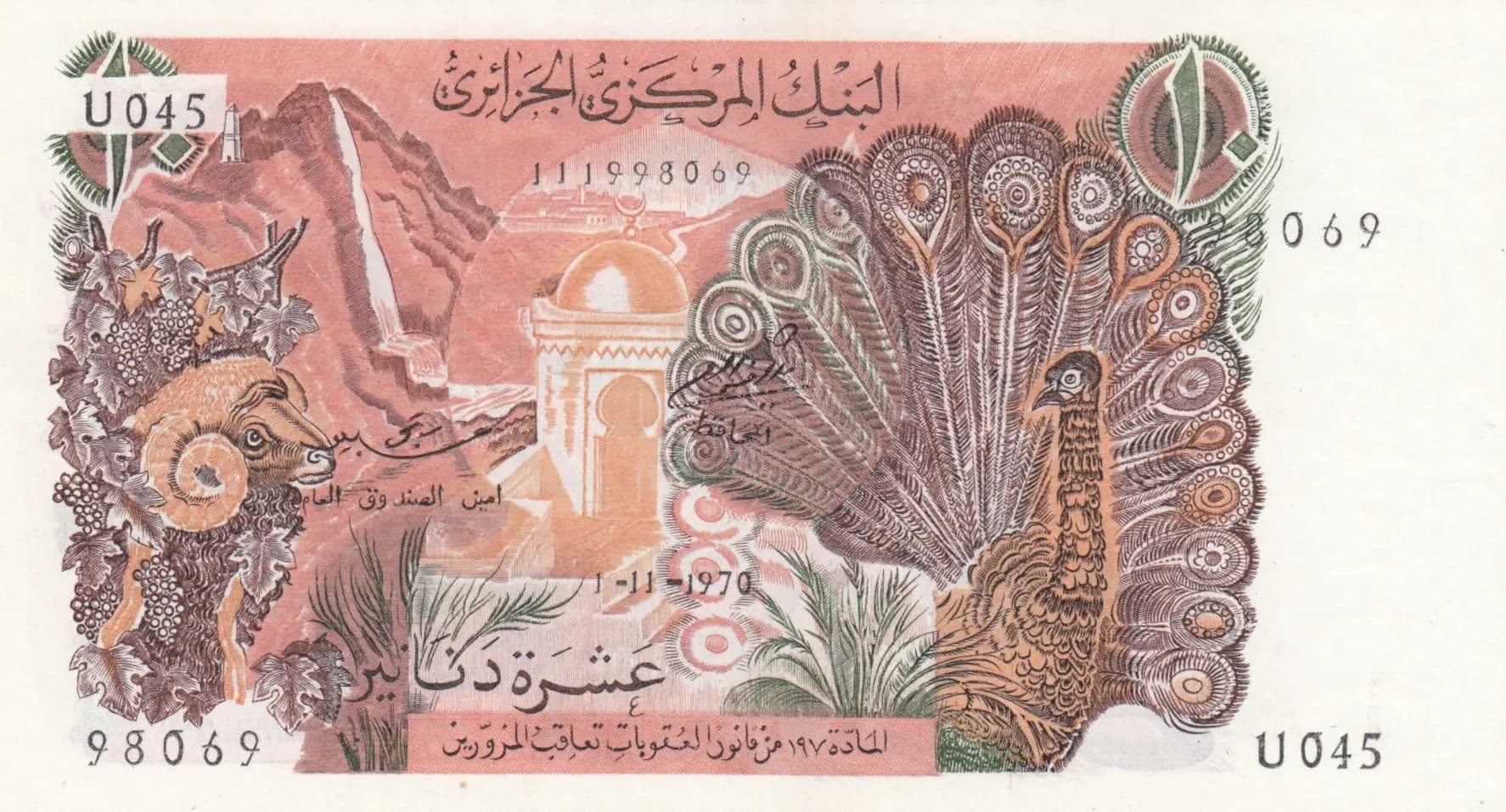
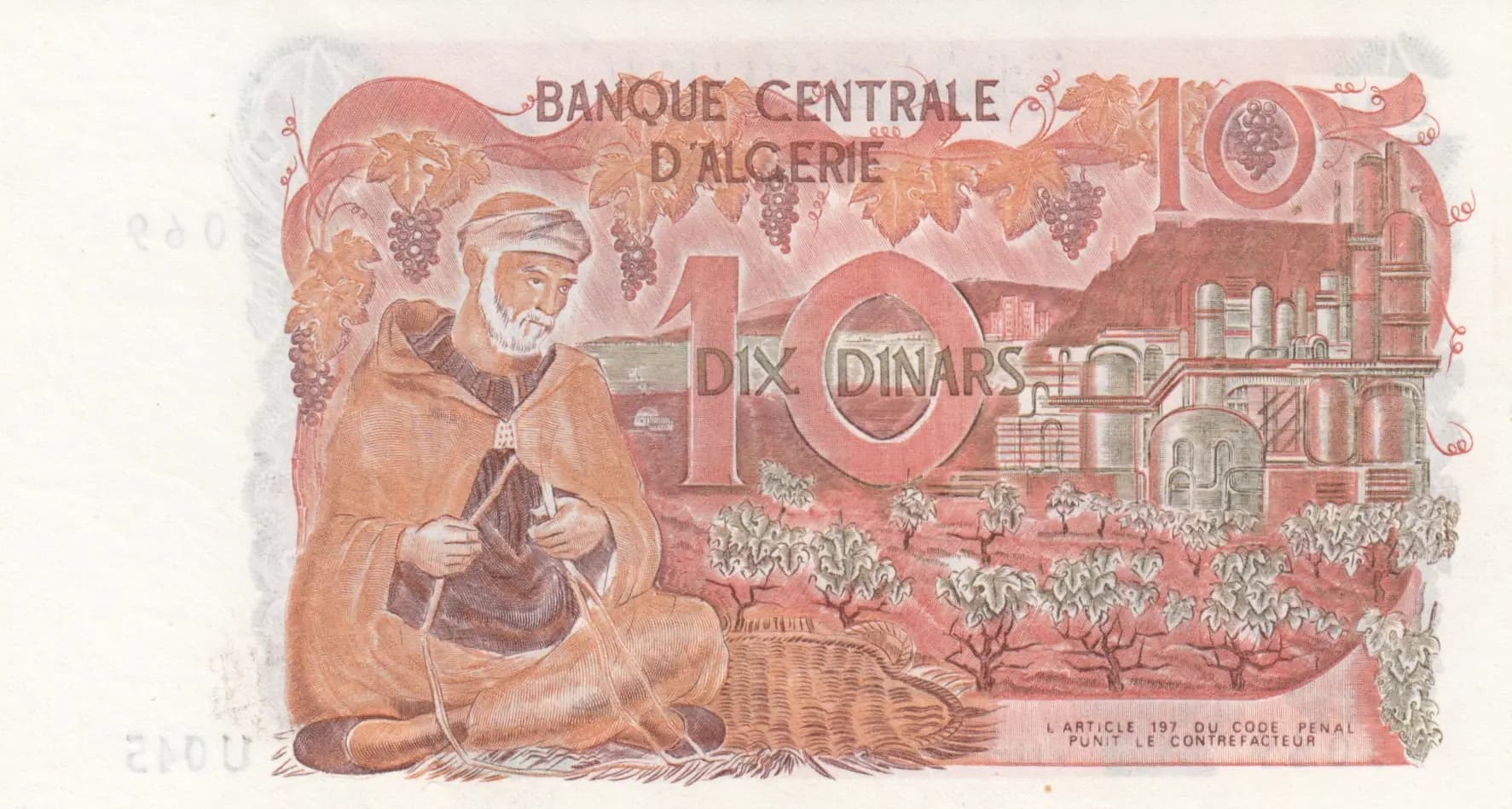
A stunning example of Algeria's 1970 10 Dinar note in Uncirculated condition, featuring exquisite multi-color engraving dominated by rust, pink, and brown tones. The obverse showcases a magnificent ram's head and peacock flanking a domed Islamic mausoleum, while the reverse depicts a seated figure amid grape vines with an industrial complex representing post-independence Algeria's development. The crisp, well-preserved condition with minimal wear and excellent detail retention makes this an attractive example of early Central Bank of Algeria currency.
Common. The eBay price history shows consistent sales in the $6-$62.90 range across multiple condition grades (2016-2024), with UNC examples typically selling for $15-$46. The broad availability of this note across multiple condition grades, regular auction activity, and relatively modest price points indicate substantial print runs and ready collector availability. This is a regular issue from 1970 with no evidence of scarcity.
Issued on November 1, 1970, this note reflects Algeria's nation-building phase following independence in 1962, with imagery symbolizing both traditional cultural heritage (the Islamic mausoleum, traditional seated figure, and agricultural grape production) and modern industrial progress (the refinery complex and administrative buildings). The engraved portraits and architectural landmarks commemorate Algerian heritage and economic development during the early years of the Algerian state under the one-party socialist FLN government.
The obverse features an ornate, symmetrical design centered on the Mausoleum of a North African Islamic leader (likely Sidi Abdelkader or similar revered figure based on the watermark reference to Amir Abd el-Kader), flanked by a detailed ram's head on the left with grapevine decorations and an elaborate peacock with intricately detailed tail feathers on the right. The reverse depicts a seated bearded man in traditional Algerian dress tending to grape vines, representing agricultural labor and heritage, positioned before a large industrial complex with arched architecture and fortress-like towers—symbolizing Algeria's industrial development and modernization. The landscape background on the reverse includes cultivated agricultural fields with visible crop rows, emphasizing the nation's agrarian-industrial transition.
Front side: 'البنك المركزي الجزائري' (Central Bank of Algeria), 'عشرة دنانير' (Ten dinars), serial numbers and series identifiers. Back side: 'BANQUE CENTRALE D'ALGERIE' (Central Bank of Algeria in French), 'DIX DINARS' (Ten dinars in French), 'L'ARTICLE 197 DU CODE PENAL PUNIT LE CONTREFACTEUR' (Article 197 of the Penal Code punishes the counterfeiter).
Intaglio (recess) engraving, the traditional security printing method for banknotes, characterized by the fine line work, intricate geometric patterns, elaborate floral and botanical details, and high-quality detail reproduction visible throughout both sides. The extensive use of fine parallel lines, cross-hatching, and detailed portraiture are hallmarks of intaglio printing. The note was produced by the Banque Centrale d'Algérie's contracted security printer, likely De La Rue or a similar major security printing firm given the technical quality evident in the visual analysis.
This is cataloged as Pick 127b, which is identified by the watermark of Amir Abd el-Kader. The PMG population data indicates four cataloged varieties for this base Pick number (P-127a, P-127as, P-127b, P-127s), with watermark variations being the primary distinguishing feature. The visual analysis confirms the Amir Abd el-Kader watermark visible in the upper left corner, consistent with the P-127b designation. Series identifier 'U 045' with serial number 11198069 places this within documented printing batches for this variety.