10 zaires 1977
Market Prices
26 salesAbout This Note
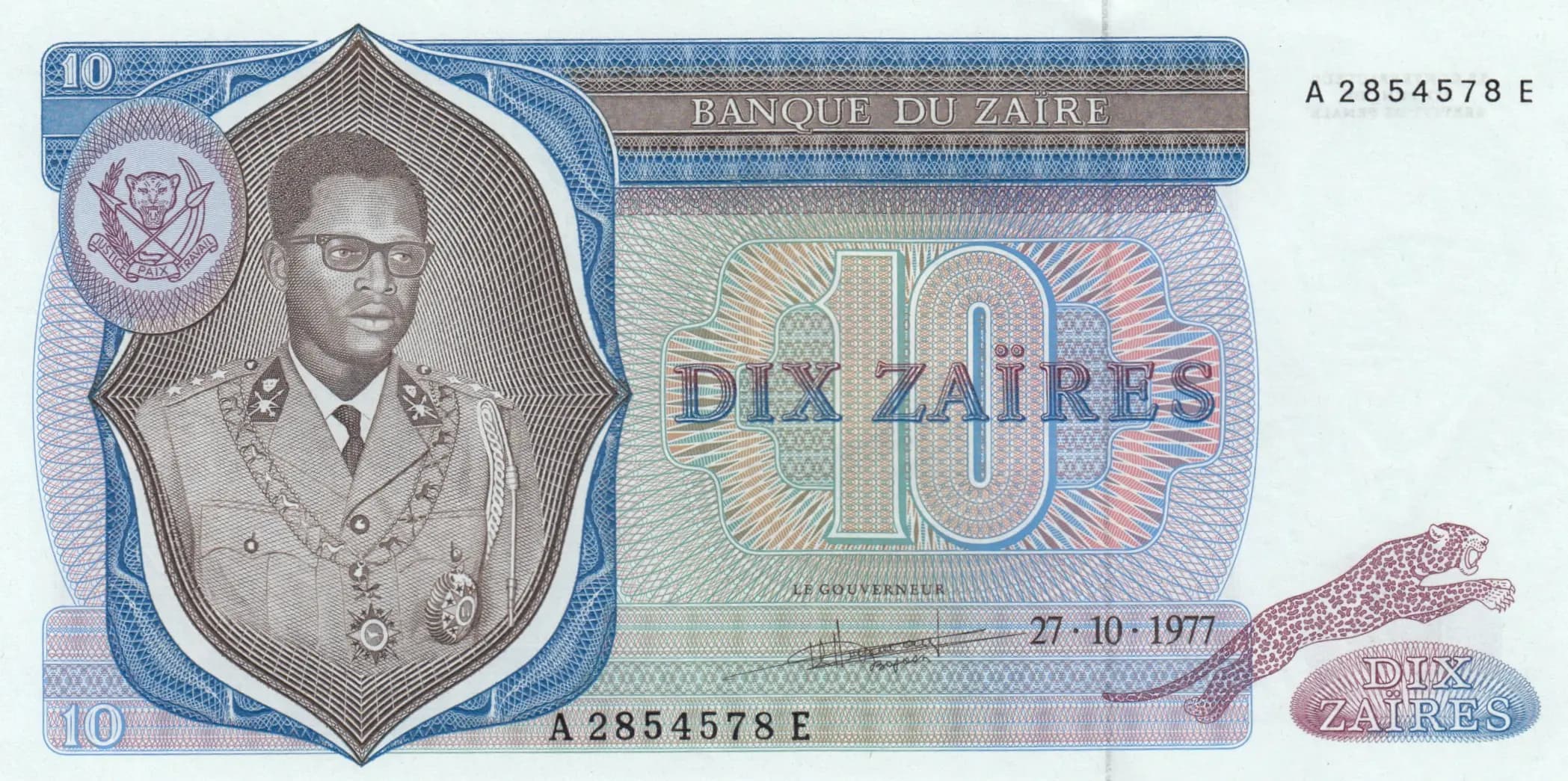
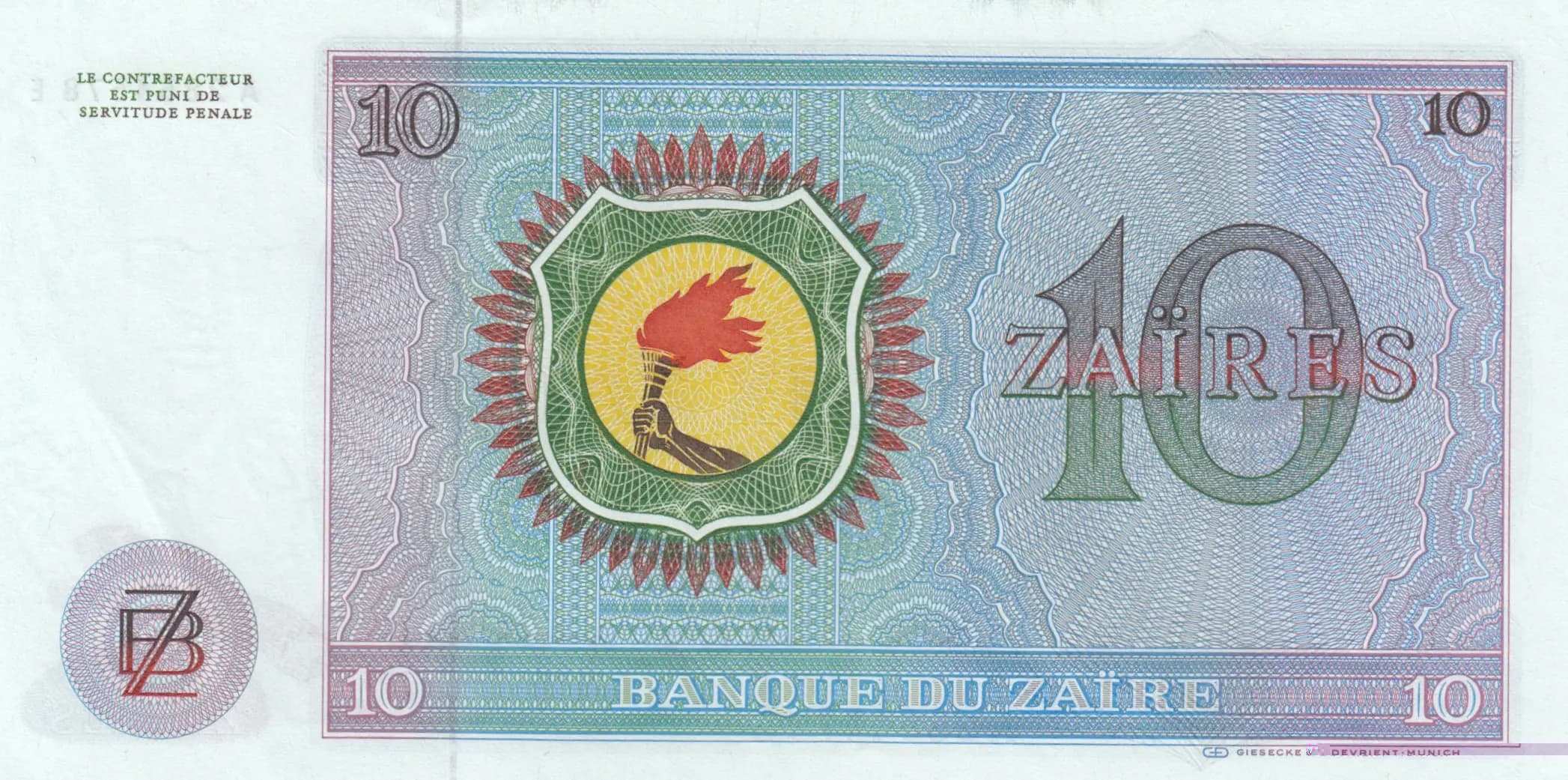
This is an exceptional uncirculated example of the 1977 Zaire 10 zaires banknote (Pick P-23b), issued by the Banque du Zaire and printed by Giesecke & Devrient. The note displays pristine condition with no visible wear, folds, or creases, featuring vibrant blue, green, and brown coloring throughout. The obverse showcases a striking portrait of President Mobutu Sese Seko in military dress uniform with distinctive glasses and medals, accompanied by an ornate coat of arms medallion and a detailed leopard illustration in the lower right corner, while the reverse presents an impressive central emblem featuring a torch and flame symbol within a radiating shield design—a powerful representation of Zairian national identity.
Common. While this is an attractive and historically significant note, the eBay market data shows consistent pricing in the $1-$16 range for various conditions, with UNC examples historically selling for $5-$30. The 2019 catalog value of $15 UNC further supports a common classification. No evidence of limited print runs, early recall, or extreme scarcity exists. The note was part of Zaire's regular currency circulation and remains readily available to collectors, making it an affordable entry point for those interested in African numismatics or Cold War-era currency.
The 1977 10 zaires banknote represents a pivotal moment in Zaire's post-independence monetary history under the regime of Mobutu Sese Seko, who ruled the Democratic Republic of Congo (renamed Zaire in 1971) from 1965 to 1997. The prominent placement of Mobutu's portrait in military uniform reflects the authoritarian personalist governance of the era, while the torch and flame emblem on the reverse symbolizes national pride and the aspirations of the newly renamed nation. This issue date of 1977 falls within a period of relative economic management before the hyperinflation and currency crises that would plague Zaire in subsequent decades.
The obverse features a formal portrait of President Mobutu Sese Seko positioned at the left, depicted in full military dress uniform with decorative medals, insignia, and characteristic eyeglasses, framed within an ornate shield-shaped cartouche. Above the portrait sits a circular coat of arms medallion representing the nation's heraldic authority. The denomination '10' appears in the upper left and lower left corners, with 'DIX ZAIRES' prominently displayed in large decorative text in the center-right portion of the note. A detailed illustration of a leopard's head, facing right, occupies the lower right corner—a traditional symbol of African strength and sovereignty. The reverse displays a dominant central emblem consisting of a torch with flames in red and orange hues, surrounded by a circular sun motif in yellow, all contained within a distinctive shield shape with radiating red spikes and green background, symbolizing national pride and revolutionary spirit. Both sides employ intricate geometric patterns, fine guilloche work, and detailed line engraving throughout the background as security measures. The overall color palette combines blues, greens, browns, reds, and yellows in a harmonious multicolor design typical of professional central bank note production.
FRONT SIDE: 'BANQUE DU ZAIRE' (Bank of Zaire), 'DIX ZAIRES' (Ten Zaires), serial number 'A2854578 E', and date '27·10·1977' (October 27, 1977). BACK SIDE: 'ZAIRES' (Zaires), denomination '10', 'BANQUE DU ZAIRE' (Bank of Zaire), 'LE CONTREFACTEUR EST PUNI DE SERVITUDE PENALE' (The counterfeiter is punished with penal servitude—standard anti-counterfeiting warning), and 'GIESECKE & DEVRIENT-MUNCHEN' (printer attribution to Giesecke & Devrient of Munich, Germany).
Intaglio (engraved) printing method, as evidenced by the fine line engraving visible in the portrait details, complex guilloche patterns, detailed cross-hatching, and security features throughout both sides. The note was printed by Giesecke & Devrient (G&D) of Munich, Germany, one of the world's premier currency printers, as indicated on the reverse side. The multi-color design and intricate security printing with fine line work and detailed background patterns are characteristic of G&D's high-security banknote production standards of the 1970s.
This note is cataloged as Pick P-23b, one of three known varieties of the 1977 10 zaires denomination (P-23a, P-23b, and P-23s also exist). The visual analysis indicates this specimen exhibits the standard G&D printing characteristics. The serial number observed is 'A2854578 E', with the letter suffix 'E' indicating a specific printing batch or signature variety. The date on this note is '27·10·1977' (October 27, 1977). Pick number classifications for Zairian currency of this era typically distinguish varieties by printer, signature combinations, and overprint variants, though without additional comparative specimens or specialized Zaire catalogs at hand, precise variety determination beyond P-23b designation requires further documentation.