200 dong 1958
About This Note
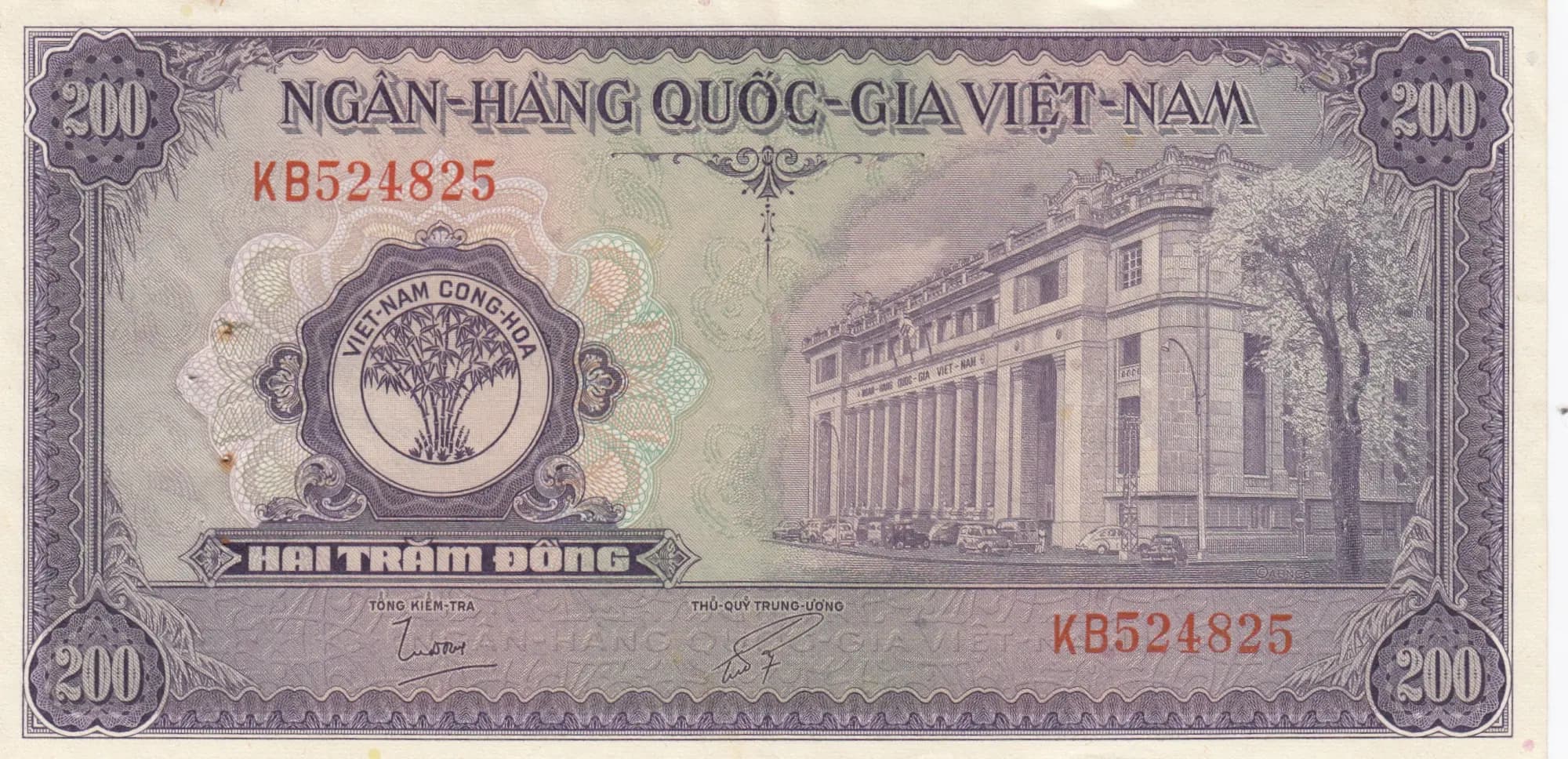
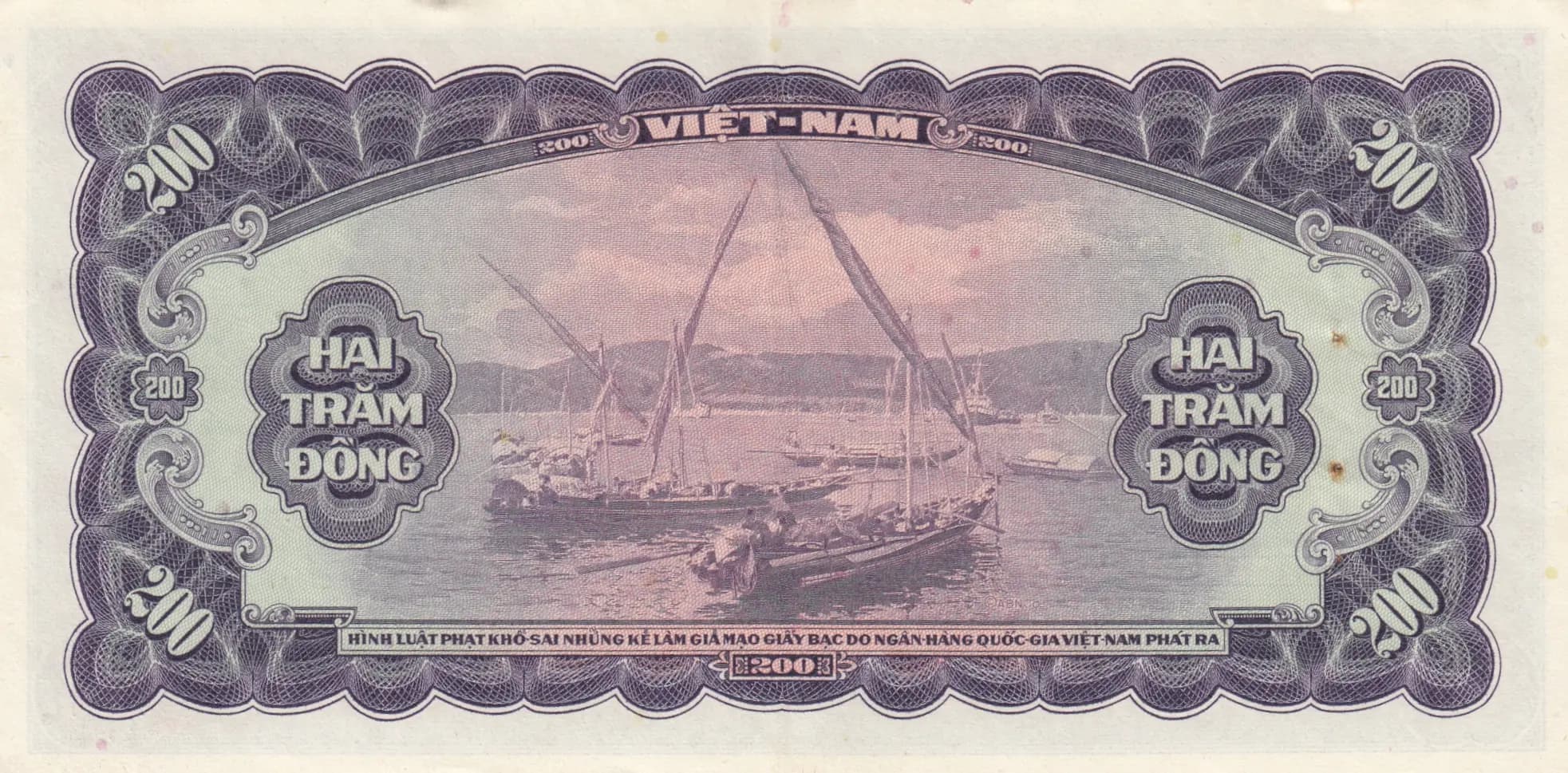
This 200 Đồng note from South Vietnam (1958) presents an excellent example of early post-colonial Vietnamese currency design, featuring ornate purple intaglio printing with a neoclassical government building on the obverse and traditional junks in a coastal harbor on the reverse. The note displays typical VF-grade wear with light foxing and browning consistent with 1950s-era circulation, while maintaining excellent legibility and color retention. The detailed guilloche patterns and red serial number KB524825 exemplify the security printing standards of the State Bank of Vietnam during this transitional period.
Common. The 200 Đồng denomination (Pick-9) from 1958 was produced in substantial quantities as a standard circulating denomination for the State Bank of Vietnam during the early Republic of Vietnam period (1954-1975). No evidence of limited print runs, recalls, or short-lived issuing authority affects rarity. The VF condition grade is typical for surviving examples from this era and does not indicate scarcity. These notes remain readily available in numismatic markets at modest valuations, consistent with common twentieth-century banknotes.
Issued by the State Bank of Vietnam (Ngân-Hàng Quốc-Gia Việt-Nam) during the consolidation of the Republic of Vietnam in 1958, this note reflects the newly independent nation's assertion of sovereignty through distinctive nationalist imagery. The obverse's neoclassical building symbolizes state institutions and modernization aspirations, while the reverse's depiction of traditional Vietnamese sailing vessels (junks) in a harbor scene celebrates the nation's maritime heritage and economic recovery during the early post-colonial period. The bamboo plant emblem and Vietnamese inscriptions reinforce national identity following the 1954 Geneva Accords partition.
This 200 Đồng note exemplifies early South Vietnamese currency aesthetics through symmetrical, classical design elements. The obverse features a circular national emblem containing a stylized bamboo plant (representing Vietnamese national identity and resilience) surrounded by 'VIỆT-NAM CỘNG-HÒA' text, positioned left of center. To the right stands a prominent neoclassical government or institutional building with multiple stories, columned portico, and flanking trees—likely representing the State Bank of Vietnam headquarters or a major governmental structure. The reverse depicts a traditional maritime scene with Vietnamese junks (traditional sailing vessels with characteristic large sails) navigating a harbor with mountainous backdrop, evoking both historical maritime trade and contemporary economic development. All four corners display the denomination '200' within decorative rectangular frames labeled 'HAI TRĂM ĐỒNG'. The entire note is framed by ornate purple borders with elaborate scrollwork and corner ornaments in the classical European style typical of mid-20th century Asian banknote design.
FRONT: 'NGÂN-HÀNG QUỐC-GIA VIỆT-NAM' (State Bank of Vietnam) - issuing authority; 'VIỆT-NAM CỘNG-HÒA' (Republic of Vietnam) - state name encircling the bamboo emblem; 'HAI TRĂM ĐỒNG' (Two Hundred Đồng) - denomination in words; 'TỔNG KIỂM-TRA' (Inspector General) and 'THỦ-QUỲ TRUNG-ƯƠNG' (Central Treasurer) - official titles; Serial number 'KB524825' printed in red. BACK: 'VIỆT-NAM' (Vietnam) - country name at top; 'HAI TRĂM ĐỒNG' (Two Hundred Đồng) - denomination repeated in corners; Legal warning regarding counterfeiting: 'ĐỊNH LUẬT PHÁT KHÓ SÀI NHƯNG KỂ LÀM GIÁ MẠO GIẤY BẠC ĐỎ NGÂN-HÀNG QUỐC-GIA VIỆT-NAM PHẠT ĐẠI' (Law regarding penalties for counterfeiting currency of the State Bank of Vietnam carries severe punishment).
Intaglio (engraved) printing on security paper, evidenced by the crisp, deeply-defined guilloche patterns, fine line work visible throughout, and the characteristic raised surface texture visible in the photographs. The ornate borders, security guilloché backgrounds, and detailed architectural and maritime scene engravings are consistent with high-security intaglio production standards. The red serial number was applied via secondary overprinting. The State Bank of Vietnam likely contracted with an international security printer, though specific printer attribution for Pick-9 requires consultation of institutional records; French printing influence is evident in the classical design aesthetic reflecting Vietnam's colonial heritage and post-colonial transition.
The observed serial number 'KB524825' indicates this note carries the 'KB' series prefix. Varieties for Pick-9 (200 Đồng 1958) would be distinguishable by serial number prefixes, signatures of issuing officials (State Bank representatives), and potential minor design variations across print runs. The red ink coloring of the serial number is a standard feature. Without access to comprehensive Pick catalog serial number range documentation or signature variety databases specific to South Vietnamese currency, further variety identification cannot be definitively established from this single specimen; however, the 'KB' prefix appears to represent a documented series within the production run of this denomination.