10 dong 1962
About This Note
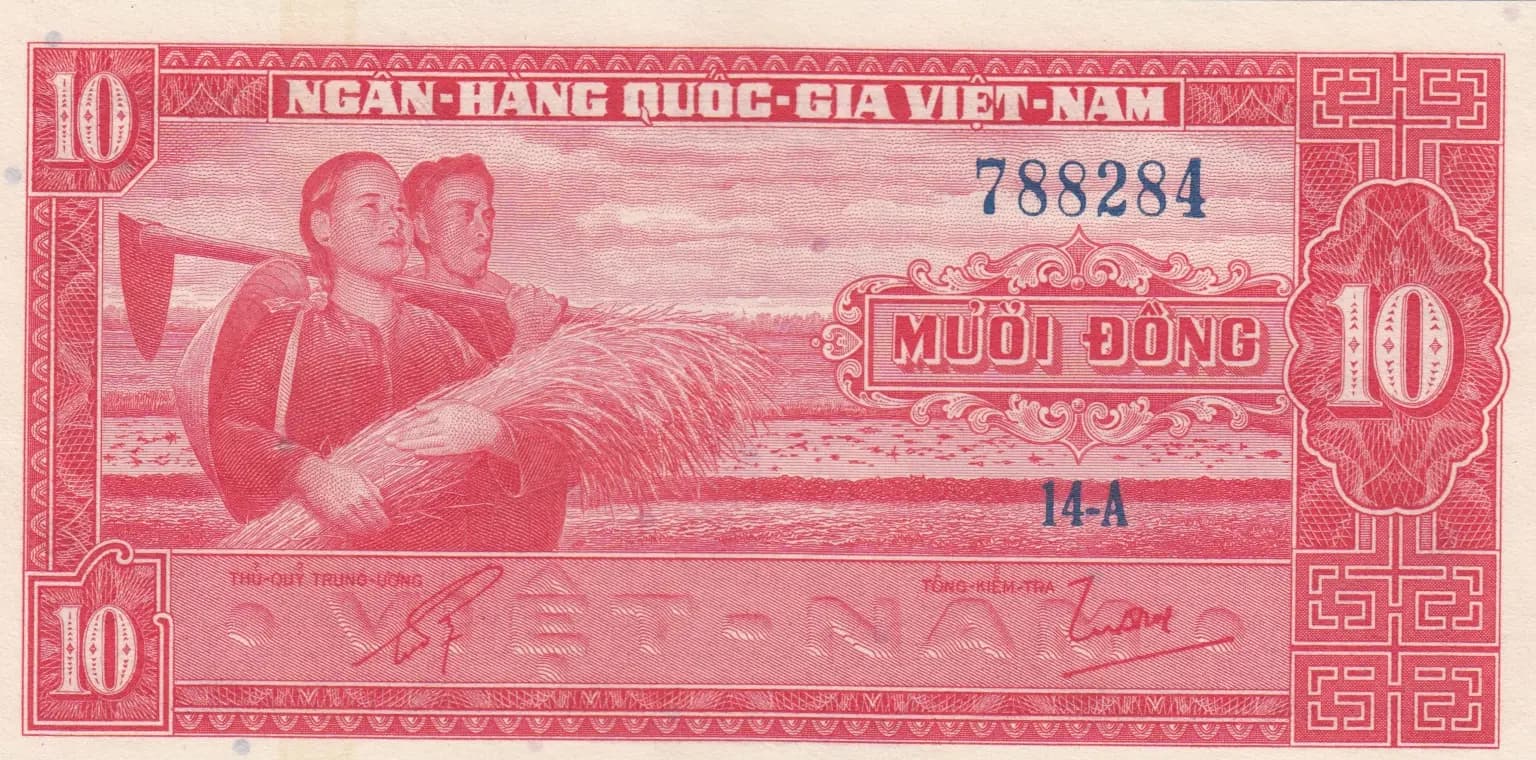
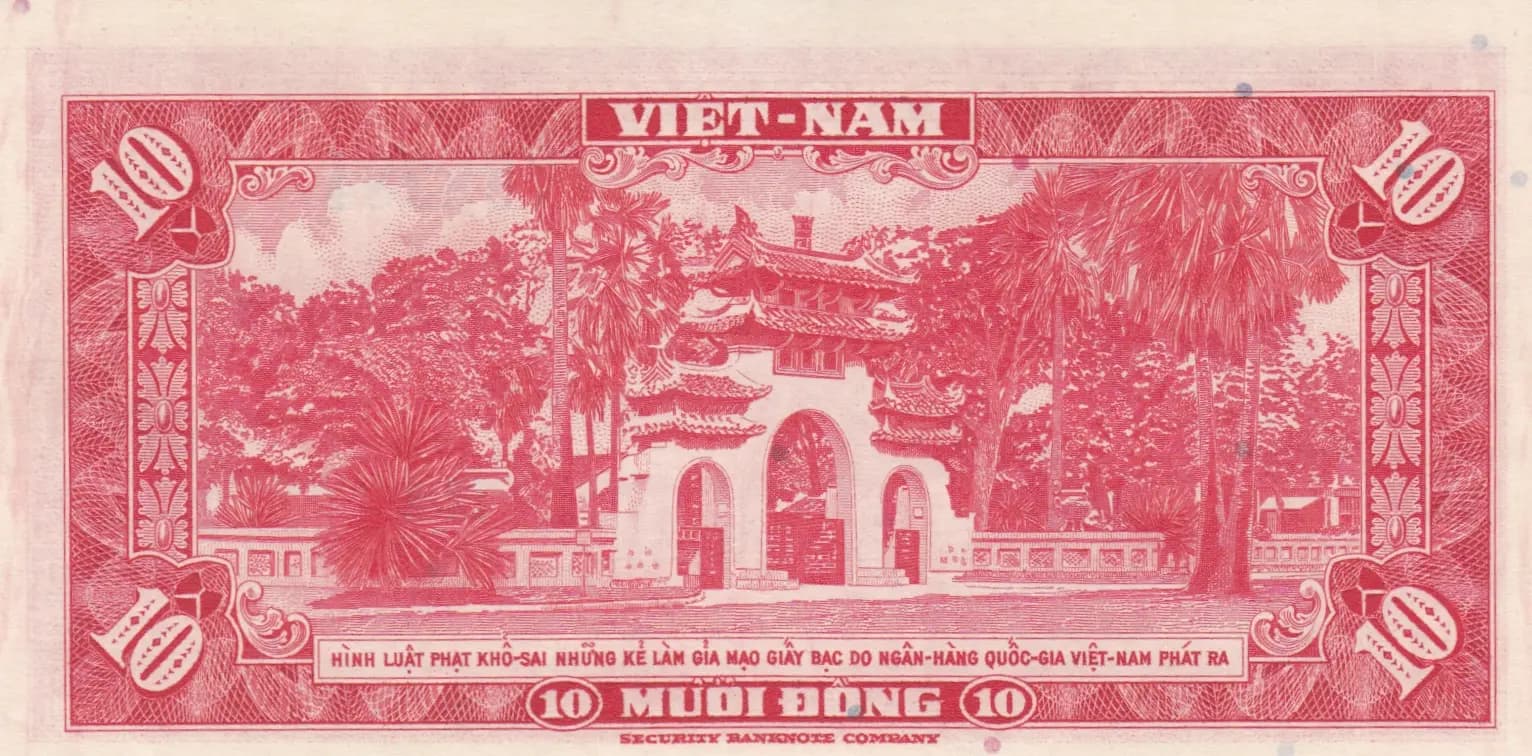
An uncirculated 10 Dong note from 1962 issued by the National Bank of Vietnam (South Vietnam), featuring exceptional clarity and crisp engraving throughout. The note displays two prominent male portraits on the front in revolutionary context against a red/pink palette, with an elegant multi-tiered pagoda temple scene on the reverse set in a tropical garden landscape. This pristine example represents an important piece of Cold War-era Vietnamese numismatics, notable for its fine line engraving quality and the symbolic imagery reflecting both political leadership and cultural heritage.
Common. This is a standard circulation issue from the Pick catalog series for South Vietnam (P-5). While South Vietnamese currency from this period has become collectible due to historical interest, the 10 Dong P-5 was issued in substantial quantities for a nation-state of that era. The uncirculated condition enhances its appeal to collectors, but the note itself is not scarce. Standard market pricing for similar uncirculated examples typically falls in the $10-30 range, which is consistent with a common-grade banknote.
This 10 Dong note was issued during the early period of the Republic of Vietnam (South Vietnam) in 1962, a critical juncture as the nation struggled with political consolidation and growing Cold War tensions. The dual portraits on the obverse represent political and military leadership of the era, while the pagoda reverse reflects the cultural and Buddhist heritage of Vietnam, serving as a counterpoint to the regime's modernizing agenda. The note's design and the Security Banknote Company printing credit reflect the involvement of Western security printing expertise in establishing South Vietnam's monetary credibility during this period.
The obverse features two male political figures depicted in profile within the upper left quadrant, rendered in a revolutionary or wartime context that emphasizes their leadership roles during the nation's formative period. A mountainous landscape forms the background vignette, symbolizing Vietnam's geography and national identity. The reverse depicts a monumental multi-tiered Vietnamese pagoda or Buddhist temple with characteristic curved roofs and elaborate architectural detailing, set within a landscaped garden environment complete with palm trees and tropical vegetation, representing the cultural and spiritual traditions of the Vietnamese people. Both sides feature ornate decorative borders with repeating geometric patterns, circular corner emblems containing the numeral 10, and elaborate scrollwork characteristic of professional security printing. The red/pink monochromatic color scheme creates visual cohesion while the fine line engraving provides intricate detail throughout.
FRONT SIDE: 'NGAN-HANG QUOC-GIA VIET-NAM' (State Bank of Vietnam); 'MUOI DONG' (Ten Dong); Serial number 788284; Series identifier 14-A; Denomination 10. BACK SIDE: 'VIET-NAM' (Vietnam); 'HINH LUAT PHAT KHO-SAI NHUNG KE LAM GIA MAO GIAY BAC DO NGAN-HANG QUOC-GIA VIET-NAM PHAT RA' (According to law, those who counterfeit banknotes issued by the State Bank of Vietnam will be punished); '10 MUOI DONG 10' (10 Ten Dong 10); 'SECURITY BANKNOTE COMPANY' (printer credit); Denomination 10.
Intaglio (line engraving) printing, as evidenced by the fine, crisp line work visible throughout both sides of the note, complex border patterns, and the detailed architectural elements of the pagoda. The note was produced by Security Banknote Company, a prominent security printer of the era, whose credit appears on the reverse. The precision of the geometric border elements and the intricate detail work in the portraiture and temple architecture are characteristic of professional intaglio security printing from the 1960s.
The observed serial number 788284 with series identifier 14-A represents one of many serial number combinations for this pick number. Known varieties for P-5 may include different signature combinations and plate numbers, though these require specialized catalog references for definitive identification. The visual analysis confirms this is the standard 10 Dong design without the oval frame variants mentioned in the external reference data (which described P-6 and P-7 as having larger portraits in oval frames). No significant overprints or alterations are visible on this example.