10 000 tengas 1919
About This Note
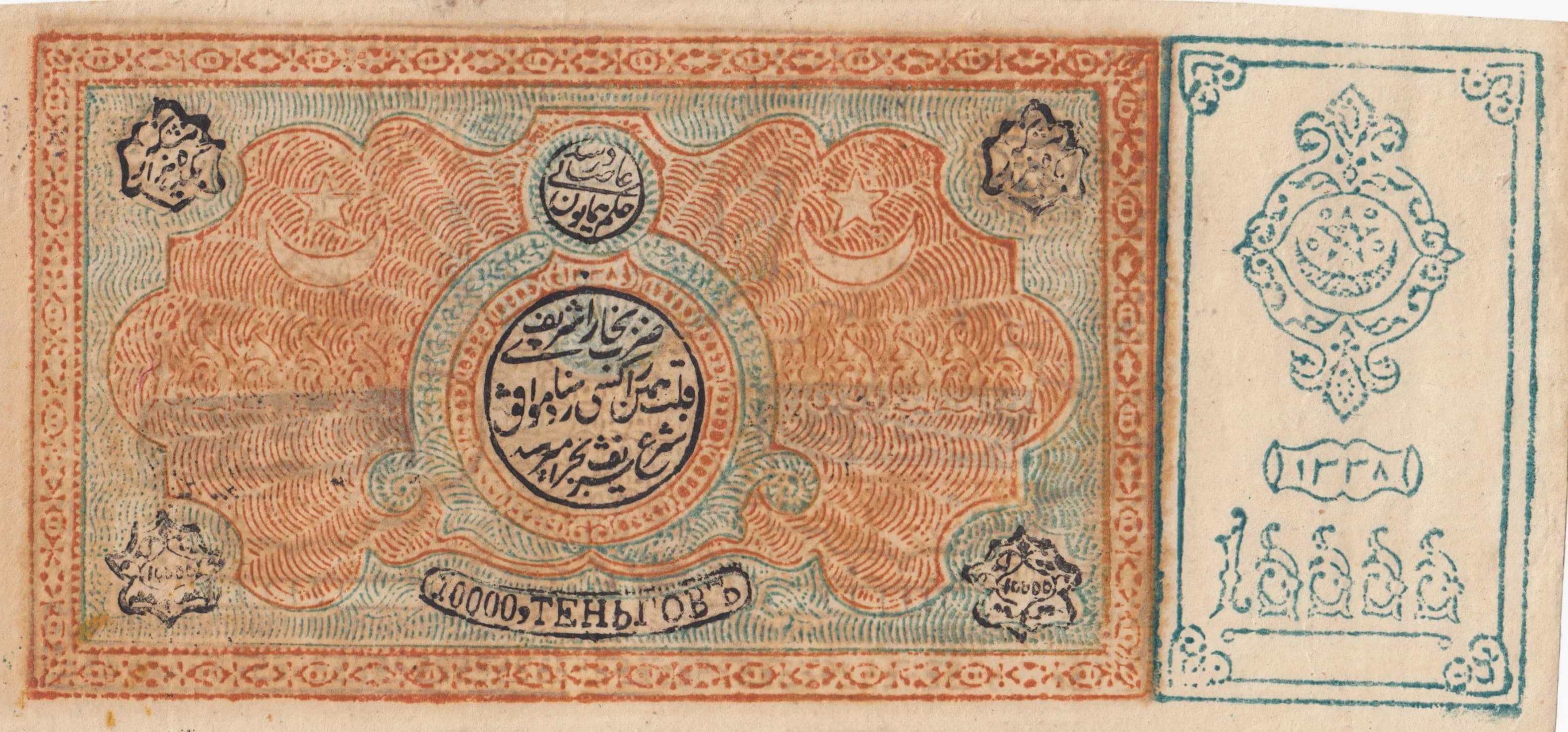
This 10,000 Tengas note from the Bukhara Emirate (1919) is a visually striking example of Central Asian monetary design during the Russian Civil War period. The note features a sophisticated two-color printing scheme in rust-orange and teal, with intricate geometric and Islamic decorative patterns characteristic of Bukharan artistic tradition. In AU condition, this note displays the aged patina and foxing expected of early 20th-century Central Asian currency, with all structural elements intact and inscriptions clearly visible.
Common. The Bukhara Emirate issued multiple denominations of currency during 1919 under Russian Civil War conditions, and 10,000 Tengas notes in this series appear with reasonable frequency in collector markets and institutional holdings. No documented print run restrictions, recalls, or extreme scarcity indicators exist for Pick 24. The note's historical interest ensures steady collector demand, but production volumes during the emirate's autonomous period (1919-1920) were substantial enough to support availability. AU condition examples are not exceptionally scarce, though they command premiums over lower grades.
Issued by the Bukhara Emirate in AH 1338 (1919), this banknote represents a brief period of monetary autonomy during the Russian Civil War, when the emirate maintained independent state functions before Soviet incorporation. The predominance of Persian/Farsi script and Islamic geometric ornamentation reflects Bukhara's role as a major Central Asian cultural and commercial center with strong Persian administrative traditions. The note's design deliberately evokes traditional Islamic monetary aesthetics rather than European currency conventions, asserting Bukharan sovereignty and cultural identity during a period of regional upheaval.
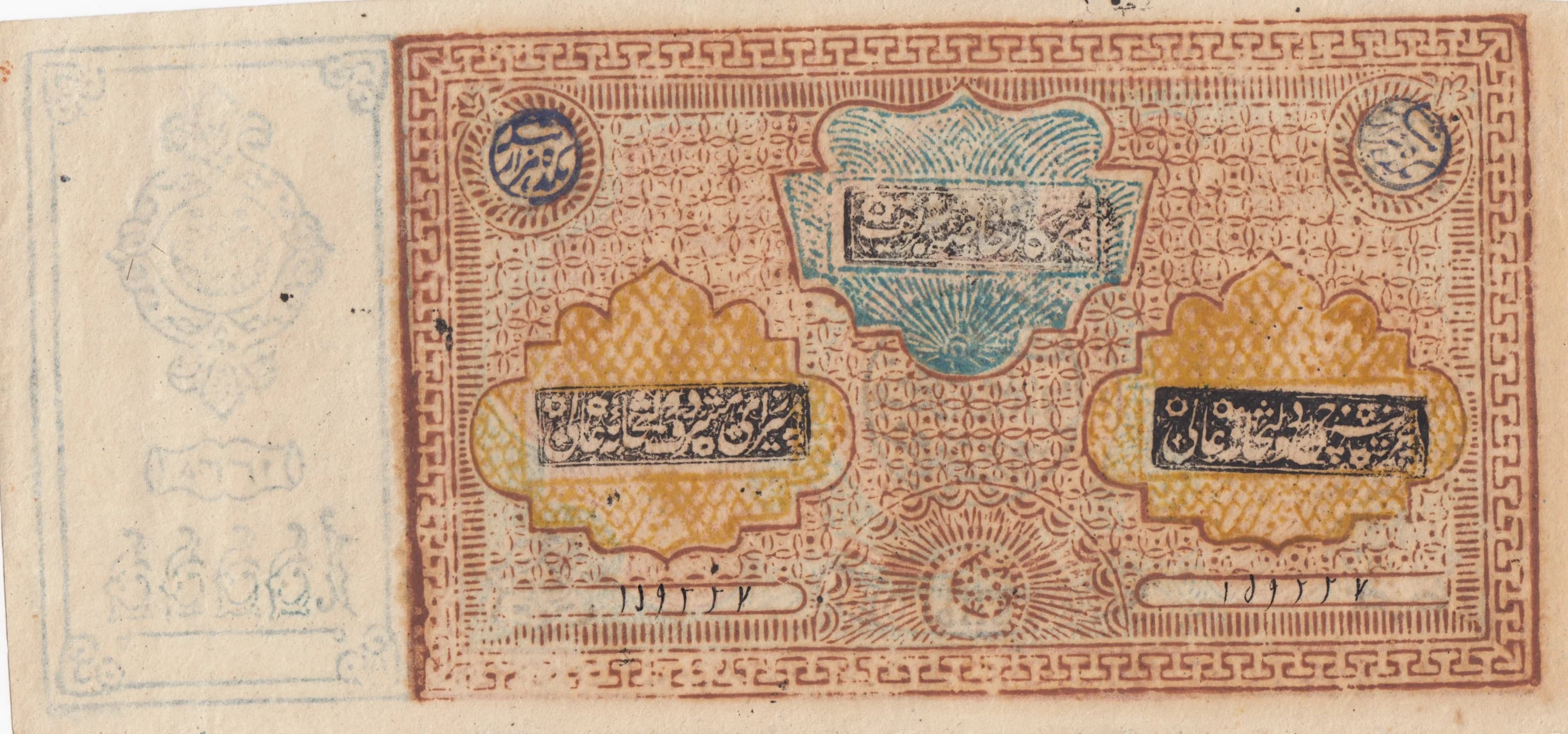
This is a highly ornate banknote employing classical Islamic geometric and calligraphic design principles. The front features a central circular medallion containing Persian script, flanked by decorative four-pointed star seals with calligraphic centers positioned at the corners—these are heraldic emblems of the Bukhara Emirate. The composition is framed by an intricate geometric border of repeating patterns. The reverse side employs a Greek key pattern border in rust tones and presents two large rounded rectangular cartouches in yellow-gold, separated by a decorative teal scalloped element with an upper circular medallion seal. Fine wavy line background patterns throughout serve both decorative and anti-counterfeiting purposes. The color palette—rust/orange, teal/turquoise, gold, and cream—reflects traditional dyeing techniques and artistic preferences of the region. No portrait figures appear; instead, the design relies entirely on abstract ornamentation, calligraphy, and heraldic symbols appropriate to Islamic artistic conventions of the period.
FRONT SIDE: Primary denomination inscription reads '۱۰۰۰۰ تنگههای' (10,000 tengas/ten'gov). The Islamic calendar date '۱۳۳۷' (AH 1337, corresponding to 1918-1919 CE) appears in Persian numerals. The issuing location 'بخارا' (Bukhara) is prominently displayed. Additional script appears within the central circular medallion and corner seals, though precise content is not clearly legible in the images provided. BACK SIDE: Two large rectangular cartouches contain administrative or treasury authority text in Persian/Farsi script, the specific content of which is not clearly legible from the image quality. Persian numerals appear below the cartouches, likely indicating serial numbers or administrative notations. Multiple decorative seals and medallions contain calligraphic inscriptions typical of formal Ottoman and Persian administrative documents.
This note was produced using multi-color letterpress or intaglio printing technology, indicated by the precise registration of multiple color separations (rust-orange, teal, and gold/yellow) and the crisp, detailed reproduction of fine geometric patterns and calligraphic elements. The intricate wavy line background patterns and fine detail work suggest intaglio engraving was employed for security purposes. The banknote.ws reference to related notes (PS-1034) suggests these notes may have been produced by a Russian or Central Asian state printing facility during the Russian Civil War period, though the specific printer is not definitively established in available catalogs. The quality and sophistication of execution indicates a state-level security printer rather than local production.
The banknote.ws reference notes that similar notes with different signatures exist (RUSSIA Central Asia PS-1034), indicating signature varieties are known for this series. The observed note does not show clearly legible signature fields in the provided images, preventing definitive signature variety identification. The Islamic calendar date AH 1338 corresponds to 1919-1920 CE; notes dated AH 1337 may represent an earlier printing. No serial number, overprint, or significant distinguishing variety characteristics are clearly visible in the images provided. Collectors should verify signature variants and calendar date variations when cataloging examples from this series.