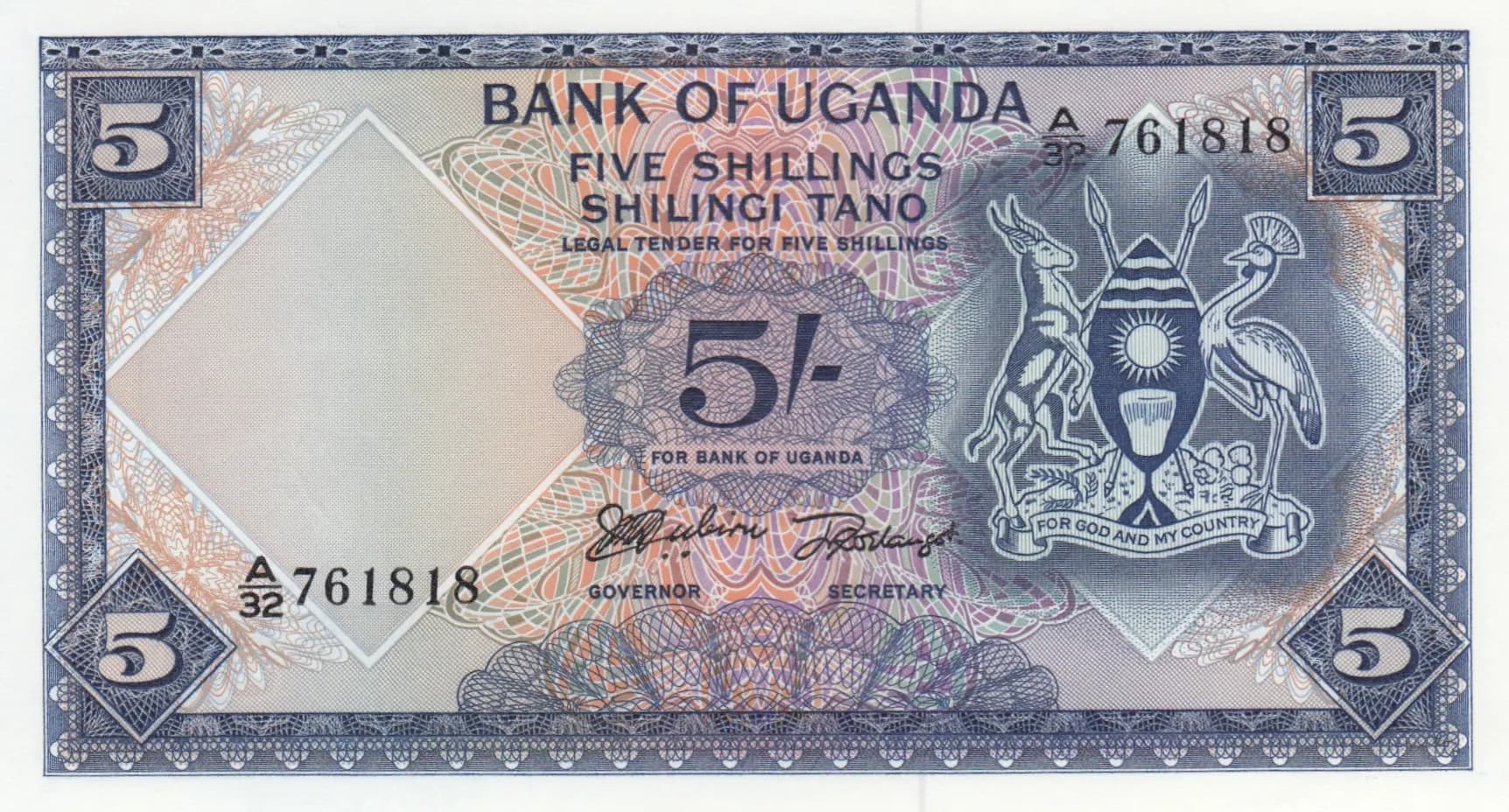
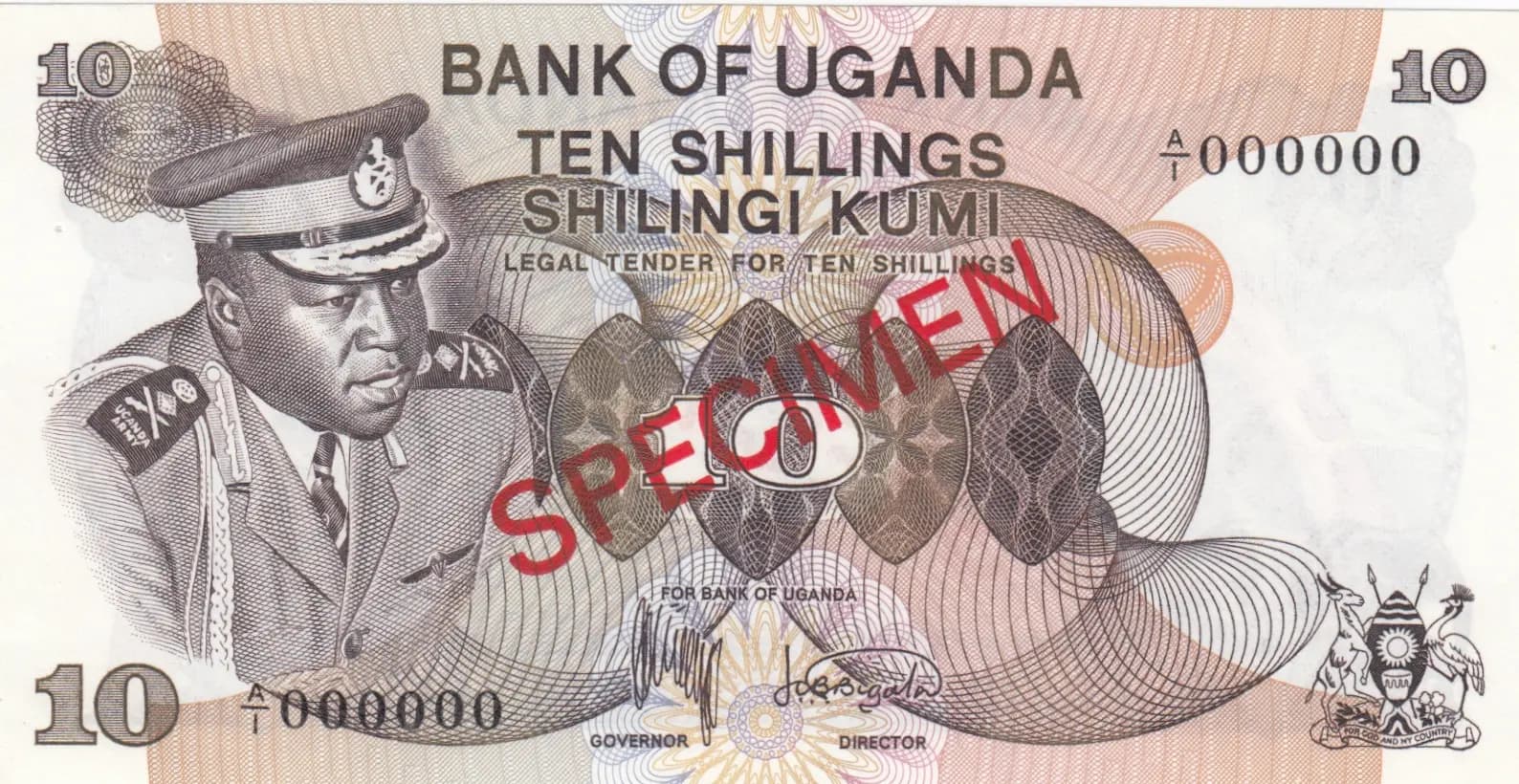
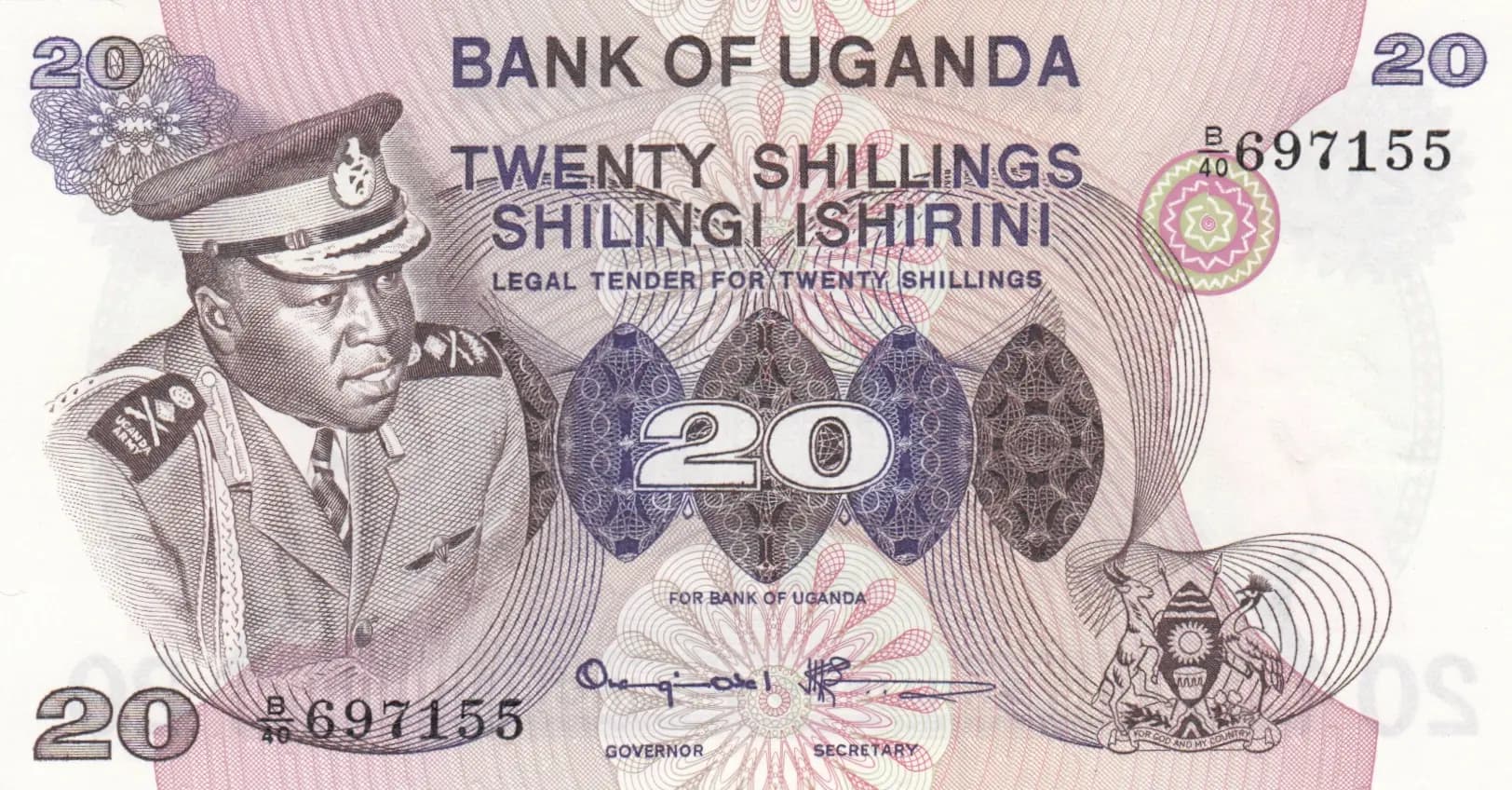
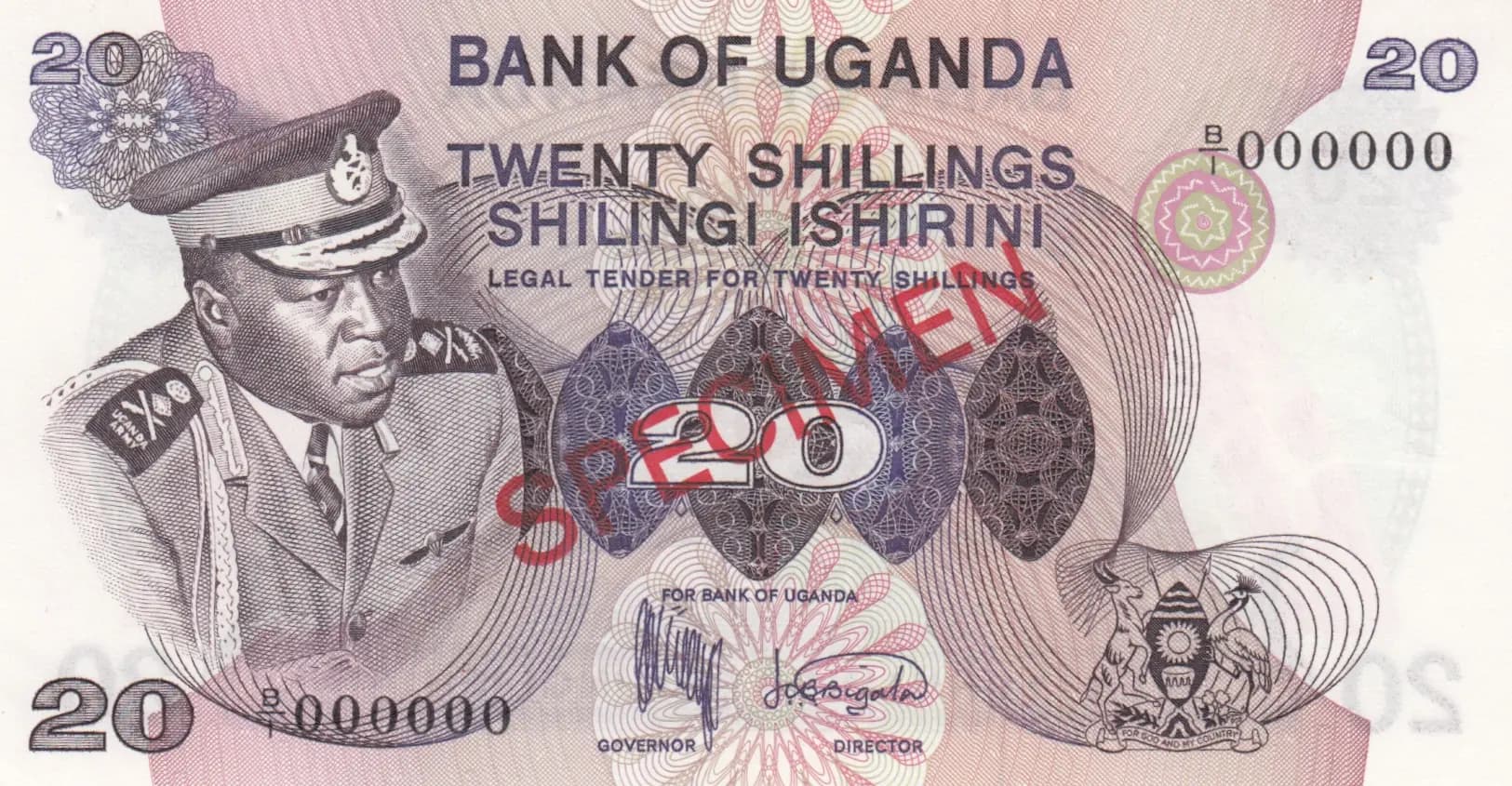
5 shillings 1979
Market Prices
23 salesAbout This Note
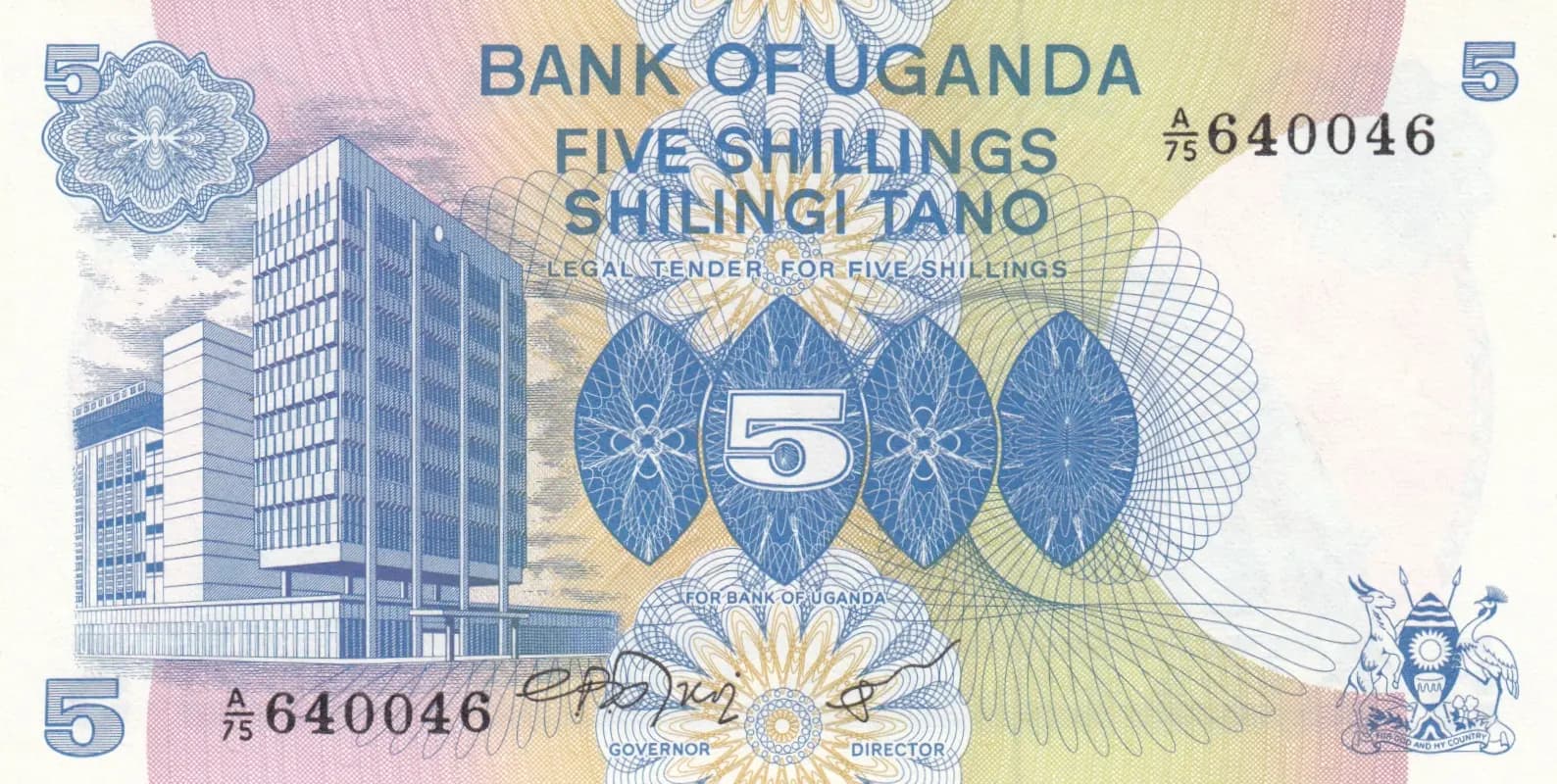
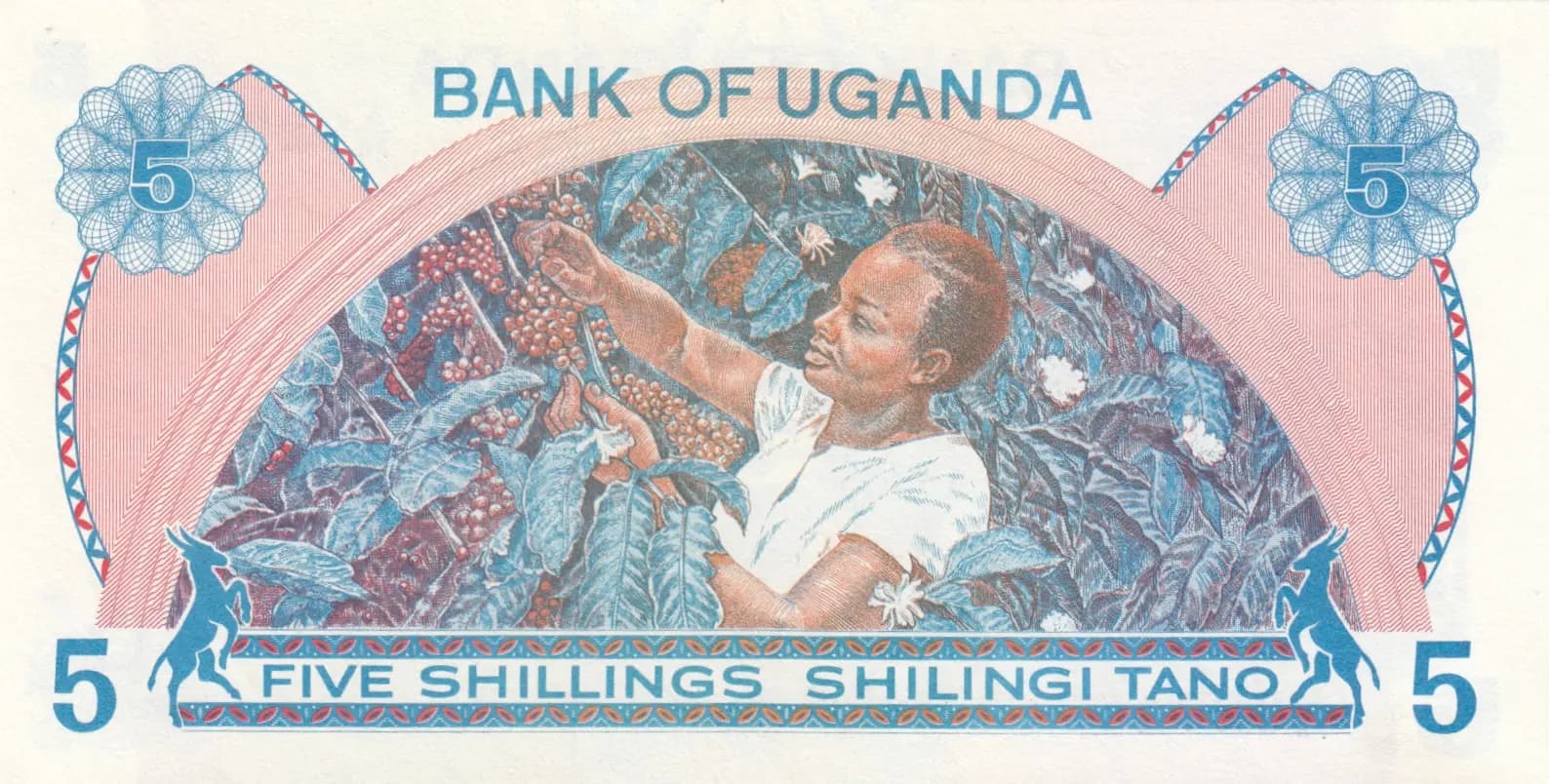
This is a high-grade uncirculated example of the Bank of Uganda's 1979 5 shillings note (Pick P-10), featuring vibrant multicolor printing with a striking blue and pink color scheme. The obverse showcases the Bank of Uganda building in Kampala with ornate decorative rosettes and security guilloché patterns, while the reverse depicts an agricultural scene with a male figure among coffee and other crops, reflecting Uganda's agricultural heritage. The note exhibits sharp, crisp printing with no visible wear, creases, or stains, making it an attractive addition to any East African currency collection.
Common. This is a regular issue 5 shillings note from 1979 with substantial print runs typical for currency denominations of this value. Market data from realbanknotes.com shows consistent eBay sales primarily in the $1–$4 range for uncirculated examples over multiple years (2013–2025), with even professionally graded PMG 65 and 66 examples selling in the $9–$11.50 range. The 2019 catalog value of $1 in UNC condition further confirms this is a common note in the collector market. Such pricing patterns and catalog valuations are characteristic of widely circulated regular issues rather than scarce or rare varieties.
This note was issued in 1979 during a transitional period in Uganda's post-independence monetary history under the Bank of Uganda's governance. The imagery emphasizes national symbols—the prominent Bank of Uganda building representing institutional stability and the agricultural harvest scene celebrating Uganda's primary economic sector, particularly its important coffee industry. The bilingual inscriptions in English and Luganda reflect Uganda's commitment to preserving indigenous languages alongside colonial administrative traditions during this era of nation-building.
The obverse features the Bank of Uganda's main office building in Kampala, a modern multi-story structure with a regular grid window pattern, positioned on the left side of the note. This architectural landmark represents the central bank's institutional authority. The design is dominated by ornate circular rosette patterns with intricate guilloché work in the corners and center, containing large blue oval medallions with radiating geometric patterns. The Uganda coat of arms appears in the bottom right corner, displaying the national shield with geometric patterns and an eagle motif. The reverse depicts a male figure in profile (facing left) wearing a white short-sleeved shirt, positioned among agricultural produce including coffee plants and other crops rendered in blue and reddish tones. Stylized animal figures (possibly antelopes or gazelles) appear in a geometric triangular border pattern at the bottom, emphasizing Uganda's wildlife heritage. The color palette transitions from pink/purple on the left to yellow-green on the right on the obverse, while the reverse features pink/red bands, blue foliage, and brown/cream agricultural elements.
Front side: 'BANK OF UGANDA' (English), 'FIVE SHILLINGS' (English), 'SHILLINGI TANO' (Luganda, meaning 'Five Shillings'), 'LEGAL TENDER FOR FIVE SHILLINGS' (English), 'FOR BANK OF UGANDA' (English), 'GOVERNOR' and 'DIRECTOR' (signature titles in English), Serial number 'A/75 640046' (English), and denomination marker '5' (English). Back side: 'BANK OF UGANDA' (English), 'FIVE SHILLINGS SHILLINGI TANO' (English and Luganda combined), and denomination marker '5' (English).
This note employs intaglio engraving (recess printing) combined with multicolor lithography or offset printing, evident from the fine line work, complex guilloché patterns, microprint-style security elements, and sophisticated color gradient backgrounds. The sharp detail in the architectural rendering, portrait work, and agricultural imagery, combined with the intricate geometric patterns throughout, indicates professional security printing characteristic of Bank of Uganda notes from this period. The color separation and layering visible in the multicolor design suggests advanced offset printing technology combined with classical engraved security elements.
The observed serial number prefix 'A/75' indicates a regular issue note. According to catalog references, this Pick number (P-10) has three recorded variants: P-10 (regular), P-10* (replacement notes with prefixes Z/1, Y/1, X/1, W/1), and P-10s (possibly specimen or special issue). The note examined appears to be the standard P-10 regular issue variety. No overprints or special designations are visible on this example. The signature titles 'GOVERNOR' and 'DIRECTOR' are present as expected for this issue type.