50 escudos 1967
Market Prices
23 salesAbout This Note
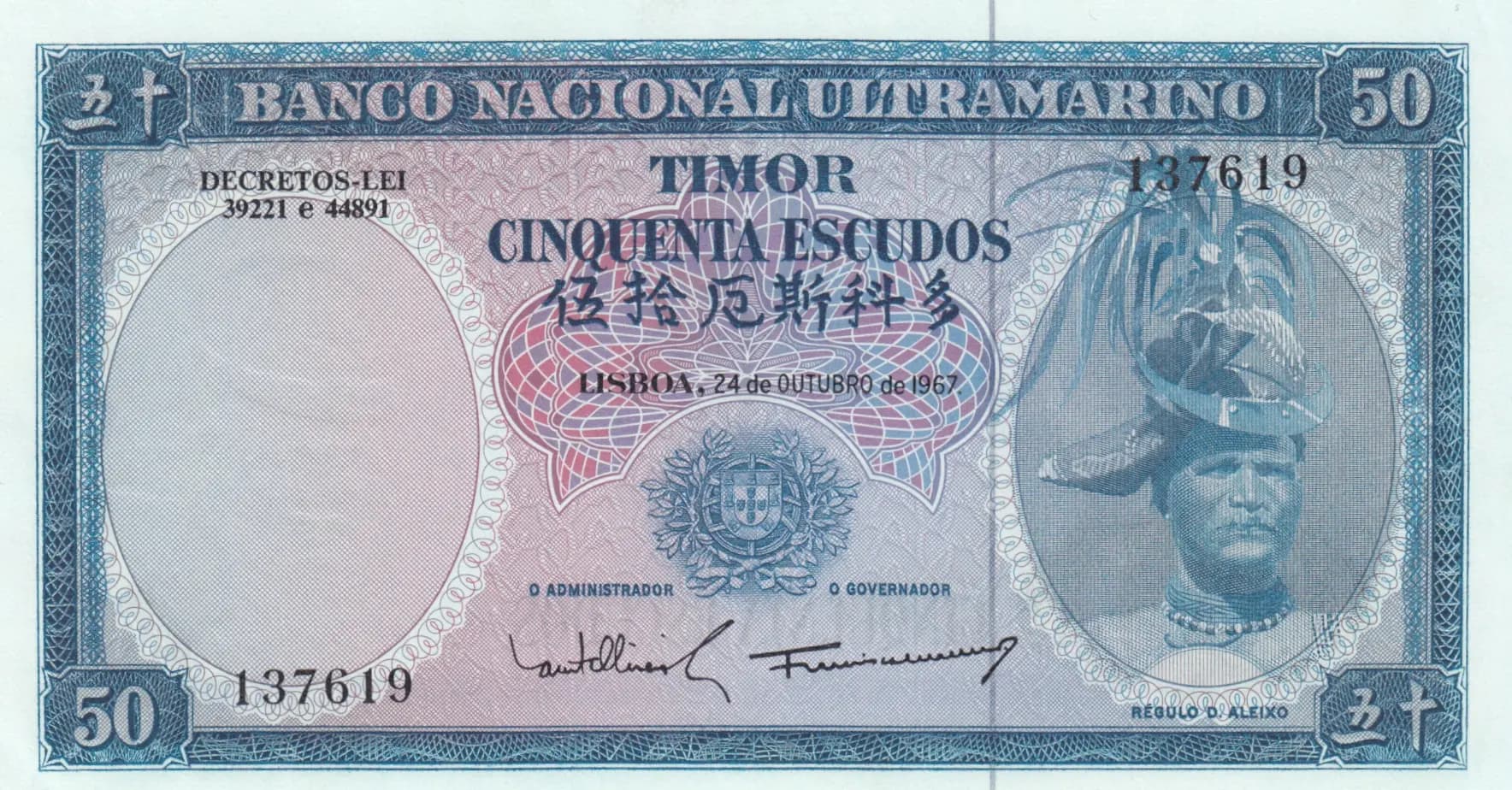
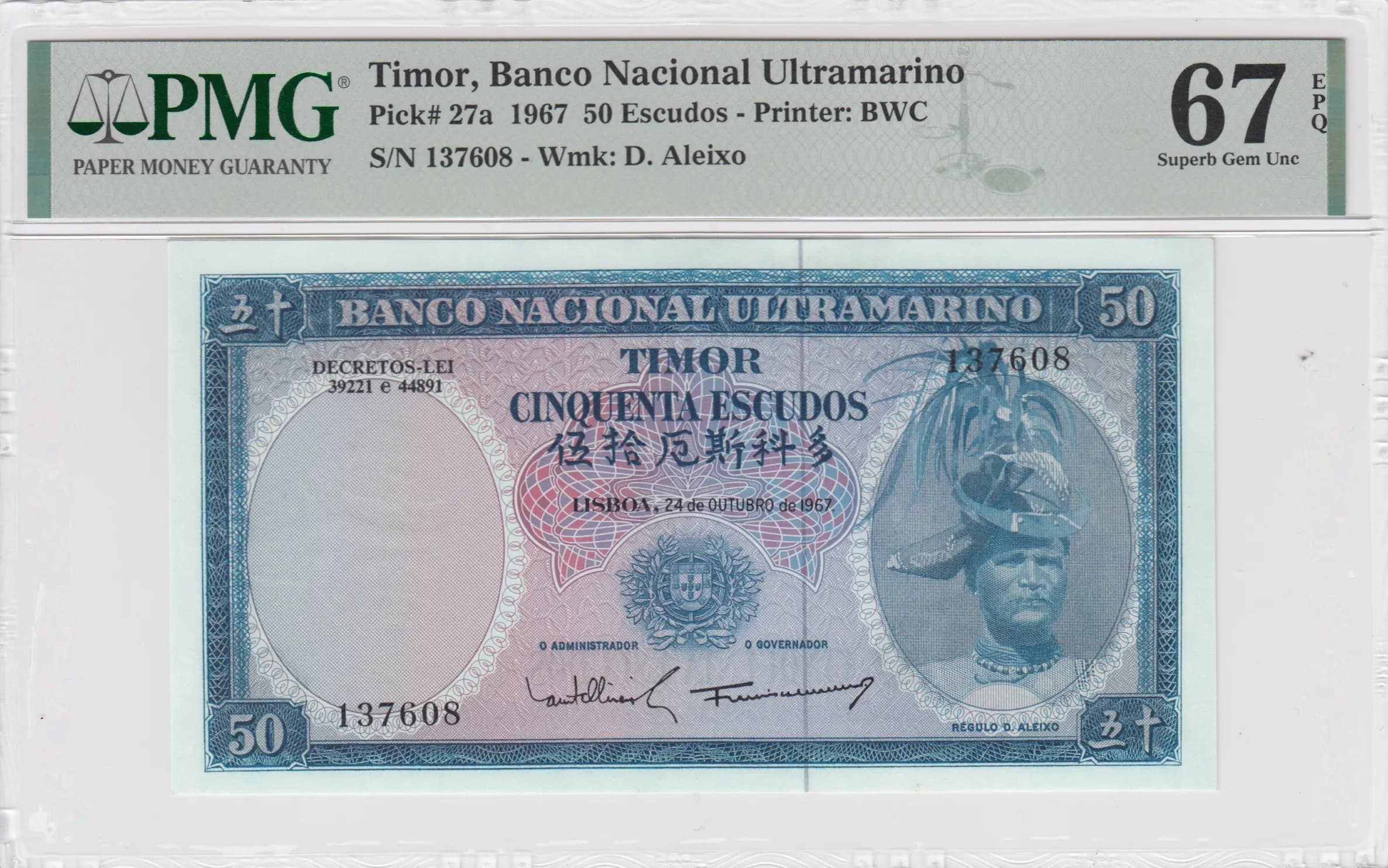
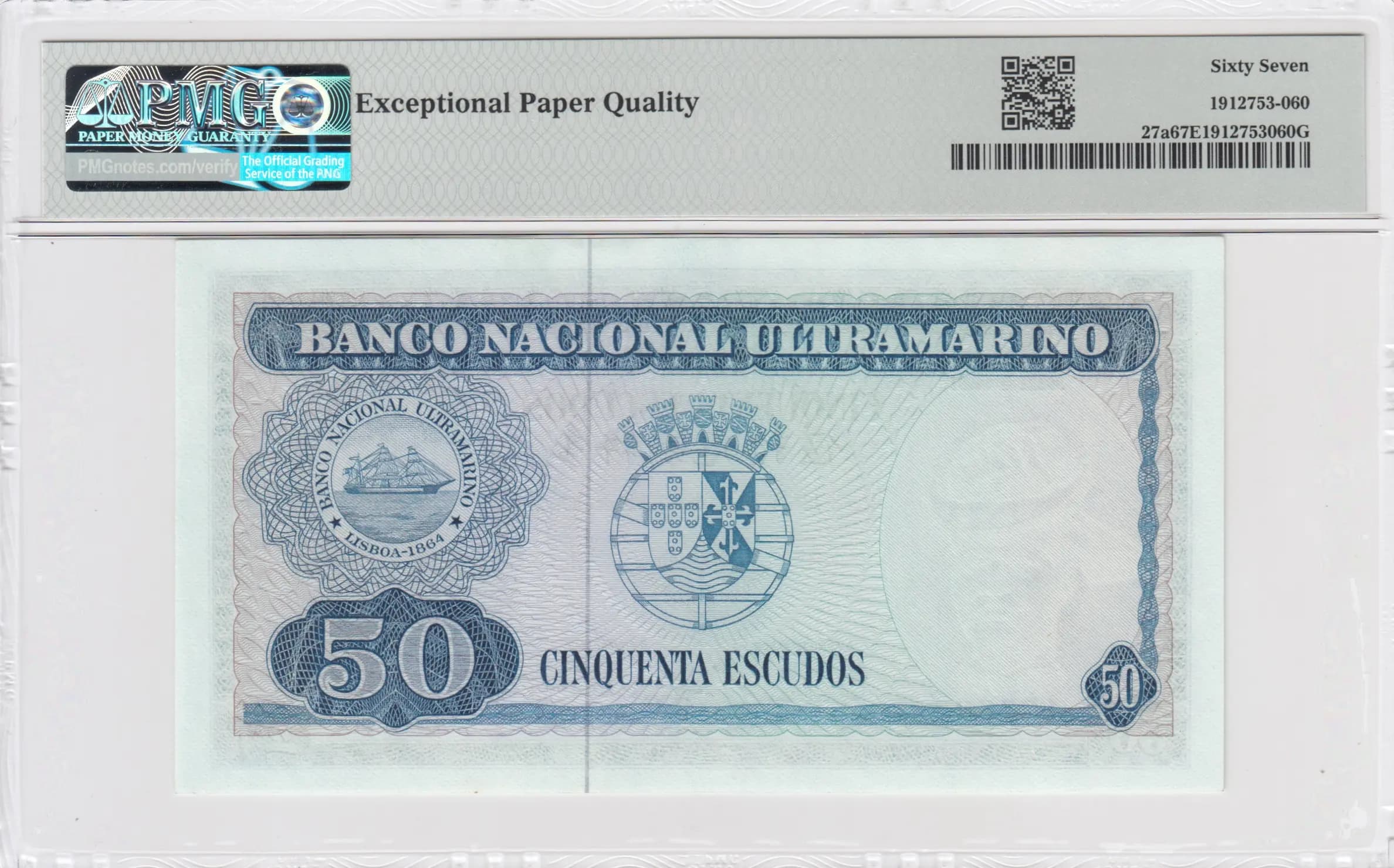
This is a PMG 67 EPQ example of the 1967 Banco Nacional Ultramarino 50 Escudos from Portuguese Timor (Pick-27), featuring an elegant blue and pink color scheme with a striking portrait of R. D. Aleixo in military dress with ceremonial feathered headdress on the obverse. The note exhibits excellent preservation with crisp printing, intricate security engraving throughout, and minimal wear consistent with its near-gem grade. This particular grade represents an especially desirable specimen, with the PMG 66 comparable selling for $89 in 2022, making this PMG 67 a noteworthy acquisition for serious Portuguese colonial currency collectors.
Common. While this is a colonial-era note from a territory that ceased Portuguese rule in 1975, the eBay market data shows consistent availability across multiple grades over the past decade, with examples selling from $2 to $89 depending on condition. PMG 64 examples (lower graded) regularly sold for $20-$43, indicating steady supply at reasonable prices. The absence of any evidence of small print runs, recalls, or extreme scarcity combined with regular market activity confirms this as a commonly encountered note among collectors of Portuguese colonial currency. The PMG 67 grade is notably better than most surviving examples but does not indicate extreme rarity.
Issued on October 24, 1967, during the final decade of Portuguese colonial rule in Timor, this note reflects the Portuguese Estado Novo's continued assertion of control over its overseas territories. The Banco Nacional Ultramarino, established in Lisbon in 1864 (as commemorated on the reverse), served as the central monetary authority for all Portuguese colonies, making this 50 Escudos note a tangible symbol of Portugal's late colonial economic presence in Southeast Asia prior to Timor's independence struggle in 1975. The formal imagery and Portuguese inscriptions underscore the colonial administration's bureaucratic structure and cultural dominance during this transitional historical period.
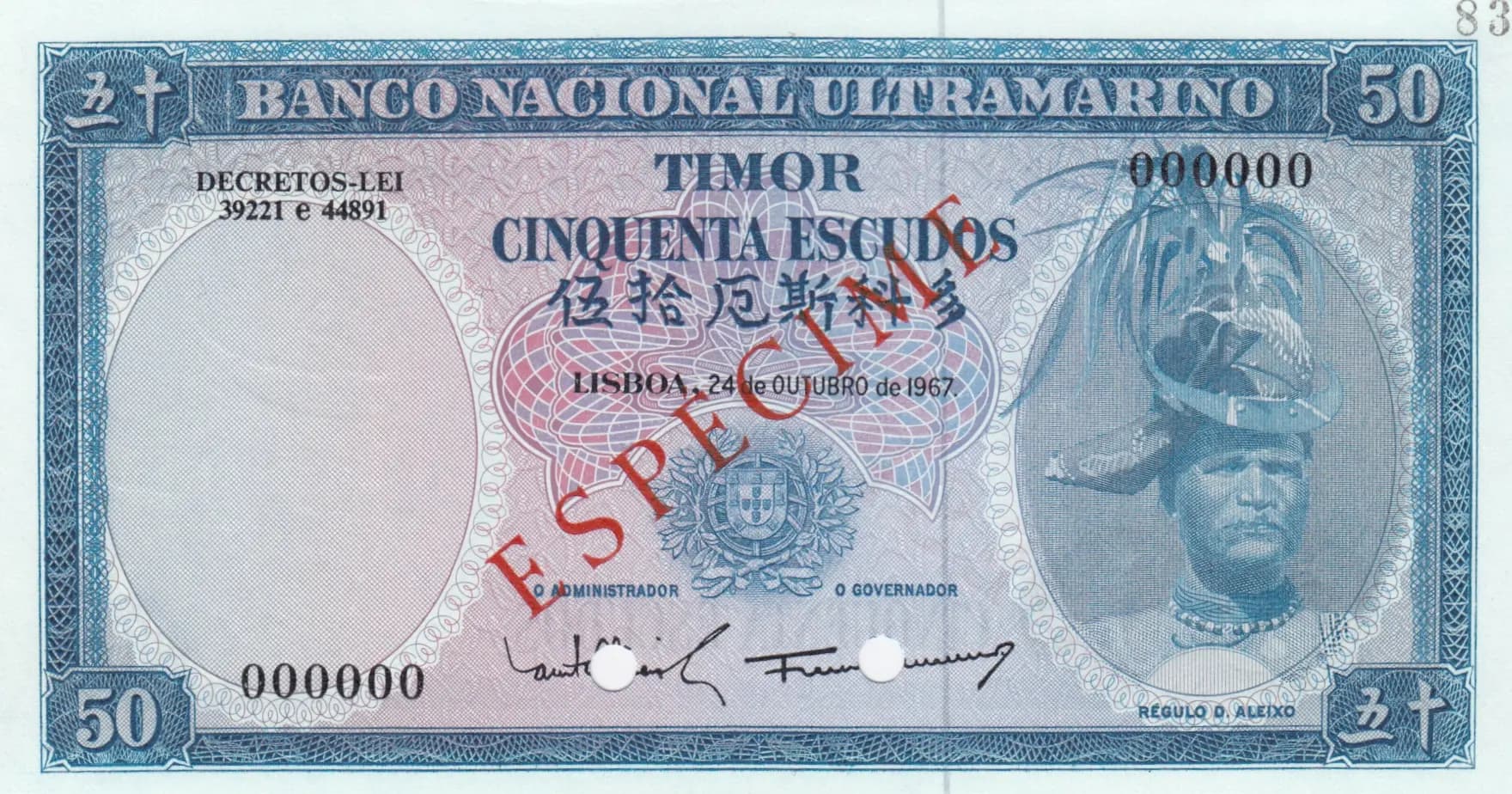
The obverse features a well-composed colonial monetary design with R. D. Aleixo (likely a Portuguese colonial administrator or dignitary) portrayed in profile on the right side, dressed in formal military uniform with an elaborate feathered ceremonial headdress characteristic of Portuguese colonial pageantry. The left side contains an empty oval frame (watermark location), while the center displays an ornate red circular design with grid pattern and the Portuguese coat of arms featuring the characteristic shield with cross and globes. Decorative corner ornaments with floral and geometric patterns frame the composition in intricate detail. The reverse presents a more austere security-focused design in light blue/cyan with two prominent circular medallions: a ship-adorned medallion on the left representing the Banco Nacional Ultramarino with its founding date (1864), and a crowned Portuguese arms medallion at center, with large ornamental denomination numerals positioned in the corners.
FRONT SIDE: 'BANCO NACIONAL ULTRAMARINO' (National Overseas Bank) / 'TIMOR' / '50' and 'CINQUENTA ESCUDOS' (Fifty Escudos) / 'DECRETOS-LEI 39221 e 44891' (Decree-Laws 39221 and 44891) / 'LISBOA, 24 de OUTUBRO de 1967' (Lisbon, October 24, 1967) / 'O ADMINISTRADOR' (The Administrator) / 'O GOVERNADOR' (The Governor) / 'NEGÓLIO. D. ALEIXO' (By D. Aleixo—referring to the portrayed figure) / Serial number '137608'. BACK SIDE: 'BANCO NACIONAL ULTRAMARINO' (National Overseas Bank) / '50' and 'CINQUENTA ESCUDOS' (Fifty Escudos) / 'LISBOA-1864' (Lisbon-1864, commemorating the bank's founding).
Intaglio engraving (line engraving/steel engraving) executed by British American Bank Note Company (BWC), as evidenced by the detailed guilloche patterns, fine micro-line security work, and the characteristic crisp impression visible throughout both sides. The multiple color application and gradient effects from blue to lighter tones indicate sophisticated multi-plate intaglio printing, a standard security printing method for major international banknote producers of the 1960s. The intricate border work, security line patterns, and fine detail preservation in the observed PMG 67 specimen demonstrate the high quality of BWC's colonial currency production.
This specimen appears to be Pick-27a (standard variety with BWC printer mark), the most common variant. The PMG Population Report indicates three catalogued variants exist for this base Pick number (P-27a, P-27cts, and P-27s), all produced by BWC. The observed serial number 137608 places this within the standard production range. No counterstamp, overprint, or signature variation is evident that would indicate the scarcer P-27cts or P-27s varieties. The October 24, 1967 issue date and standard layout confirm classification as the regular issue P-27a.