5 kronor 1943
About This Note
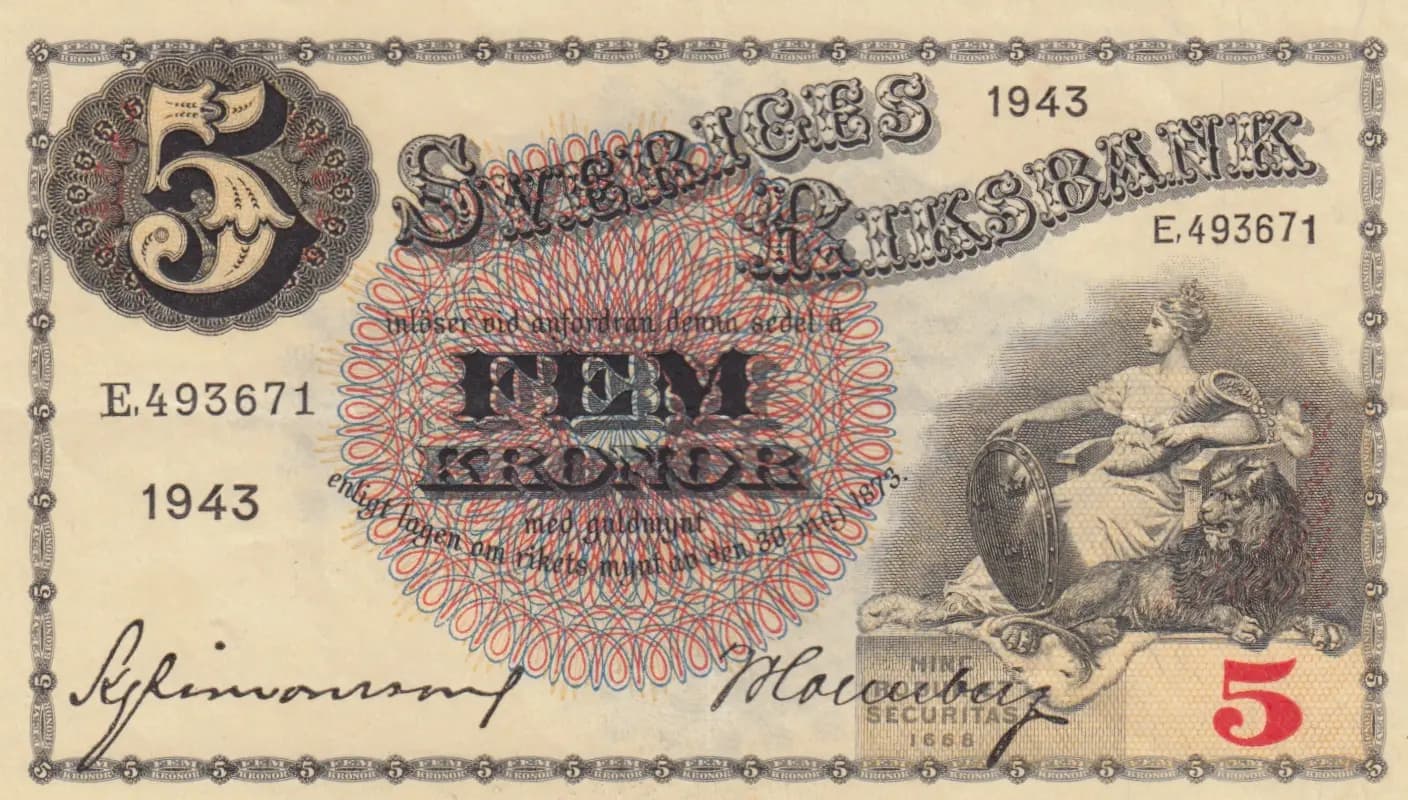
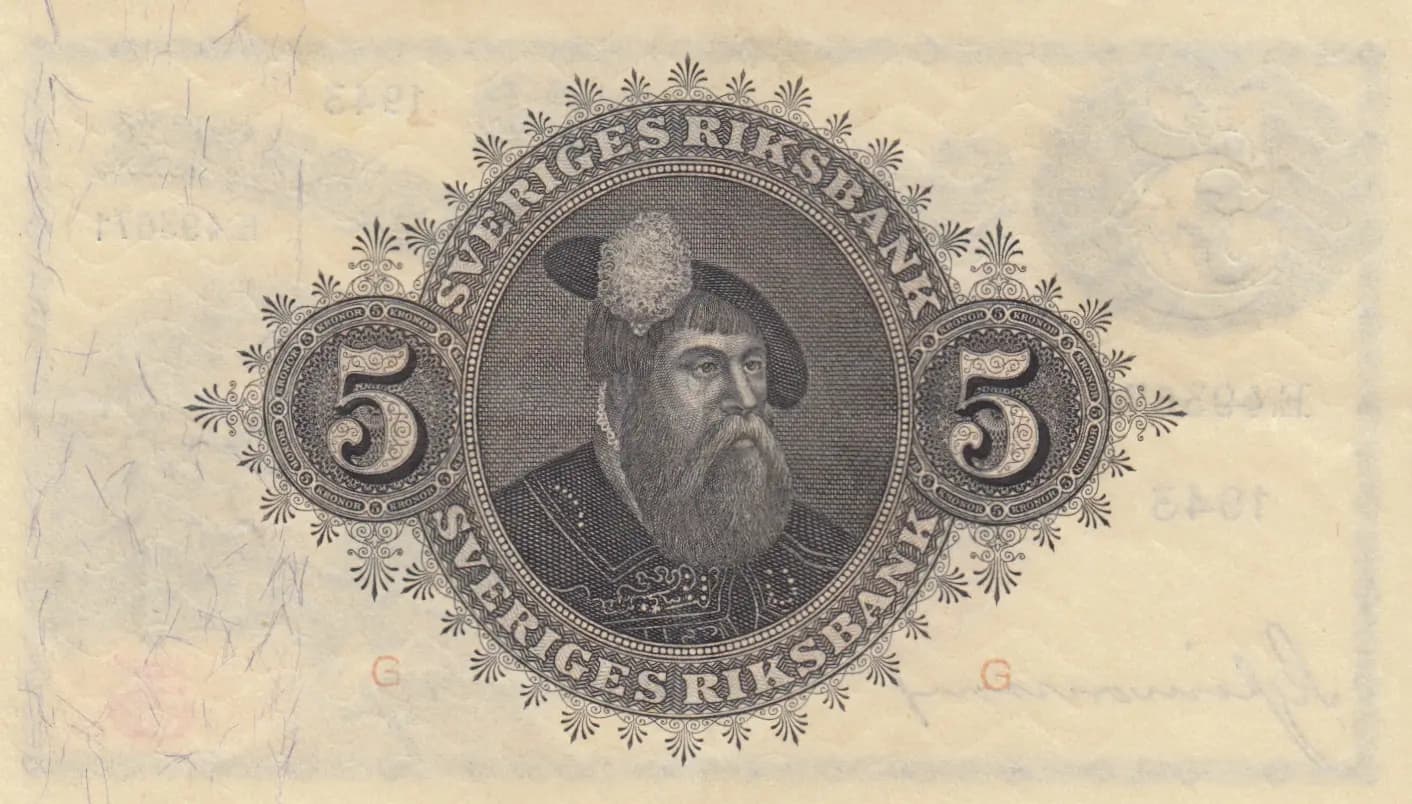
A Swedish 5 kronor banknote from 1943 issued by Sveriges Riksbank, featuring the allegorical female figure Svea on the front and King Gustav Vasa in profile on the reverse. The note displays characteristic early 20th-century intaglio engraving with elaborate ornamental borders and security rosette patterns in red and black. In UNC condition as cataloged, though the visual analysis suggests moderate circulation wear with visible creases and foxing, indicating this assessment may reflect a high-grade circulated rather than uncirculated example.
Common. The 5 kronor denomination from the 1918-1952 series was produced in substantial quantities throughout its issue period. While the specific 1943 date and serial number combination is unique to individual notes, there is no evidence of limited print runs, recalls, or scarcity for Pick-33z(3). The note remains widely available in the collector market, with typical examples trading at modest prices reflecting their common status.
Issued during World War II when Sweden maintained official neutrality, this note reflects the classical artistic traditions of Sveriges Riksbank's currency design from the 1918-1952 series. The depiction of Svea (the allegorical personification of Sweden) with her lion companion on the front and the historical figure of King Gustav Vasa (founder of the Vasa dynasty and first elected king of Sweden, r. 1523-1560) on the reverse emphasize national identity and continuity during a turbulent European period.
The front features Svea, the female allegorical personification of Sweden, depicted in classical engraved style seated with her characteristic lion companion and holding a shield or circular emblem symbolizing national sovereignty. She is surrounded by an elaborate ornamental rosette pattern in red and black at the center, flanked by decorative numeral cartouches displaying '5' on the left. The reverse displays a bearded male portrait in profile within an ornate oval medallion—identified as King Gustav Vasa, the 16th-century founder of the Swedish Vasa dynasty. The portrait is surrounded by radiating floral and geometric decorative patterns in the finest classical engraving tradition. Both sides feature elaborate repeating border ornaments and symmetrical design elements characteristic of high-security currency of the era.
Front side: 'SVERIGE' (Sweden), 'RIKSBANK' (Central Bank), denomination '5' (Five kronor), year '1943', serial number 'E.493671' (printed twice). Back side: 'SVERIGES RIKSBANK' (Sweden's Central Bank), denomination '5' (Five kronor), printer's mark 'G'. All text in Swedish, rendered in ornate classical lettering typical of the period.
Intaglio engraving (line engraving), the primary method for Swedish currency of this period. The fine line work visible throughout both sides, the detailed portrait rendering, the elaborate decorative patterns, and the rosette security feature are all characteristic of intaglio engraving. The red and black color separation on the front indicates multi-plate printing. Sveriges Riksbank contracted with major European security printers for this series; the 'G' mark on the reverse may indicate the specific printer, though definitively identifying the security printer from this mark alone requires specialized Swedish banknote printer records.
This example is cataloged as Pick-33z(3), indicating it is a specific variety within the 1943 5 kronor issue. The serial number prefix 'E' with the number 493671, combined with the year 1943 and the presence of two signatures at the bottom of the front, identifies this as part of the standard circulation variety from that year. The 'G' printer's mark on the reverse may indicate a specific printing. Without access to detailed Swedish Riksbank records distinguishing z(1), z(2), and z(3) varieties, the specific distinguishing characteristics of the z(3) variety cannot be definitively stated from visual analysis alone, but likely relate to printer, signature combination, or minor design variations common to this series.