2 1/2 gulden 1961
Market Prices
2 salesAbout This Note
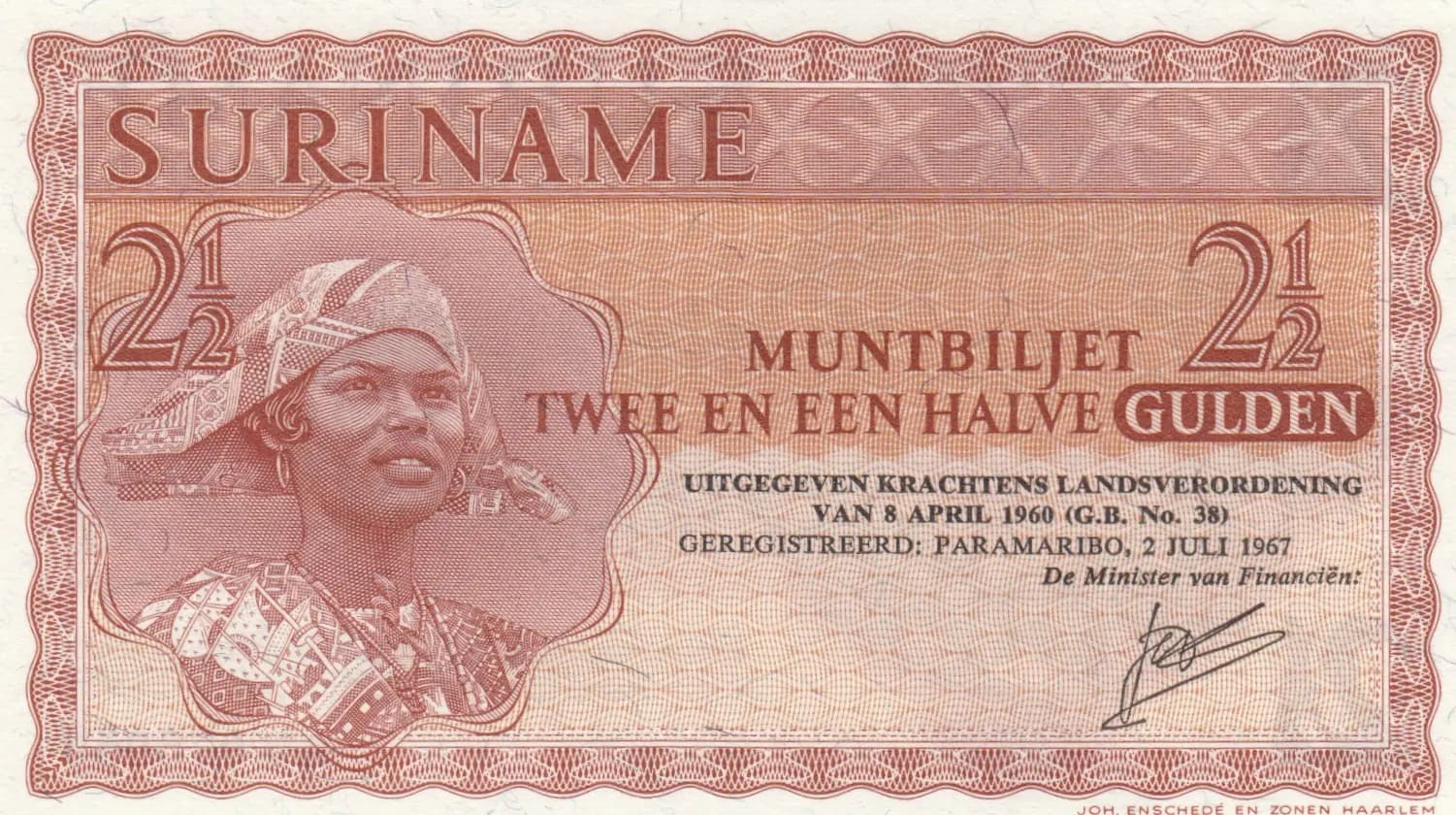
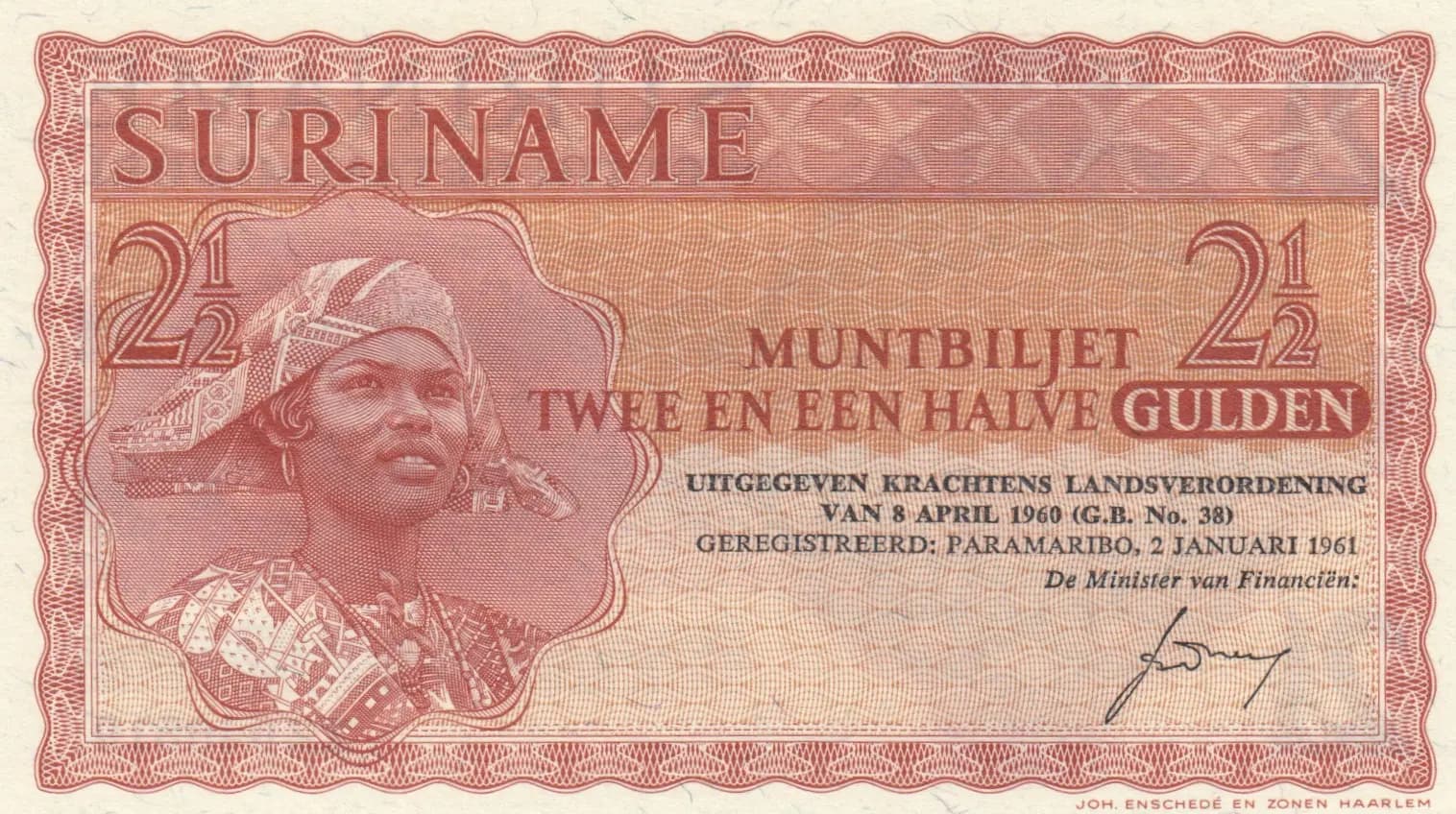
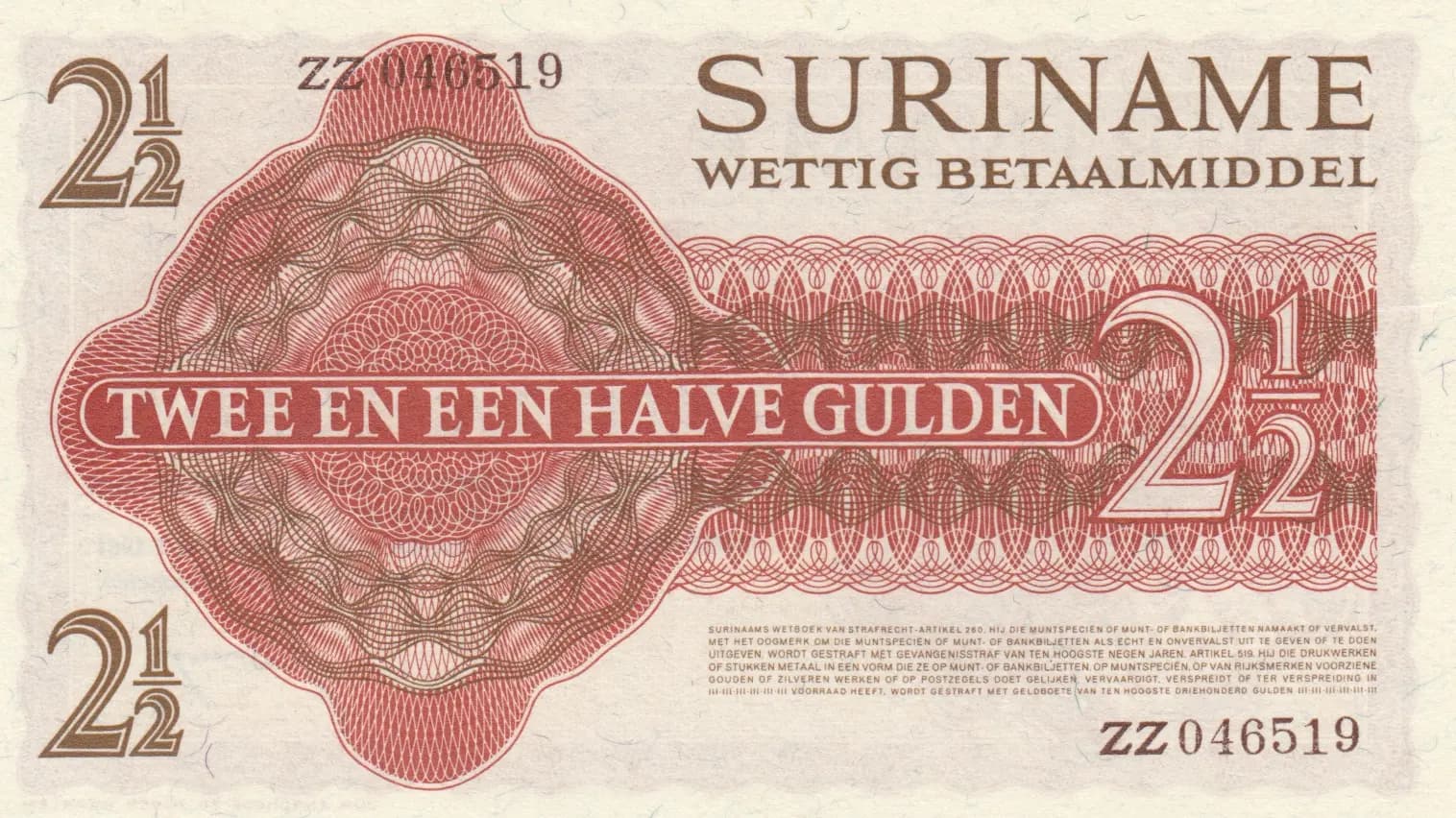
This 1961 Surinamese 2½ Gulden note (Pick P-117a) presents in UNC condition with crisp, well-preserved printing throughout. The obverse features a striking portrait of a man in military uniform with decorative headwrap, rendered in red and rose tones with intricate engraved detailing and an ornate wavy border. The reverse displays an elaborate geometric rosette medallion centered on the note, maintaining the same color palette and fine line work characteristic of Johan Enschedé's production. This is a straightforward, commonly available early post-independence Surinamese currency note with excellent eye appeal.
Common. The eBay price data shows an AUNC example selling for $34.99 and an F grade example for $7.50 in 2016, with catalogue values of $12.50 for UNC (2019 data). Notes with modest catalogue values and regular market appearances are clearly common-date issues. The print run for this 1961 Surinamese denomination was not recalled or limited. There is no evidence of scarcity for Pick P-117a in the standard catalog.
Issued under State Ordinance of April 8, 1960, and registered in Paramaribo on January 2, 1961, this note was part of Suriname's early monetary independence period following the establishment of the Muntbiljet (state currency note) system. The military-uniformed portrait likely represents a significant political or military figure from Suriname's mid-20th century governance. The note's formal Dutch inscriptions and production by the prestigious Dutch printer Johan Enschedé reflect the close economic and institutional ties between Suriname and the Netherlands during this transitional post-colonial era.
The obverse features a dignified portrait of an unidentified male figure in formal military dress with decorative insignia and a wrapped headwrap or military helmet, depicted in profile facing left. The subject is framed by an ornate scalloped border design with fine engraved patterns. Large denomination numerals '2½' flank both sides of the note in a serif typeface. Official governmental text, issuing authority information, and the signature of the Minister of Finance occupy the center-right area. The reverse abandons portraiture in favor of a dominant ornamental rosette or circular medallion featuring complex geometric and floral patterns arranged in concentric circles—a classic security and aesthetic feature of mid-20th century banknote design. The entire note employs a warm palette of red, rose, and cream with brown accents, created through fine line engraving visible throughout both sides. The serial number 'ZZ046519' appears in the lower right of the reverse.
FRONT: 'SURINAME' (Suriname); '2½' (Two and one-half); 'MUNTBILJET' (Currency Note); 'TWEE EN EEN HALVE GULDEN' (Two and One-Half Guilders); 'UITGEGEVEN KRACHTENS LANDSVERORDENING VAN 8 APRIL 1960 (G.B. No. 38)' (Issued under State Ordinance of April 8, 1960, Government Bulletin No. 38); 'GEREGISTREERD: PARAMARIBO, 2 JANUARI 1961' (Registered: Paramaribo, January 2, 1961); 'De Minister van Financiën:' (The Minister of Finance:); 'JOH. ENSCHEDÉ EN ZONEN HAARLEM' (Joh. Enschedé and Sons, Haarlem). BACK: '2½' (Two and one-half); 'SURINAME' (Suriname); 'WETTIG BETAALMIDDEL' (Legal Tender); 'TWEE EN EEN HALVE GULDEN' (Two and One-Half Guilders); Serial number 'ZZ046519'; 'SURINAAM'S WETBOEK VAN STRAFRECHT ARTIKEL 260' and 'ARTIKEL 519' (Suriname's Criminal Code Articles 260 and 519 regarding counterfeiting penalties and unauthorized reproduction of currency, with specified imprisonment terms and fines).
Intaglio engraving (copperplate/steel plate printing), executed by Johan Enschedé en Zonen (Joh. Enschedé and Sons) of Haarlem, Netherlands—one of Europe's most prestigious security printers and known for their mastery of fine line engraving. The visual characteristics observed (intricate background patterns, precise fine line work, detailed portrait rendering, and the complex geometric rosette) are all hallmarks of traditional intaglio production. This technique provided both security through complexity and aesthetic quality valued in currency of the era.
Pick catalog identifies P-117a as the base variety (printed by Johan Enschedé) with at least one known variant, P-117b, and a starred variety P-117b* (printed by JEZ). The observed note's serial number prefix 'ZZ' and printer attribution to 'JOH. ENSCHEDÉ EN ZONEN HAARLEM' confirm this as the P-117a variety. No overprints, date variations, or other distinguishing marks are visible on this example. The date '2 JANUARI 1961' (January 2, 1961) registration mark is consistent with the 1961 issue date for P-117a.