10 cents 1919
About This Note
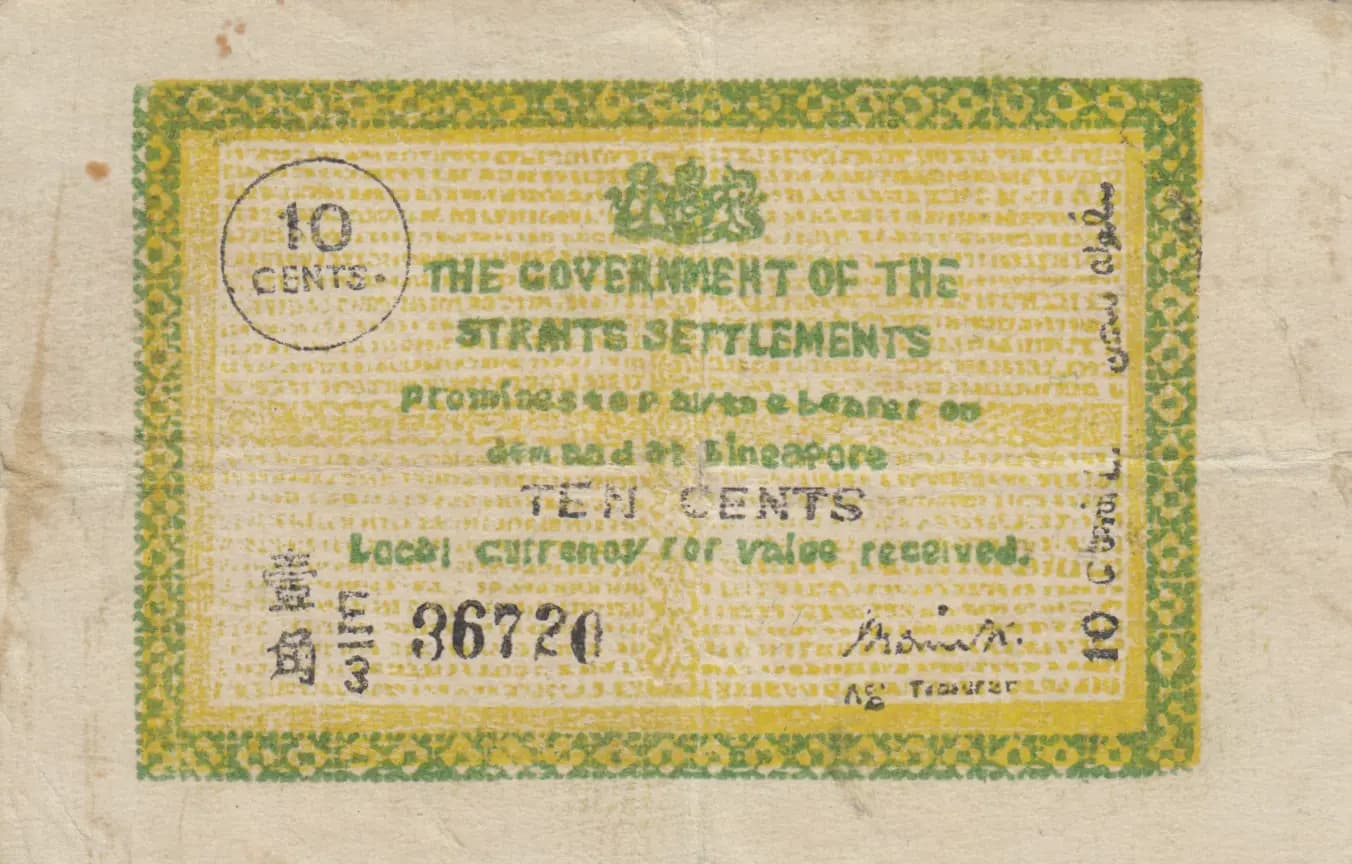
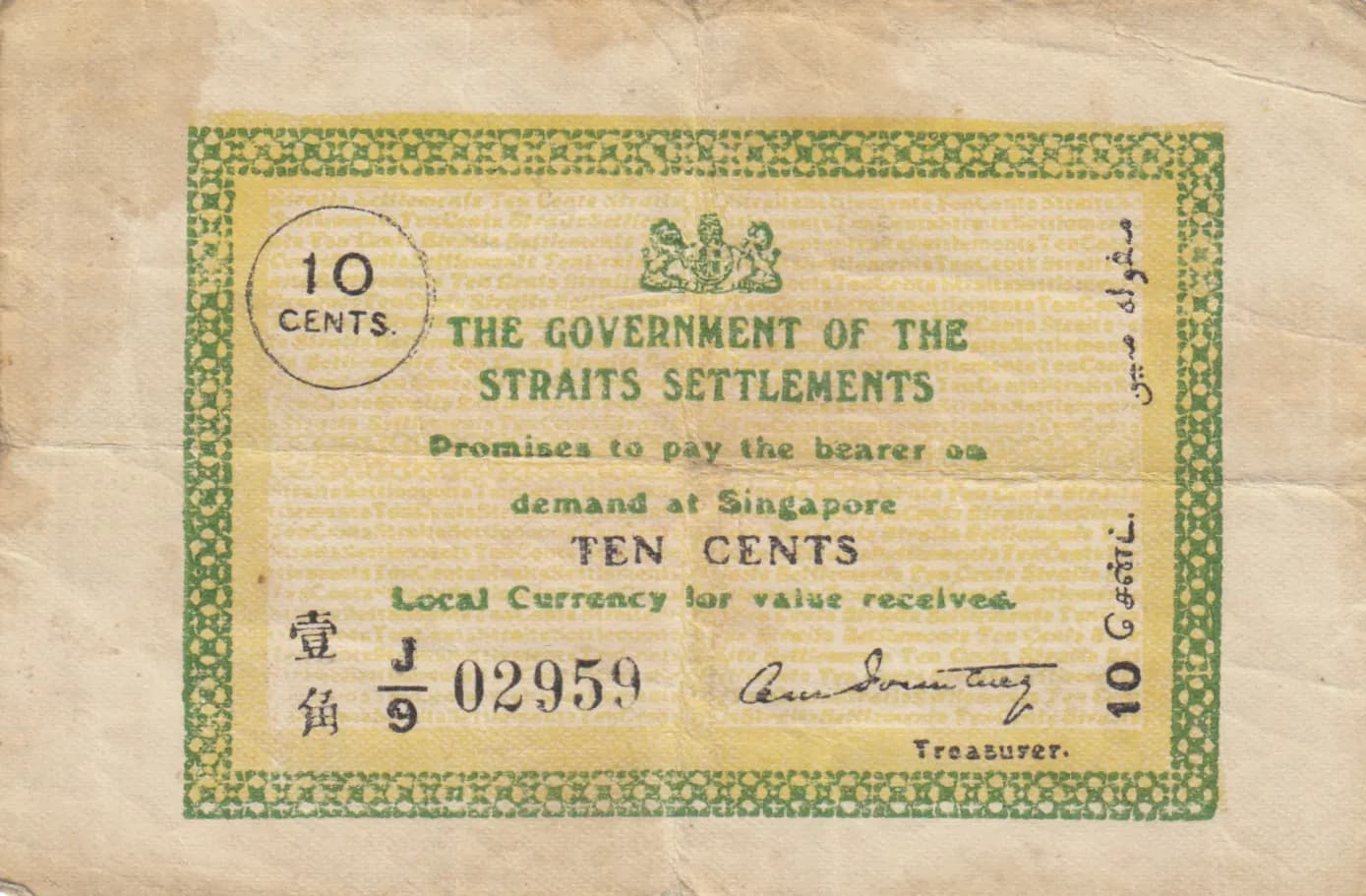
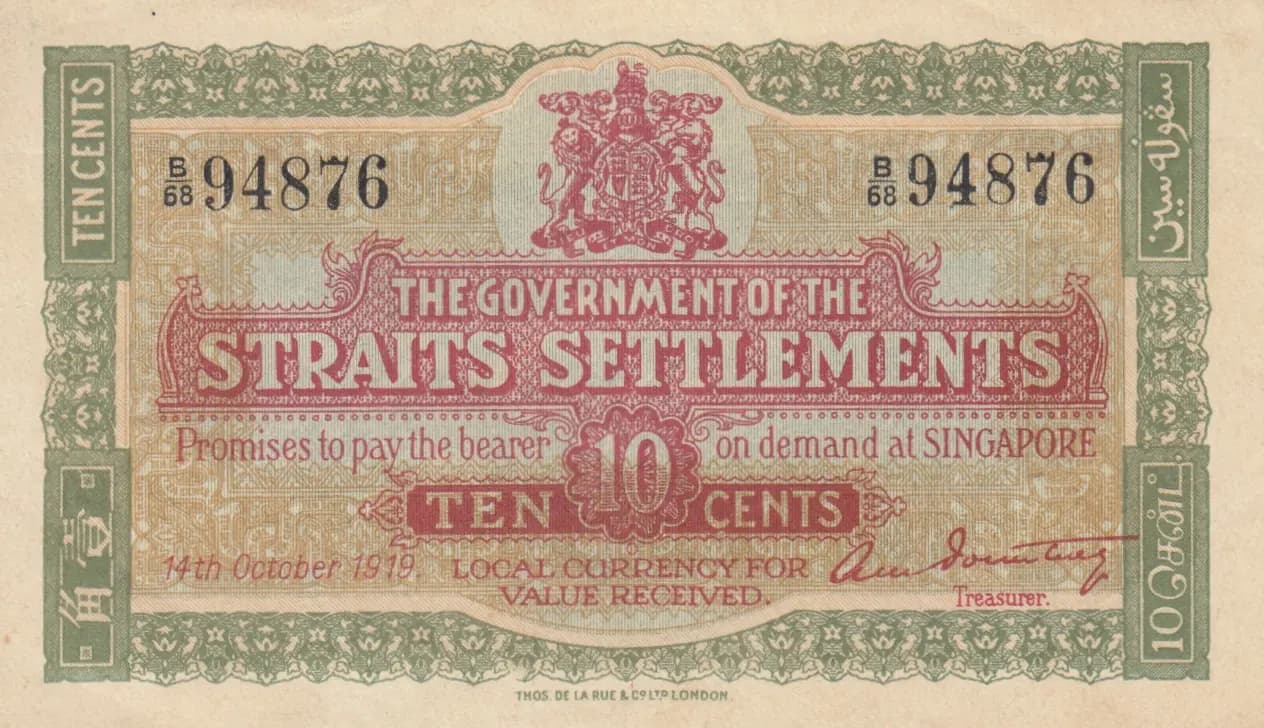
This is a VF-graded 10 Cents note from the Government of the Straits Settlements dated 14th October 1919, representing an important early 20th-century colonial currency issue. The note displays the characteristic two-color printing (green and red/crimson) typical of the period, with an ornate coat of arms, elaborate decorative borders, and the iconic dragon motif on the reverse. Despite showing appropriate aging with cream-toned paper and some foxing consistent with a century-old note, the design elements remain crisp and the serial number B 68 948876 is clearly legible, making this an attractive example for colonial currency collectors.
Common. The Straits Settlements government issued these 10 Cents notes in significant quantities during 1919 and subsequent years to meet regular currency demand across the colonies. No historical evidence suggests limited print runs, recall, or short-lived issuance. The Pick catalog lists multiple variants (P-8a, P-8app1, P-8b, P-8bs), indicating substantial surviving populations. VF-graded examples of this denomination appear regularly in the market, and these notes typically command modest valuations consistent with common colonial-era minor denominations.
Issued during the twilight years of World War I, this note reflects the Straits Settlements' status as a major British colonial trading hub. The coat of arms featuring heraldic lions and crown emphasizes British sovereignty, while the multilingual text—including Tamil, Chinese, and Arabic scripts alongside English—demonstrates the cosmopolitan, multicultural character of Singapore and the region's diverse merchant communities. The promise to pay 'on demand at SINGAPORE' underscores the colony's role as the financial center of the Straits Settlements.
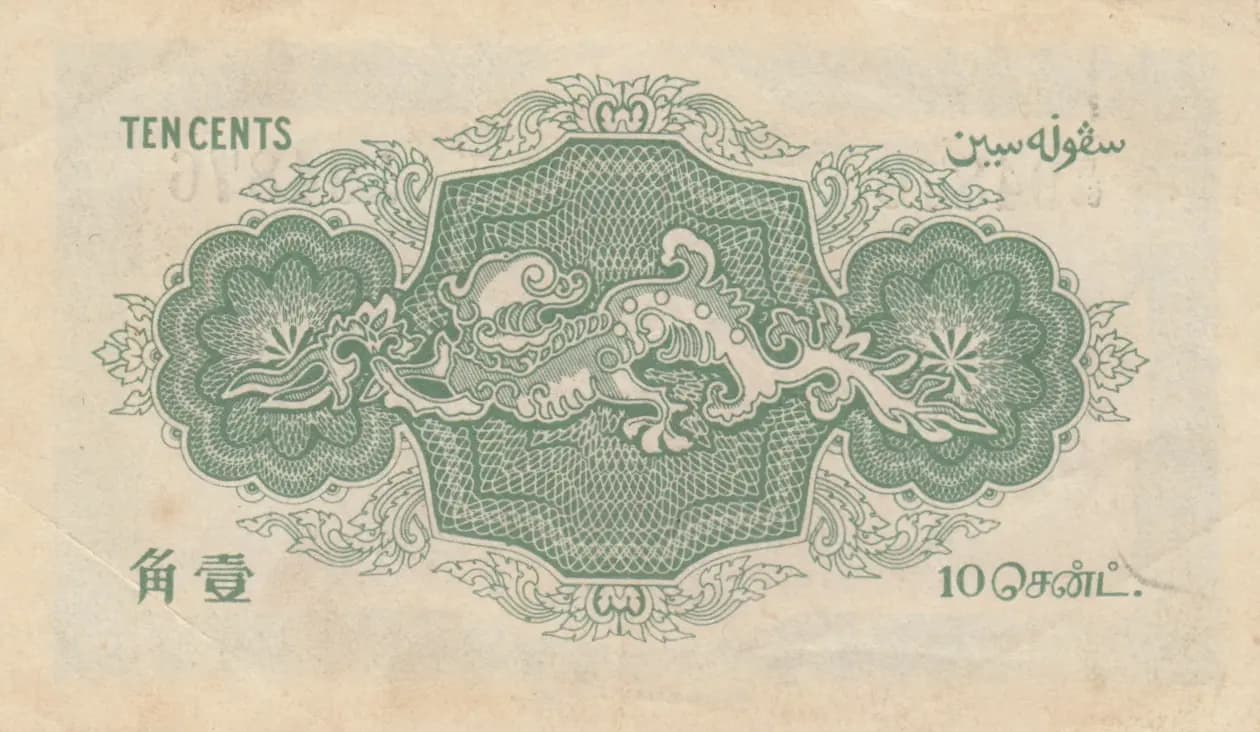
The front features the Coat of Arms of the Straits Settlements prominently centered at the top, composed of ornate heraldic lions and a crown, representing British imperial authority. The denomination 'TEN CENTS' appears in a decorative cartouche in the center in red/crimson ink. Elaborate green decorative borders with floral and geometric patterns frame both sides of the note, while the text block includes the government promise and treasury authentication. The reverse displays a striking dragon or mythical creature motif enclosed within an ornate decorative cartouche in green ink, surrounded by intricate scrollwork and floral designs. The multilingual inscription (English, Tamil, Chinese, and Arabic/Urdu) on the reverse reflects the diverse populations served by this currency in the straits colonies.
FRONT: 'THE GOVERNMENT OF THE STRAITS SETTLEMENTS' / 'TEN CENTS' / 'Promises to pay the bearer on demand at SINGAPORE' / 'LOCAL CURRENCY FOR VALUE RECEIVED' / '14th October 1919' / 'Treasurer' / Serial number: 'B 68 948876' (left and right) / Printer: 'THOS. DE LA RUE & CO LTD LONDON'. BACK: 'TEN CENTS' (English) / 'சுலோசின' (Tamil, 'ten cents') / '角壹' (Chinese characters, 'ten cents') / 'ڈکنٹ' (Arabic/Urdu script, 'cents') / '10' (Arabic numerals).
Intaglio engraving, executed by Thomas De La Rue & Co Ltd of London, one of the world's premier security printers. The fine line work, intricate decorative borders, complex ornamental patterns, and detailed dragon engraving are characteristic of intaglio printing. The two-color printing (green and red/crimson) was applied through separate passes, typical of high-security banknote production in this era.
This note is identified as Pick P-8b, printed by Thomas De La Rue & Co Ltd (TDLR). The PMG population data indicates this is one of four cataloged variants for the 10 Cents denomination from this issue. The serial number prefix 'B 68' and the specific serial number 948876 may help distinguish this particular example within the P-8b variety classification, though without access to full PMG records, specific variety differentiation among P-8a, P-8app1, P-8b, and P-8bs requires comparison of additional specimens.