1 kopeika 1961
About This Note
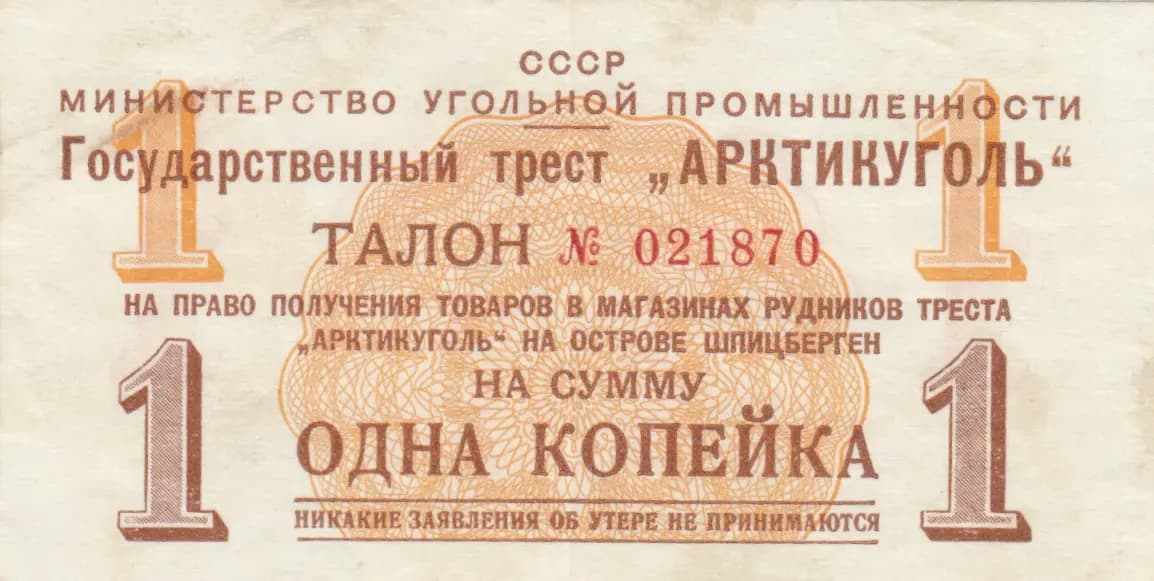
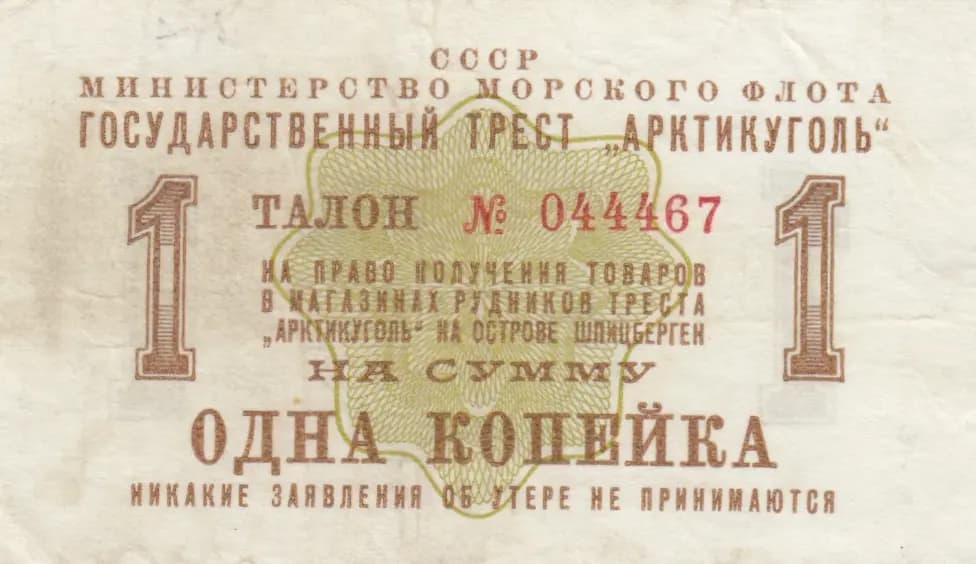
This 1961 Soviet mining company scrip note represents a fascinating artifact of Cold War-era Arctic industrial policy. The 1 kopeika coupon was issued by the State Trust 'Arcticcoal' for use in company stores on Spitsbergen, serving as payment proxy for workers in the remote Soviet coal mining operation. In VF condition, the note displays crisp ornamental design work on both sides with age-appropriate wear—creasing and foxing consistent with six decades of handling—while maintaining excellent legibility of its Russian Cyrillic inscriptions and intricate central medallion work.
Common. This coupon represents routine industrial scrip issued in potentially substantial quantities for an active mining operation. The serial number (044467) suggests a large continuous numbering sequence, indicating significant print runs. Spitsbergen mining coupons occasionally appear in specialized collections of Soviet ephemera and industrial scrip, but they were working documents with no collector value during their era, resulting in survival of multiple examples. No evidence of scarcity, limited issues, or special collector premiums exists for this denomination or issuer.
This coupon documents Soviet economic activity in the strategic Arctic territory of Spitsbergen during the early Cold War period. The note's attribution to the Ministry of Maritime Fleet and 'Arcticcoal' Trust reflects the Soviet Union's emphasis on resource extraction and Arctic development as geopolitical priorities. The 1961 date falls within the height of Soviet Arctic expansion, when maintaining a substantial presence on Spitsbergen through subsidized mining operations was considered essential to Soviet sovereignty claims in the region.
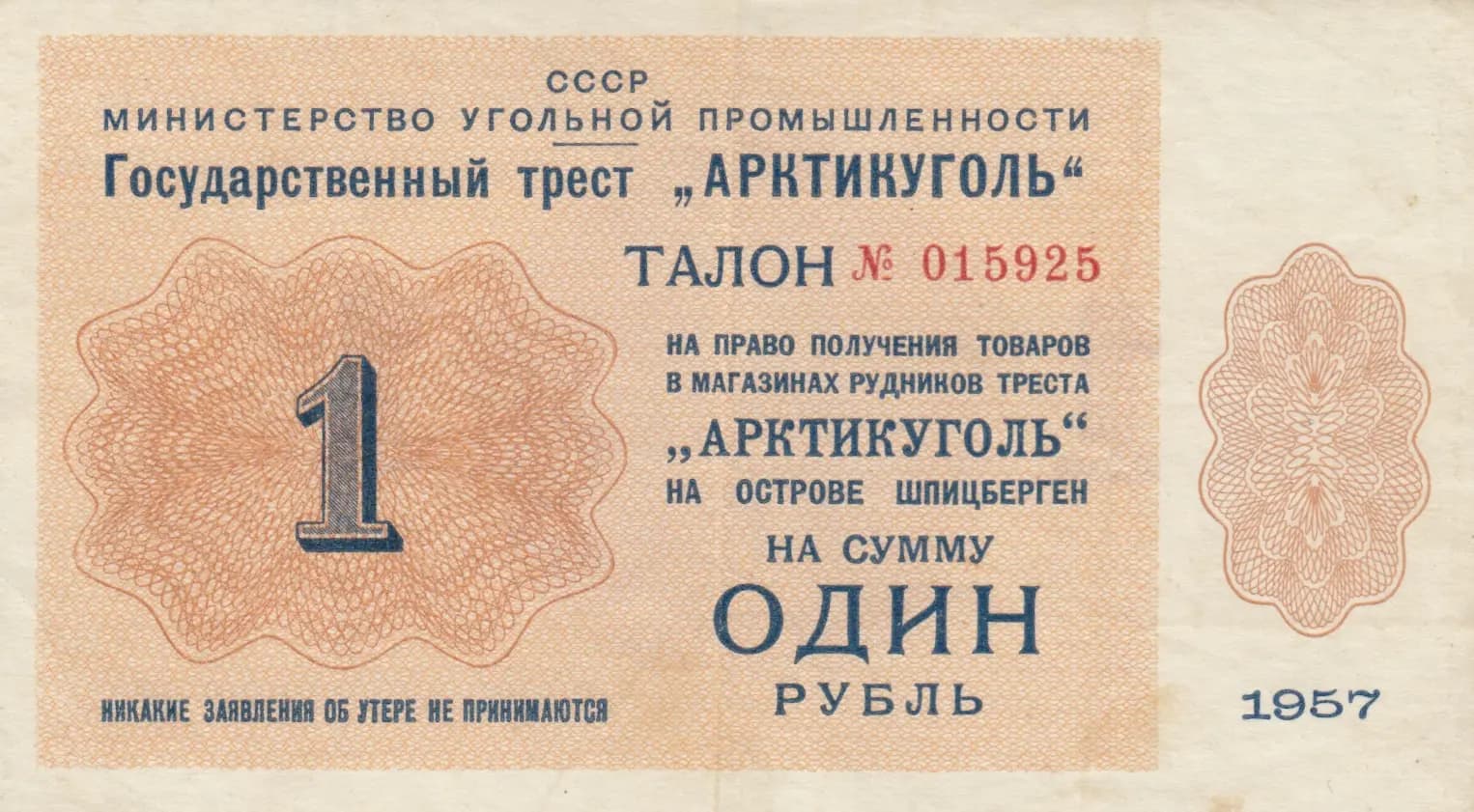
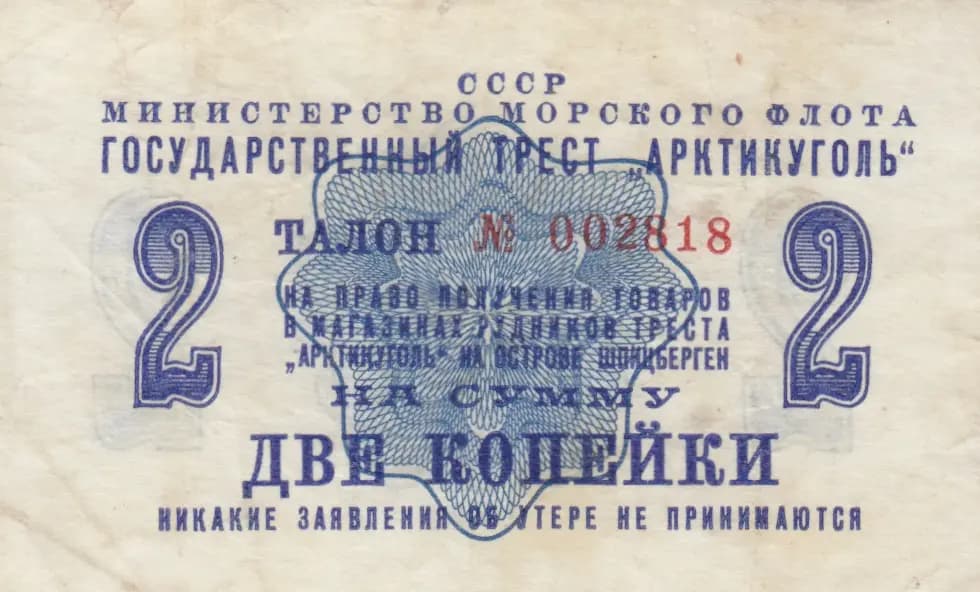
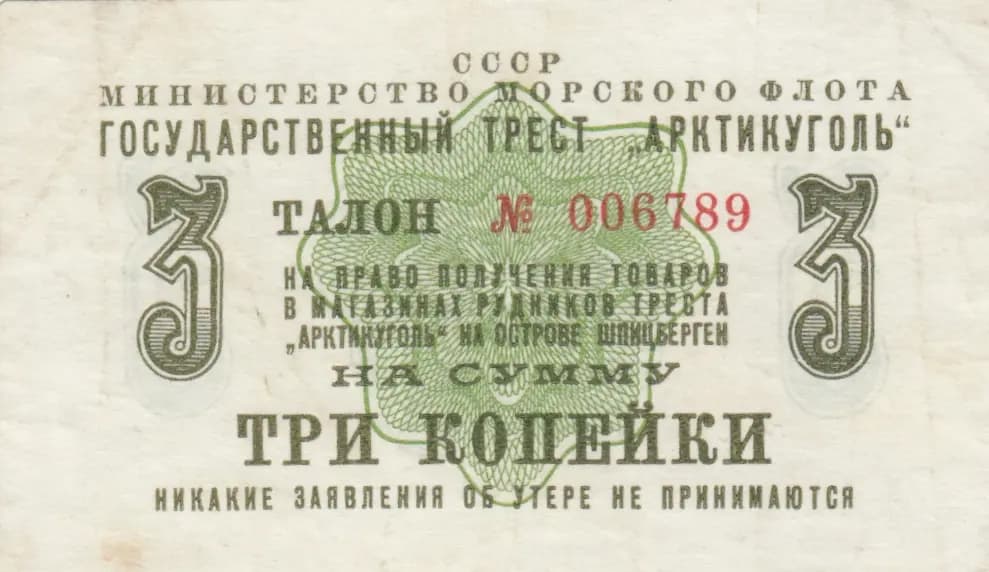
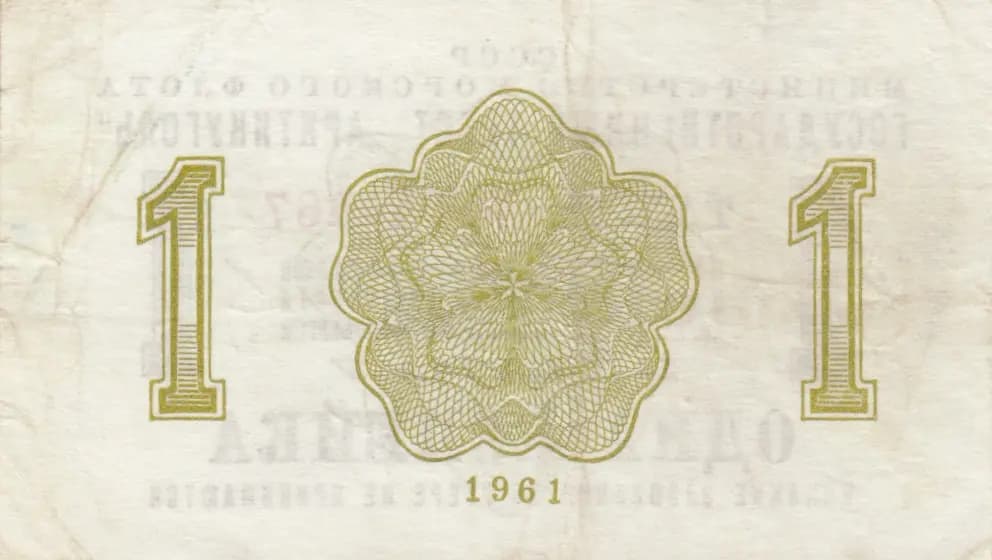
This industrial scrip coupon features a symmetrical design dominated by large denomination numerals '1' flanking both the obverse and reverse. The central focal point is an ornate oval-framed medallion containing an intricate geometric star or flower-shaped rosette pattern composed of fine crosshatched lines—a classic security feature of Soviet-era printing. The front (obverse) employs a brown/tan color scheme and presents administrative text describing the coupon's purpose as purchasing power for mine workers. The reverse uses a yellow-green/olive palette and displays the year 1961 with an emphasized geometric medallion design. The fine line engraving throughout creates subtle anti-counterfeiting complexity typical of Soviet security printing for even modest-value coupons.
FRONT SIDE: USSR (СССР) | Ministry of Maritime Fleet (МИНИСТЕРСТВО МОРСКОГО ФЛОТА) | State Trust 'Arcticcoal' (ГОСУДАРСТВЕННЫЙ ТРЕСT «АРКТИКУГОЛЬ») | Coupon No. 044467 (ТАЛОН № 044467) | Right to receive goods in stores of the Trust mines 'Arcticcoal' on the island of Spitsbergen (НА ПРАВО ПОЛУЧЕНИЯ ТОВАРОВ В МАГАЗИНАХ РУДНИКОВ ТРЕСТА «АРКТИКУГОЛЬ» НА ОСТРОВЕ ШПИЦБЕРГТЕН) | For the sum of one kopeck (НА СУММУ ОДНА КОПЕЙКА) | No claims regarding text are accepted (НИКАКИЕ ЗАЯВЛЕНИЯ В ТЕКСТЕ НE ПРИНИМАЮТСЯ) | BACK SIDE: 1961 (год выпуска / year of issue)
Intaglio/engraved line printing (taille-douce), characteristic of Soviet state security printing. The fine crosshatching visible in the central medallion, the crisp registration of numerals, and the precise ornamental borders all indicate traditional engraved plate printing. The two-color printing (brown/tan on obverse, yellow-green on reverse) suggests multiple passes through engraved plates, a standard technique for Soviet currency and scrip during this period. No specific security printer attribution is documented for this unlisted Pick number, but production likely occurred at a Soviet state printing facility under Ministry control.
This specific coupon is identifiable by serial number 044467 and the 1961 date. As an unlisted Pick catalog item, no formal variety classifications are established in standard references. Potential varieties would be distinguished by serial number ranges, though without comprehensive documentation of the production series, specific variety delineation cannot be determined. The coupon's attribution to 'Arcticcoal' and explicit Spitsbergen location reference makes this a geographic variety distinct from any Soviet domestic mining scrip issues.