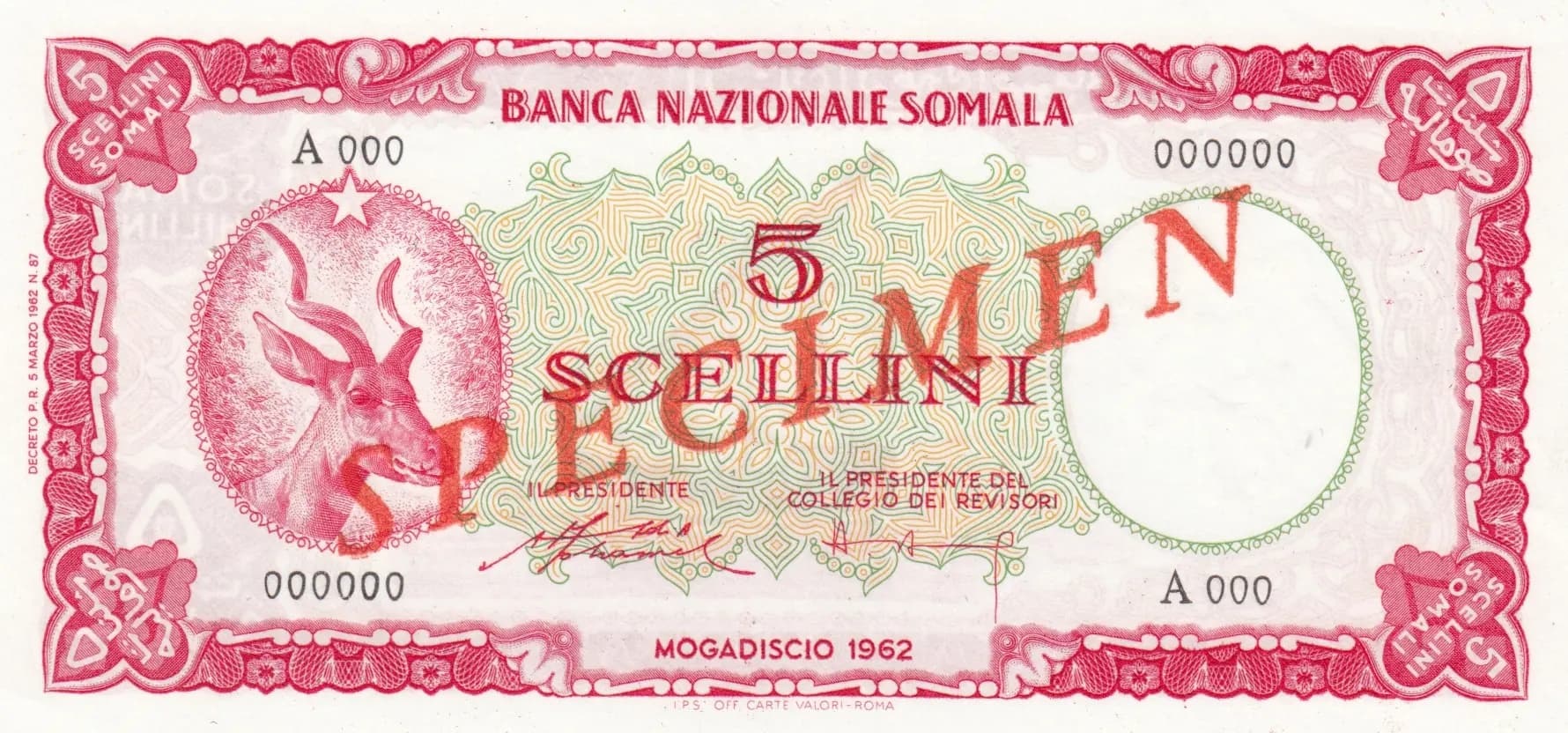
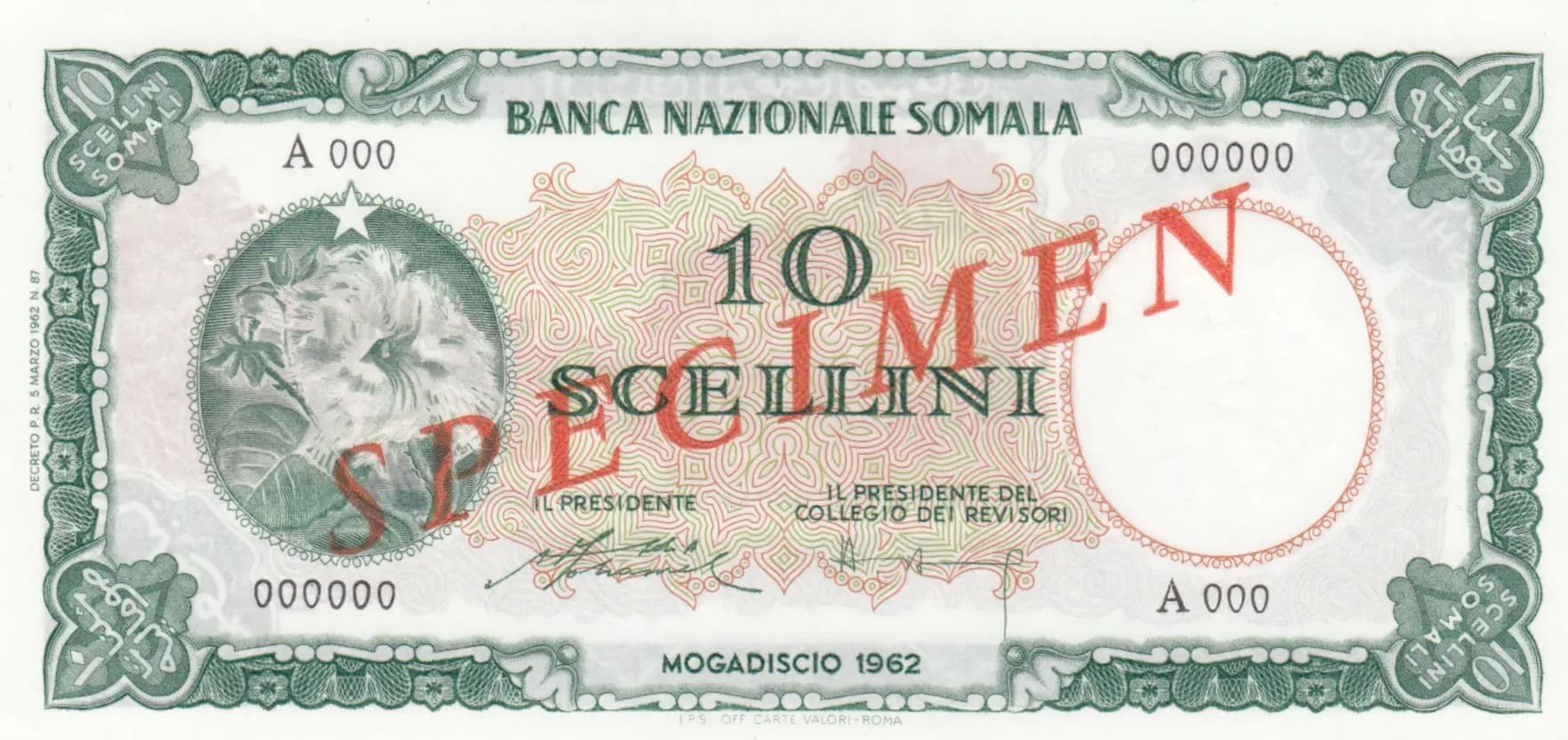
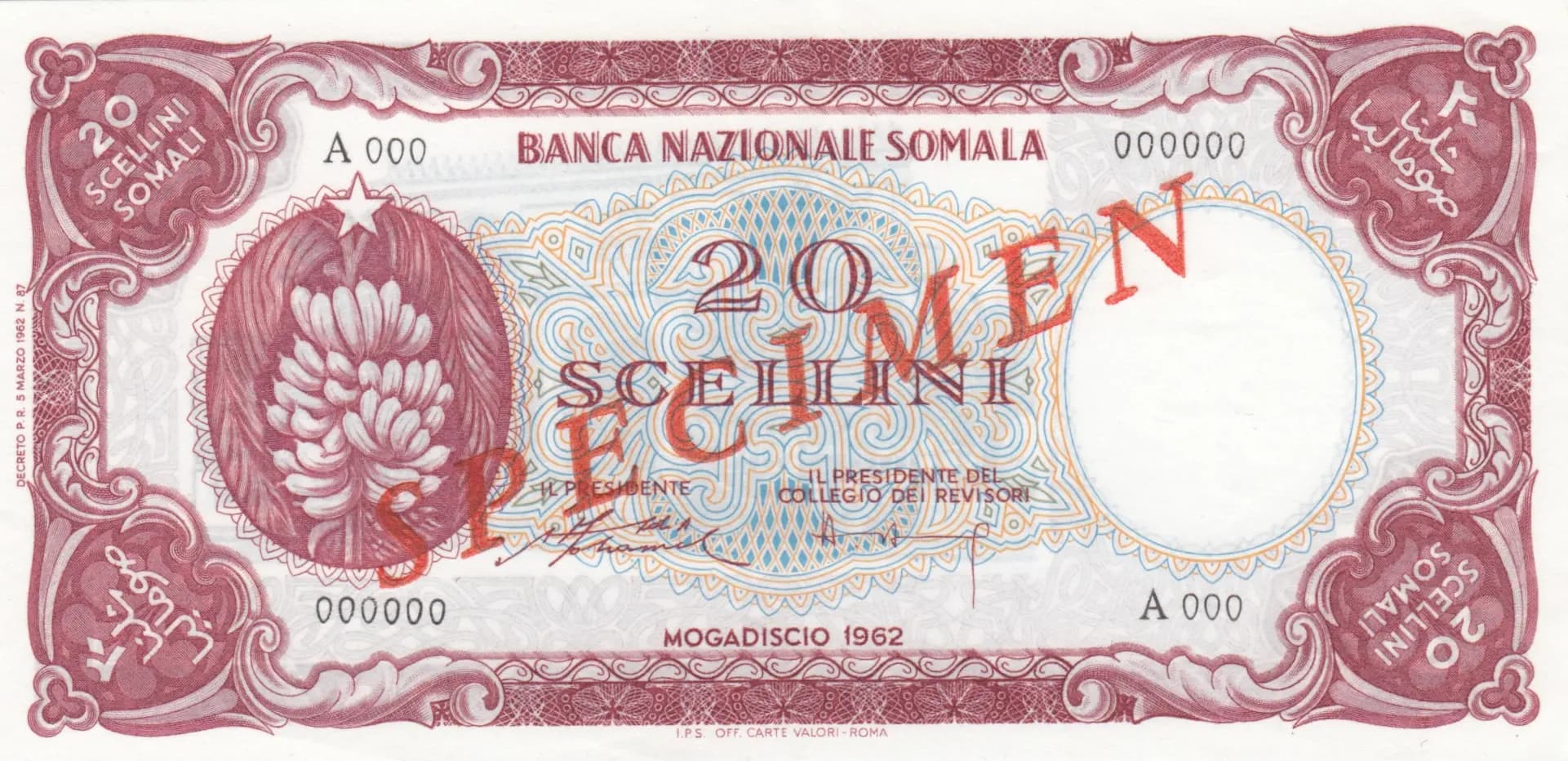
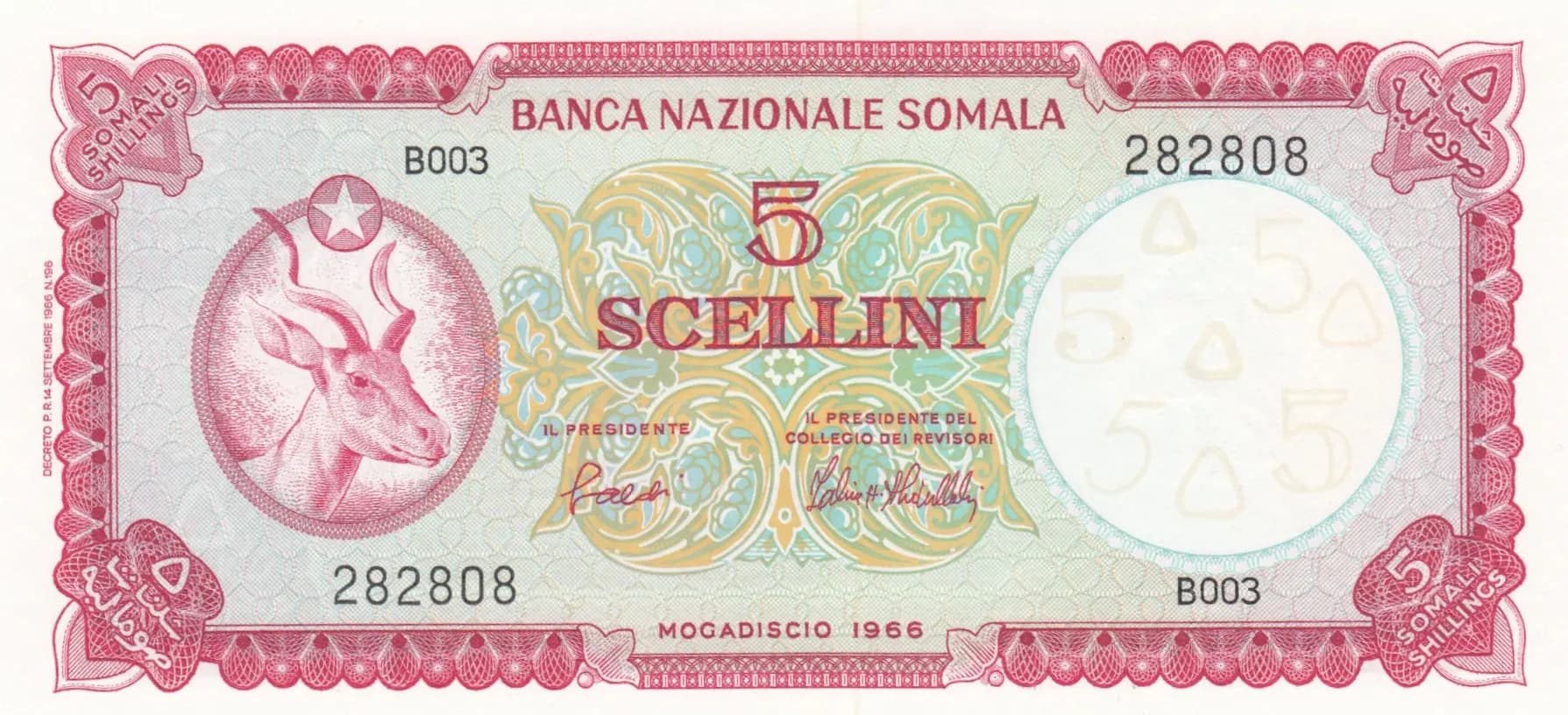
100 scelini 1962 specimen
Market Prices
1 saleAbout This Note
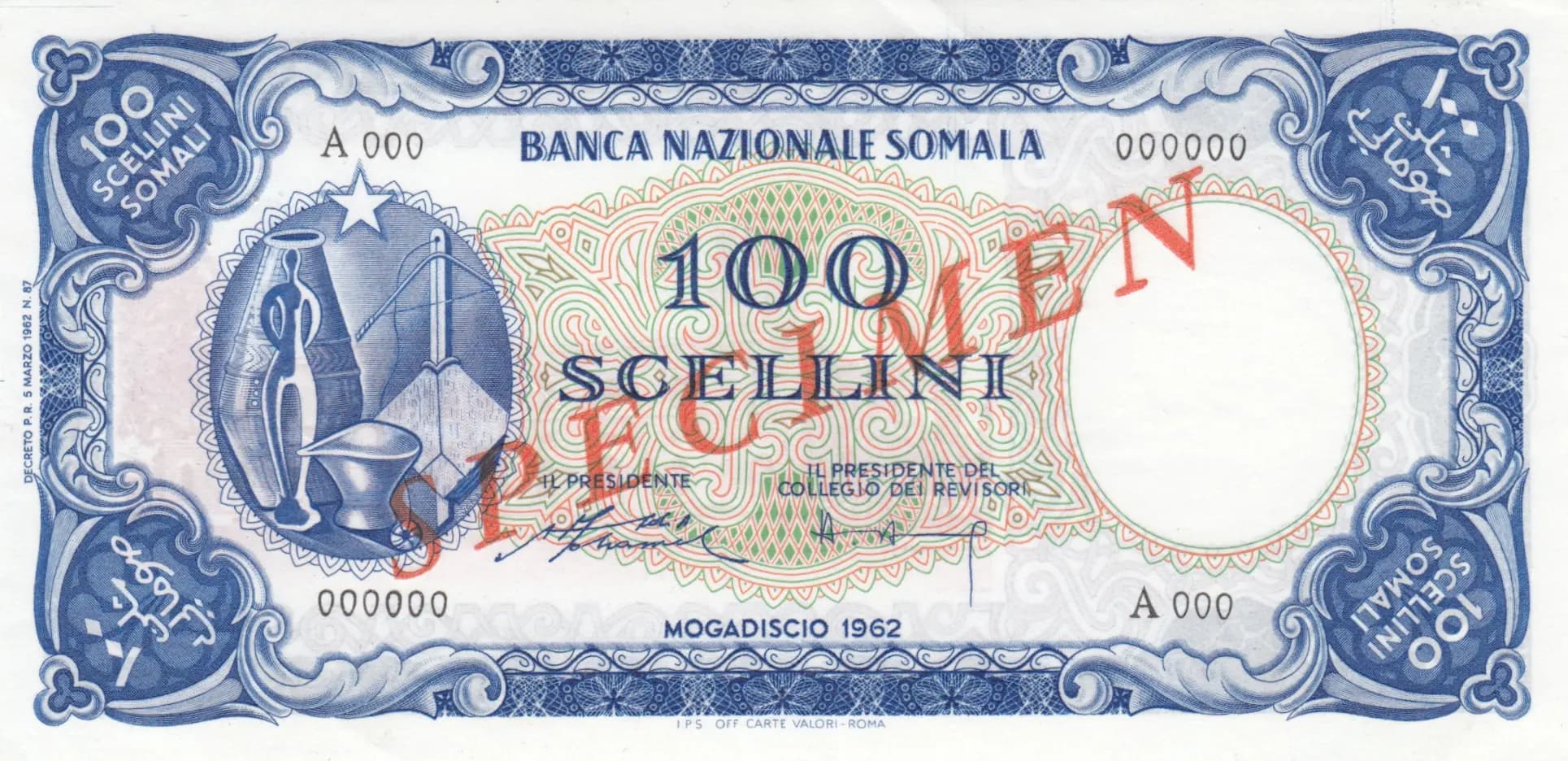
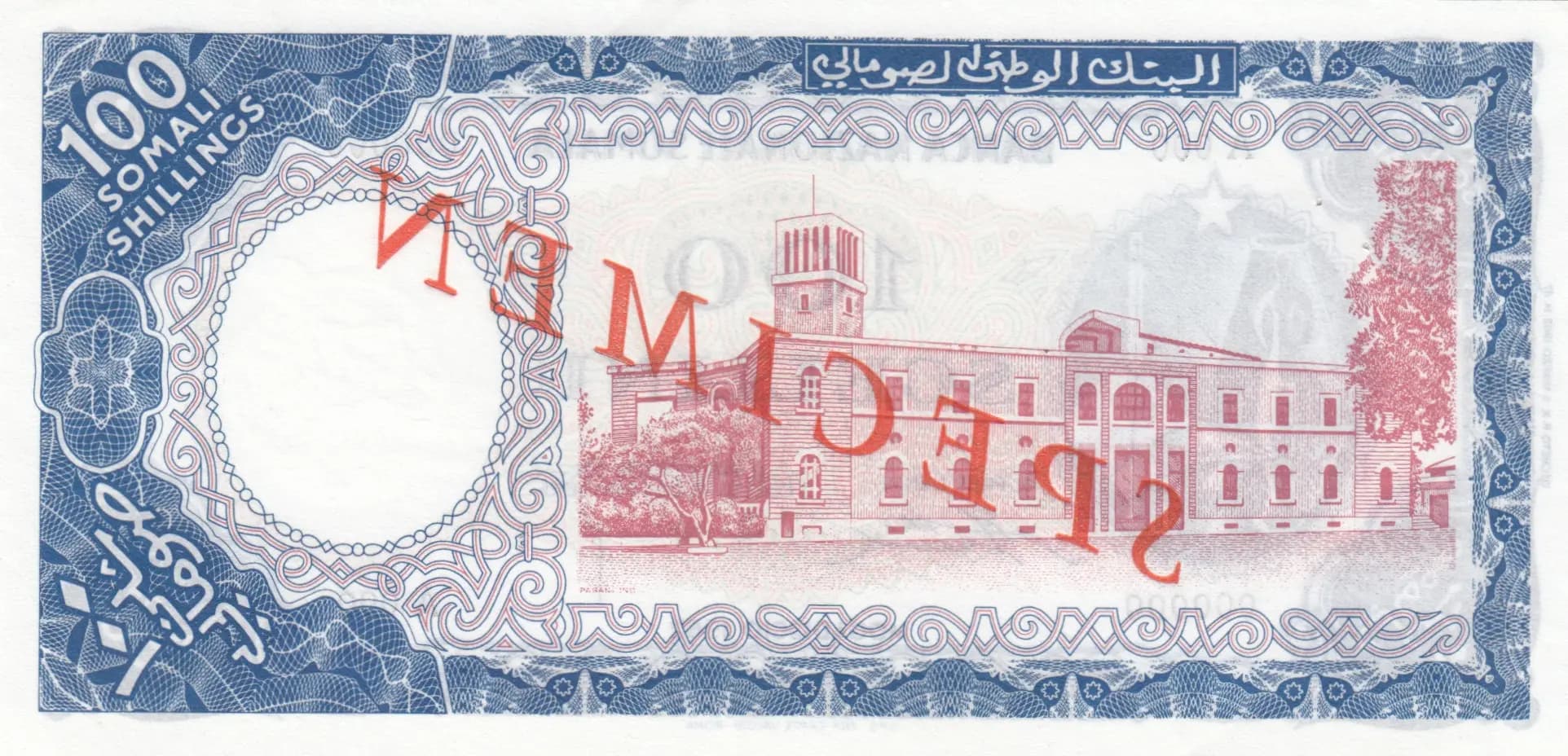
This is a 1962 Somalia 100 Scellini specimen note from the Banca Nazionale Somala, graded AU and representing an early emission from the newly independent nation. The note features vibrant blue, green, orange, and red coloring with traditional Somali decorative artwork on the obverse (an ornate incense burner or vessel) and an institutional building with Islamic architectural elements on the reverse. As a specimen note with prominent red 'SPECIMEN' overprint and all-zero serial numbers, this represents a bank presentation piece rather than a circulated note, making it a historically significant artifact from Somalia's post-independence period.
Common. While this is a specimen note from 1962 (early in Somalia's independent currency history), specimen notes were produced in larger quantities as bank presentation pieces and for distribution to financial institutions and governments. The eBay pricing data showing similar notes in VF condition selling for approximately $31 and catalog valuations at $400 for UNC indicate reasonable availability in the collector market. Specimen notes of this type are not particularly scarce; they represent institutional distribution rather than limited production runs. The AU grade in this case enhances value modestly, but the note itself is not rare or difficult to locate.
Issued in 1962, immediately following Somalia's independence from Italian and British colonial rule, this note reflects the country's transition to sovereignty and the establishment of its national banking system under Italian monetary influence (note the Italian language and spelling conventions retained from the colonial period). The depicted building on the reverse is the National Assembly in Mogadishu, symbolizing the new nation's democratic institutions, while the traditional Somali handicraft imagery on the obverse celebrates indigenous cultural heritage during this formative period of nation-building.
The obverse (front) features an ornately framed design centered on a traditional Somali incense burner or ceremonial vessel with intricate geometric and floral patterning, positioned on the left side of the note. This handicraft represents Somalia's cultural heritage and artisanal traditions. The denomination '100' appears prominently in large numerals with 'SCELLINI' below, flanked by decorative corner elements including a star symbol (upper left) and Arabic/Islamic script symbol (upper right). A large circular blank area on the right represents the watermark zone featuring a leopard's head. The reverse depicts the National Assembly building in Mogadishu with Islamic architectural characteristics including a crenellated tower, multiple stories, arched windows, and flanking trees rendered in red/pink engraving. Both sides are framed by ornate guilloché borders with geometric patterns typical of high-security banknote design. The color scheme transitions from blue and white on the obverse to blue and red/pink on the reverse.
FRONT: 'BANCA NAZIONALE SOMALA' (National Bank of Somalia) — official issuing authority; '100 SCELLINI' (100 Shillings) — denomination in Italian/Somali style spelling; 'IL PRESIDENTE' (The President) — signature title; 'COLLEGIO DEI REVISORI' (Board of Reviewers/Auditors) — official oversight body; 'SPECIMEN' — specimen overprint indicating non-circulating status; 'MOGADISCIO 1962' (Mogadishu 1962) — place and date of issue. BACK: '100 SOMALI SHILLINCS' (100 Somali Shillings) — denomination in English; 'SPECIMEN' — specimen overprint; Arabic text cartouche at top (likely the bank name or official designation in Arabic script).
Intaglio engraving (recess printing) combined with multi-color lithography, characteristic of 1960s European security printing. The note was produced by Istituto Poligrafico dello Stato – Carte Valori (Italian State Printing Office for Securities) in Rome, also referenced in some catalogs as OCV (likely Officina Carte Valori). The complex guilloché patterns, detailed building illustration, and fine line work visible in the visual analysis are consistent with intaglio engraving, while the multi-color application suggests offset or letterpress color layers. The sharp, clear impression and ornate decorative elements indicate professional European security printing standards of the period.
This is the P-4s variety (specimen note) as opposed to the P-4a regular issued variety. The specimen designation is confirmed by the red 'SPECIMEN' overprint visible diagonally across both sides and the serial numbers displayed as all zeros (A 000/000000), which is standard for specimen/presentation notes. The note bears the OCV (Officina Carte Valori/Carte Valori) printer attribution consistent with the P-4s cataloging. No date variants are apparent; the 1962 date and 'MOGADISCIO' location are consistent with the base Pick catalog entry. The Italian language and spelling conventions ('SCELLINI' rather than 'SCELLINI SOMALI') are standard for this early emission during the period when Italian influenced Somalia's monetary nomenclature post-independence.