5 dollars 1973
Market Prices
20 salesAbout This Note
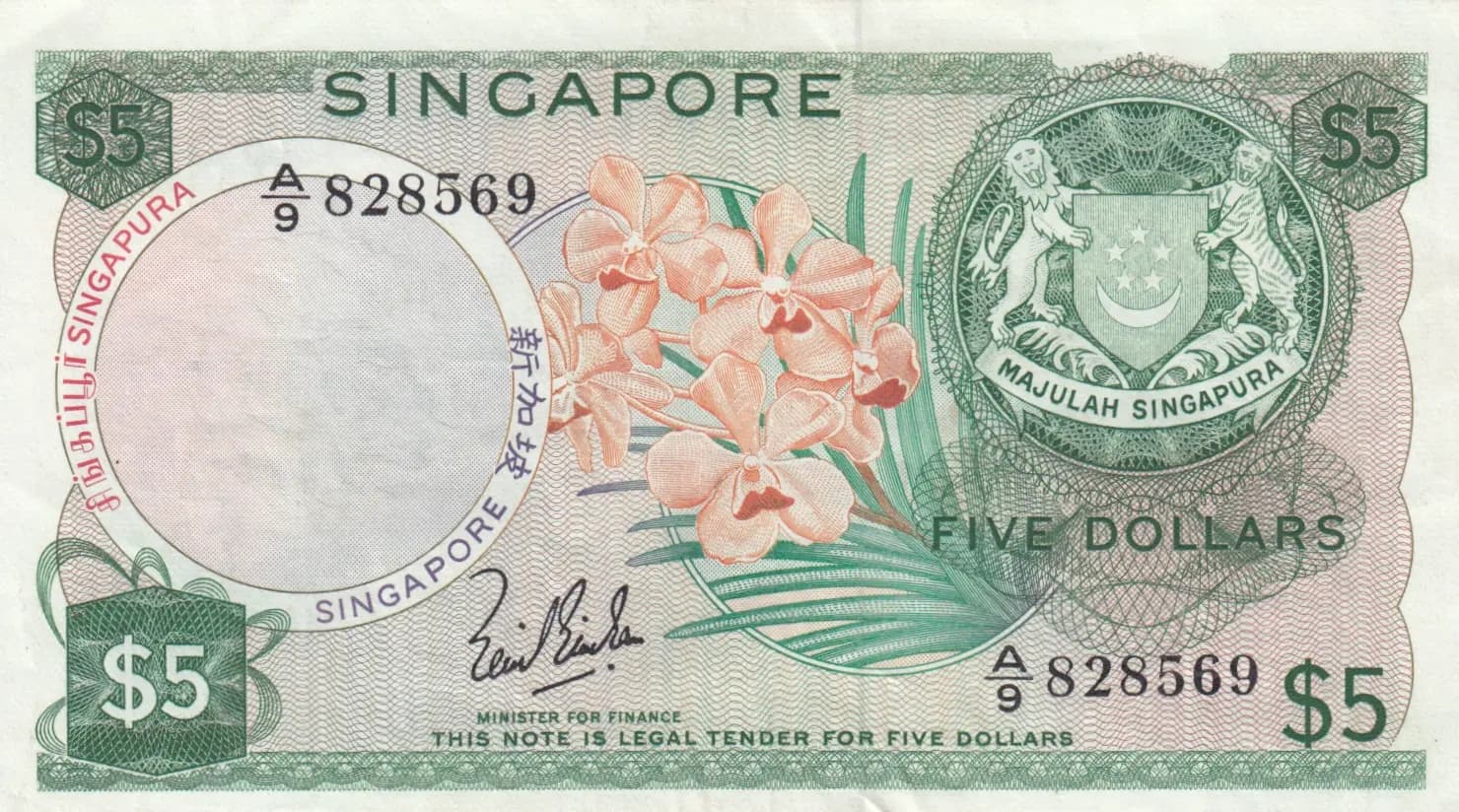
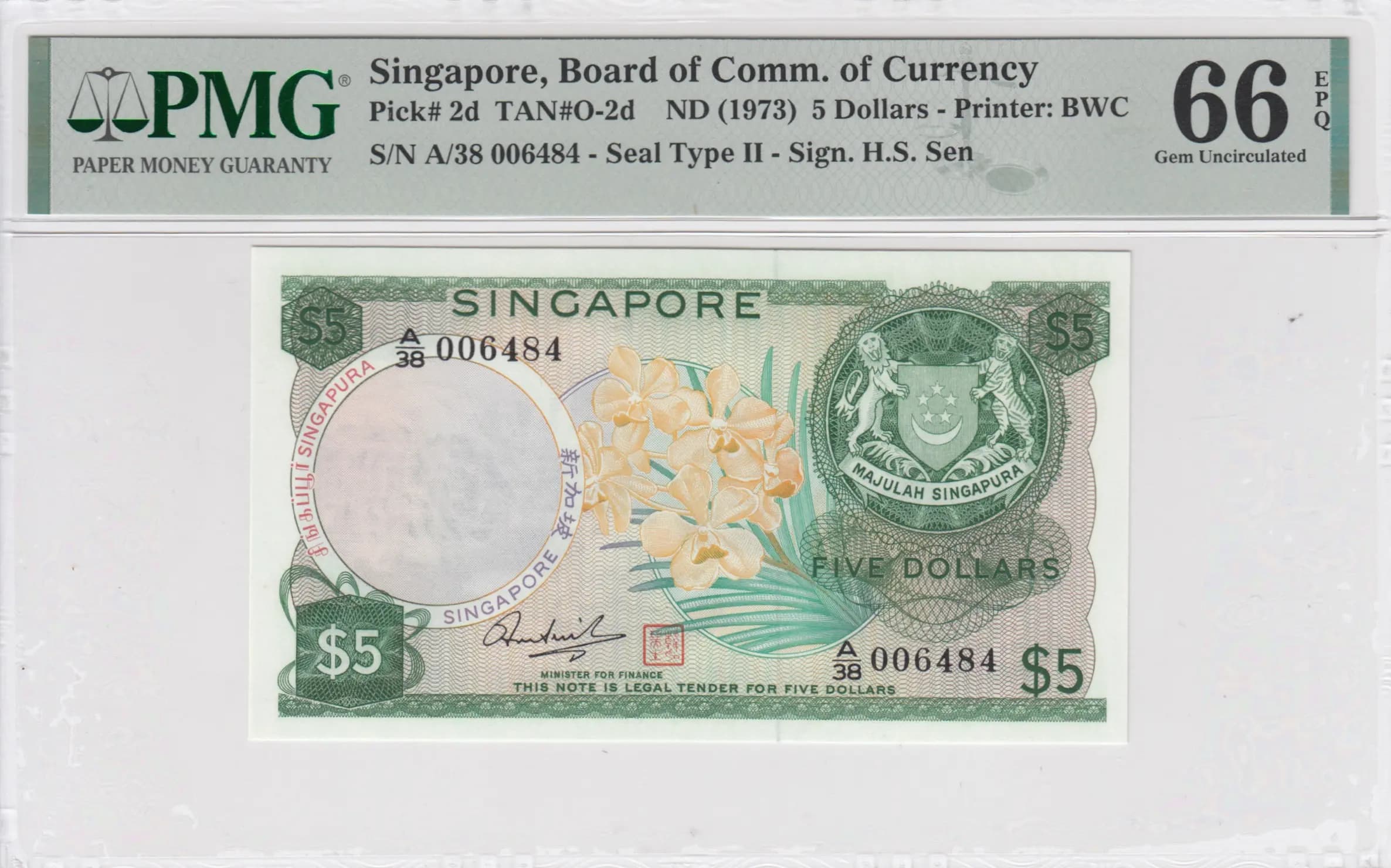
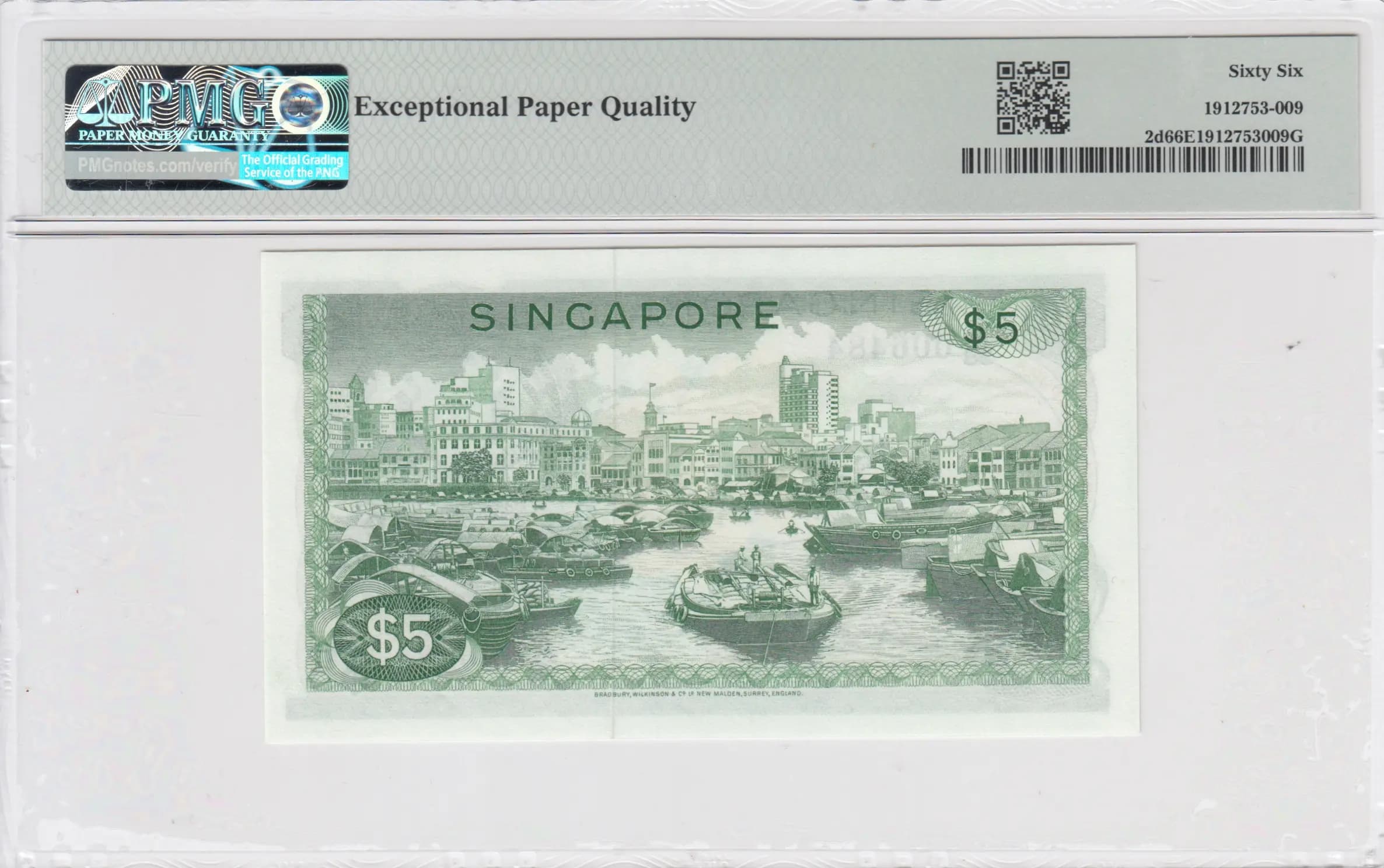
A pristine example of Singapore's 1973 $5 banknote (Pick P-2d) in PMG 66 Gem Uncirculated condition, featuring a striking center design of yellow-orange orchids flanked by the national coat of arms. The reverse showcases an intricate engraved harbor scene depicting Singapore's bustling waterfront with traditional vessels and colonial architecture, rendered entirely in fine-line green engraving. This note represents a key issue from Singapore's early independent currency period and remains highly sought by collectors, with recent PMG 66 examples commanding $300+ at auction.
Common. While this 1973 issue is popular among collectors of Singapore currency and Asian banknotes, recent eBay transaction data demonstrates consistent circulation at moderate prices ($300-350 for PMG 66 examples). The note was produced in substantial quantities as a regular-issue denomination, and multiple examples regularly appear on the market. The PMG 66 grade is achievable without extreme rarity—these notes were produced in sufficient volume that high-grade specimens are obtainable by collectors without excessive premium pricing typical of genuinely scarce notes.
Issued in 1973 by the Board of Commissioners of Currency during Singapore's early post-independence period, this banknote celebrates the nation's maritime heritage and natural identity through its carefully selected imagery. The prominent orchid motif reflects Singapore's tropical environment and horticultural significance, while the reverse's detailed harbor scene commemorates the island nation's role as a major Southeast Asian port and trading hub. The inclusion of 'MAJULAH SINGAPURA' (Onward Singapore) in the national coat of arms reinforces the nation's forward-looking identity during this formative economic development period.
The obverse features a carefully balanced composition with the Singapore national coat of arms (crescent moon, five stars, and heraldic shield bearing the 'MAJULAH SINGAPURA' motto) positioned in the upper right, while the central focus is a vibrant specimen of the tropical orchid (Theobald's Moth-Attracting orchid, or similar cultivar), rendered in naturalistic yellow and orange tones. The portrait area on the left remains blank, a design choice unique to this issue. The reverse presents an elaborate engraved vignette of Singapore's historic harbor, capturing the essence of the city-state's maritime commerce with multiple traditional vessels, a bustling waterfront, and prominent colonial-era buildings including what appears to be a church spire or civic structure. The entire design employs meticulous fine-line engraving in green ink, creating depth and visual richness characteristic of British security printing of the era.
FRONT: 'SINGAPORE' (country name); '$5' and 'FIVE DOLLARS' (denomination); 'A/38 006484' (serial number); 'MINISTER FOR FINANCE' (authority designation); 'THIS NOTE IS LEGAL TENDER FOR FIVE DOLLARS' (legal tender declaration); 'REPUBLIC OF SINGAPORE' (official country designation); 'MAJULAH SINGAPURA' (Malay: 'Onward Singapore' — national motto). BACK: 'SINGAPORE' (country name); '$5' (denomination markers in corners).
Intaglio (engraved) printing by Bradbury Wilkinson & Co. (BWC), New Malden, a renowned British security printer. The visual analysis confirms the characteristic fine-line engraving patterns, detailed background work, and sharp clarity typical of high-security intaglio production. The precision of the orchid rendering and the intricate harbor vignette reflect the advanced engraving capabilities of this premier security printer.
This specimen is catalogued as Pick P-2d, representing a specific printing variant of the 1973 $5 issue. The visual serial number prefix 'A/38' and the red signature seal Type II noted in reference materials are consistent with standard production varieties. The PMG population report indicates 15 variants exist for this base Pick number, including P-2aCS1, P-2cts, and others with different printers (BWC variants documented). The blank portrait area and specific arm positioning confirm this is the standard P-2d variety rather than later overprinted or variant printings.