50 rupees 1989 specimen
Market Prices
2 salesAbout This Note
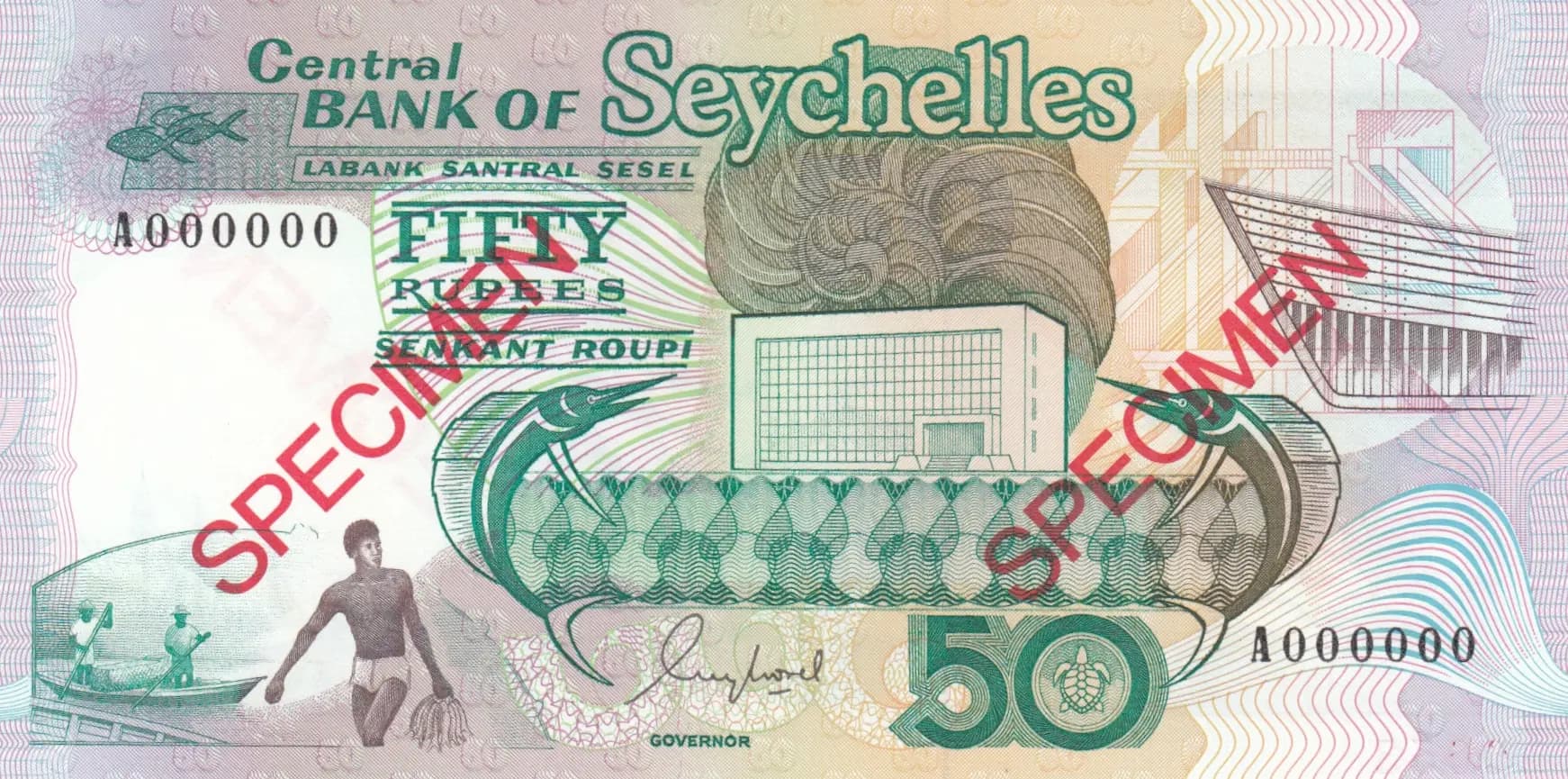
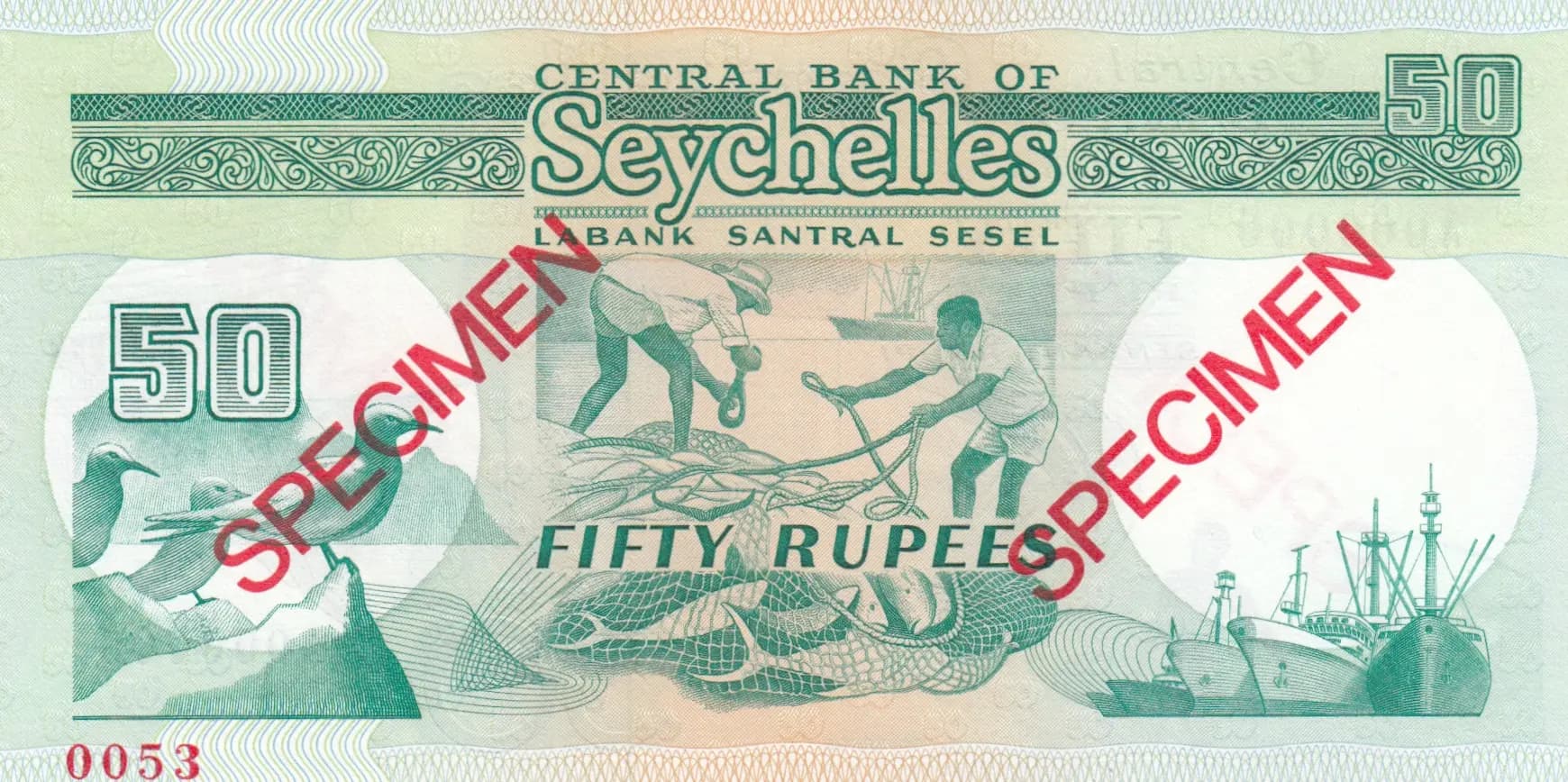
This is a 1989 Seychelles 50 Rupees specimen banknote (Pick P-34s) in pristine uncirculated condition, featuring vibrant green and multicolored printing with detailed maritime and fishing imagery. The obverse depicts a spearfisherman and a prominent sailfish or marlin illustration alongside the Central Bank of Seychelles building in Victoria, while the reverse showcases traditional fishermen with nets and modern cargo vessels. As a specimen note with clearly marked red 'SPECIMEN' overprints and zero-value serial numbers (A000000), this is a non-circulating example created for banking distribution and archival purposes.
Common. Specimen notes from the 1989 Seychelles 50 Rupees series, while not circulated, are regularly available in the collector market. The eBay sales data cited in the reference materials shows PMG-graded examples selling in the $60-$61 range with multiple bids (2020), indicating moderate collector interest and adequate supply. Specimen notes were produced in standard quantities for banking and archival distribution, and this particular denomination and date combination shows no evidence of limited print runs or recalls. The absence of significant price premiums or scarcity reports confirms this as a common variety among specimen collectors.
Issued in 1989 by the Central Bank of Seychelles during a period of economic development in the island nation, this banknote reflects Seychelles' strong maritime heritage and reliance on fishing and tourism. The dual-language design—featuring both English and Seychellois Creole inscriptions—underscores the nation's cultural identity in the post-independence era. The imagery of fishermen, sailing vessels, and commercial ships symbolizes both traditional subsistence practices and modern economic aspirations for the archipelago.
The obverse features a dynamic maritime composition with a male spearfisherman in swimming attire on the lower left, prominently wielding a speargun, paired with a large, intricately engraved sailfish or marlin as the central focal element. The modernist Central Bank of Seychelles building (located in Victoria, the capital) dominates the upper-center portion with distinctive gridded windows and geometric architecture. Flying fish illustrations appear at left and center-right, reinforcing the maritime theme. The reverse shifts to commercial fishing activities, depicting multiple male figures engaged in net fishing operations in the center, with a detailed grouper or similar commercial fish species as the primary illustration. Modern cargo ships with multiple masts are positioned on the right side, contrasting traditional fishing methods with contemporary maritime commerce. The decorative ornamental borders and scrollwork frame both sides, and geometric security line patterns create depth and anti-counterfeiting protection throughout.
OBVERSE: 'Central Bank of Seychelles' (English) / 'Labank Santral Sesel' (Seychellois Creole - Central Bank Seychelles) / 'Fifty Rupees' (English) / 'Seniant Roupi' (Seychellois Creole - Fifty Rupees) / 'Specimen' (English, in red overprint) / '50' (denomination numeral) / Serial number format 'A000000' (specimen zero-value) / 'Governor' (English). REVERSE: 'Central Bank of Seychelles' (English) / 'Labank Santral Sesel' (Seychellois Creole) / 'Fifty Rupees' (English) / 'Specimen' (English, in red overprint, appearing twice) / Reference number '0053' (specimen batch identifier).
Multi-color intaglio (engraved) printing with offset color underlays, a standard security printing technique for banknotes of this era. The fine line patterns, intricate engraving details visible in the fish and human figures, and the precision of the geometric security patterns indicate professional banknote production. The color registration across multiple layers and the sharp detail preservation in the specimen note suggest production by an established security printer, likely the British-based De La Rue or a comparable international banknote printing firm that supplied the Central Bank of Seychelles during this period.
This example is identified as a specimen note (Pick P-34s designation, where 's' denotes specimen status) with the characteristic zero-value serial number format 'A000000' and red 'SPECIMEN' overprints on both obverse and reverse. The reference number '0053' appearing on the reverse may indicate the specimen batch or distribution sequence number. No significant varieties are known for this Pick number; differences between specimens are typically limited to batch numbering and overprint placement. The 1989 date is consistent with the catalog data, with no known date varieties for this denomination in this series.