100 rupees 1977
Market Prices
7 salesAbout This Note
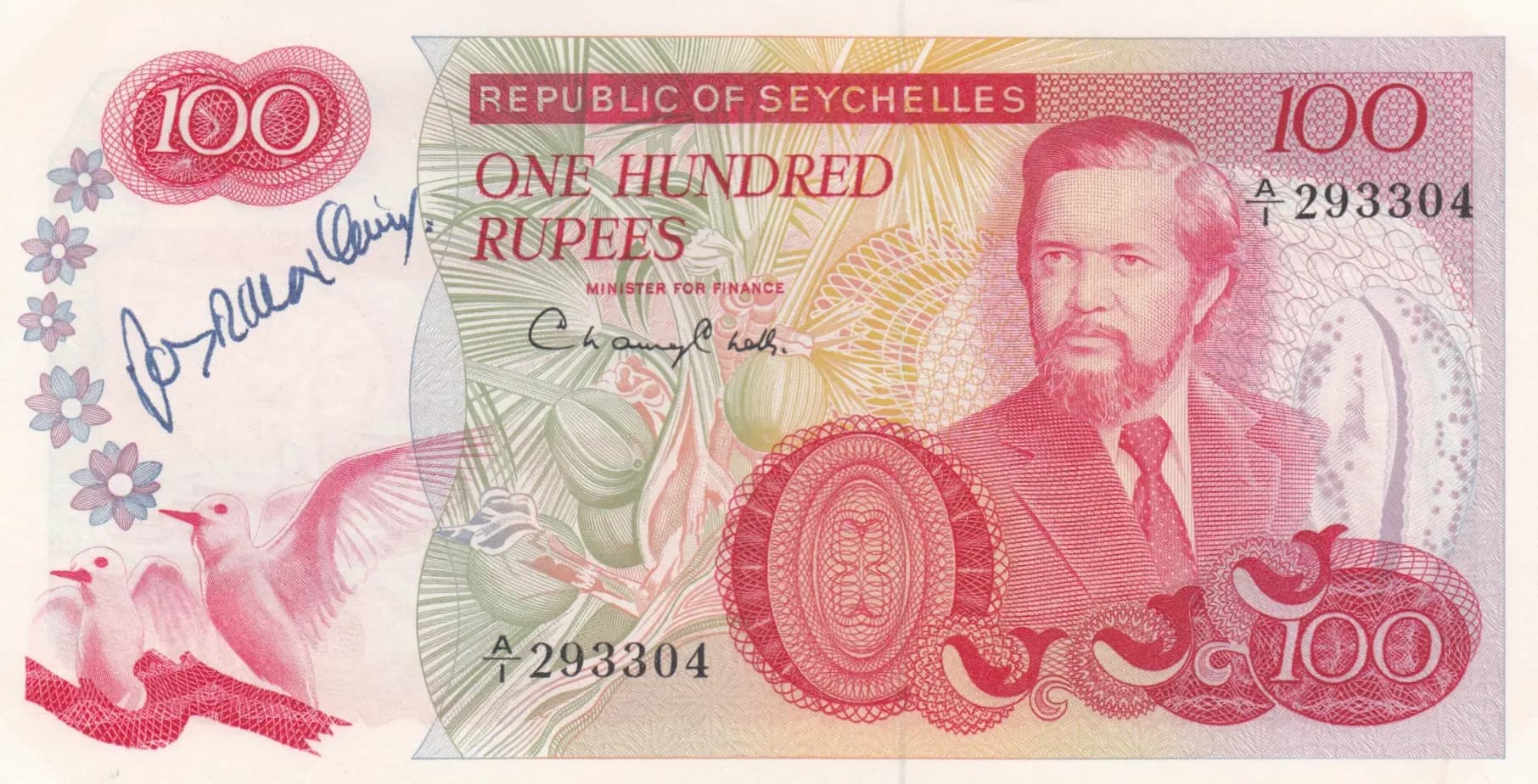
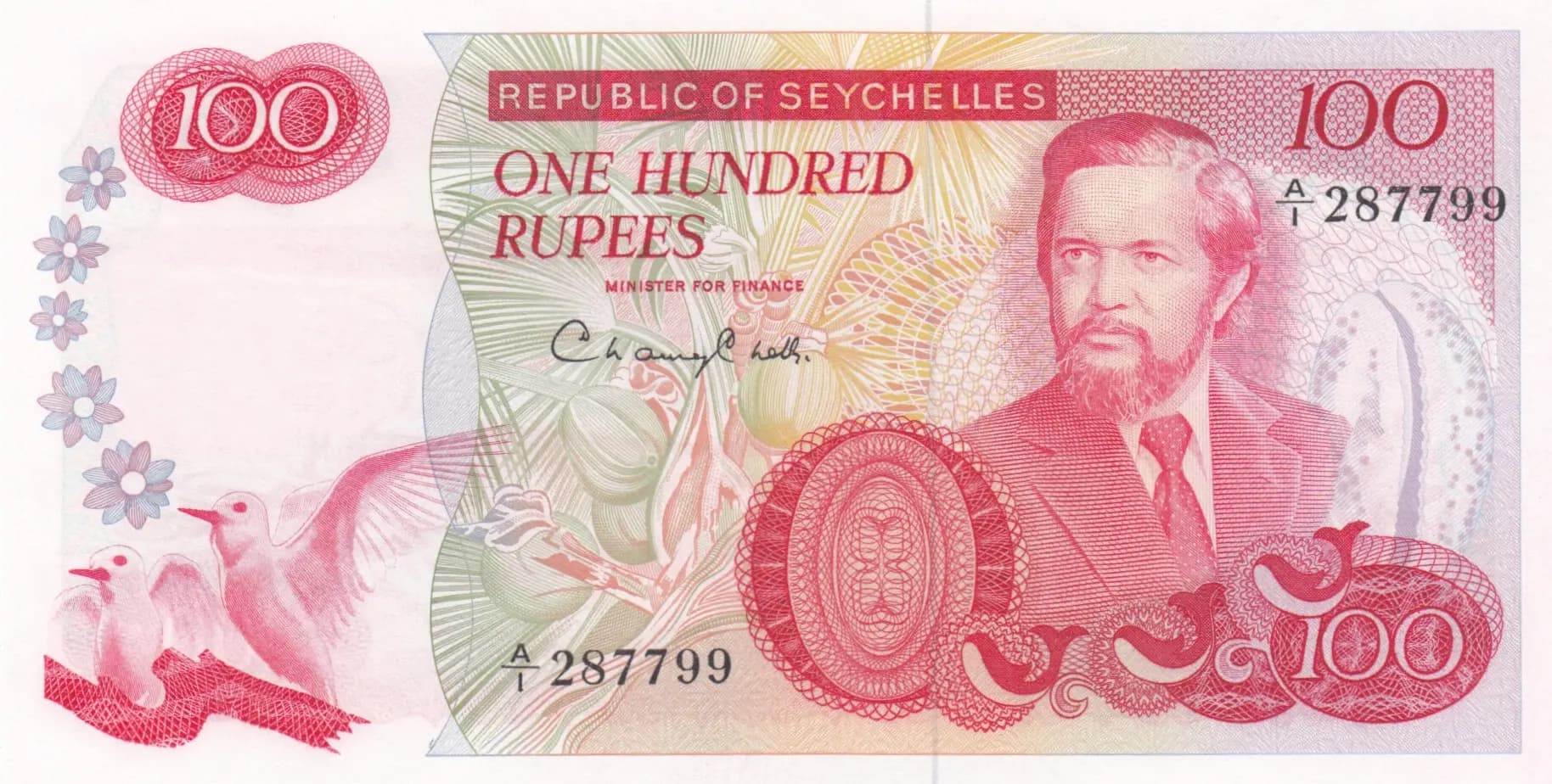
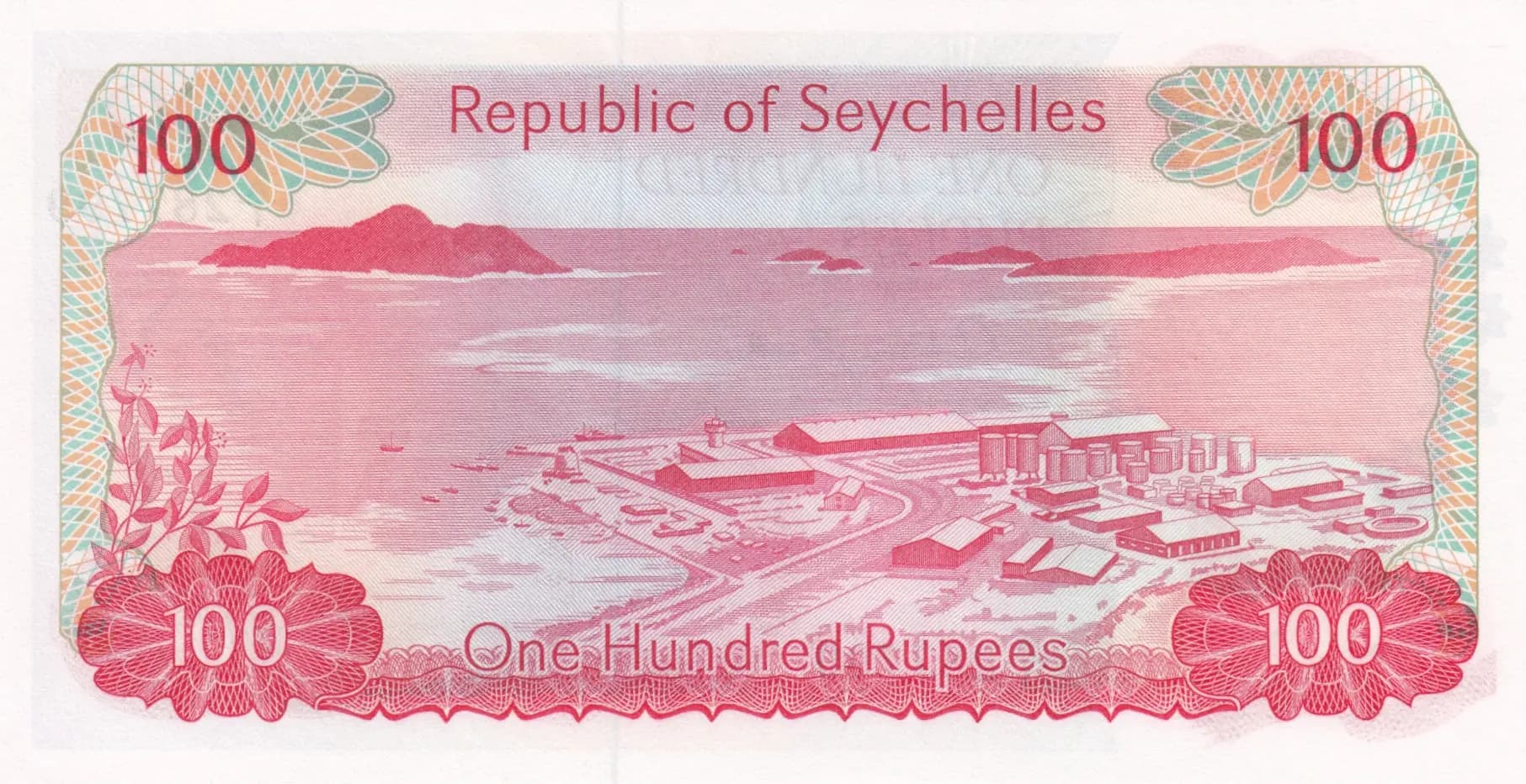
This is an uncirculated 1977 Seychelles 100 Rupees note (Pick 22) in pristine condition, featuring President Sir James Richard Marie Mancham's portrait on the obverse alongside decorative Fairy Terns and intricate floral motifs in pink, red, and multicolor tones. The reverse depicts Port Victoria's coastal harbor landscape with islands and colonial-era structures rendered in fine line engraving. The note exhibits exceptional print quality with no signs of wear, circulation, or handling, making it a desirable example of early post-independence Seychellois currency.
Common. This is a regular issue banknote from Seychelles' inaugural currency series with standard circulation throughout the nation. Market data indicates consistent eBay sales activity with notes in lower grades (Fine condition) selling for $22-$34 regularly since 2013, suggesting substantial availability. The UNC catalogue value of $225 (2019) reflects its uncirculated premium rather than scarcity—pristine examples command higher prices due to condition rarity rather than production rarity. Serial number evidence and consistent supply across decades indicate this was not a short-run emission.
Issued in 1977, just one year after Seychelles achieved independence (1976), this banknote commemorates the young nation's sovereignty under President Mancham with the depiction of Port Victoria, the capital and primary port of entry. The imagery reflects Seychelles' identity as an island nation dependent on maritime trade and tourism, with the Fairy Terns symbolizing the archipelago's unique tropical wildlife. This note represents the early monetary autonomy of the Republic of Seychelles following its transition from British colonial rule.
The obverse features a formal portrait of President Sir James Richard Marie Mancham, depicted as a bearded gentleman in business attire (dark suit and tie), positioned on the right side of the note. The left margin showcases decorative Fairy Terns (small tropical seabirds native to Seychelles) interspersed with stylized four-petaled flowers arranged vertically, representing the nation's distinctive avifauna. A prominent ornamental circular medallion with complex geometric patterns occupies the center-right, while radiating sunburst motifs form the background security design. The reverse depicts an elevated view of Port Victoria's harbor and waterfront development, showing colonial-era buildings, port infrastructure, and distant islands across the Mozambique Channel, framed by ornamental floral medallions in each corner.
FRONT: 'REPUBLIC OF SEYCHELLES' (issuing authority), 'ONE HUNDRED RUPEES' (denomination in words), 'MINISTER FOR FINANCE' (signatory title), '100' (denomination in numerals, appearing in upper left and right corners), 'A 287799' (serial number). BACK: 'Republic of Seychelles' (issuing authority), '100' (denomination in numerals), 'One Hundred Rupees' (denomination in words). All inscriptions are in English, reflecting the post-independence use of English as an official language.
The note exhibits characteristics of intaglio (engraved line printing) combined with multicolor offset lithography, evidenced by the fine detailed line work visible throughout the portrait, landscape elements, and ornamental patterns, as well as the precise color separation across multiple printing layers. The intricate geometric security patterns, particularly in the central medallion and radiating backgrounds, are typical of 1970s currency security engraving standards. While the specific security printer is not definitively documented in standard catalogs, this note likely employed De La Rue or similar Commonwealth-affiliated printers common for newly independent nations' first currency series.
Serial number observed: A 287799. The prefix 'A' appears standard for this series. No overprints, date variations, or signature varieties of significance have been documented for Pick 22. The note exhibits consistent design and printing across known examples, indicating a single primary variety for the 1977 issue. Condition-based variants exist (UNC vs. circulated grades) but no distinct catalog varieties are recognized by major numismatic references.