1 dollar 1935
Market Prices
25 salesAbout This Note
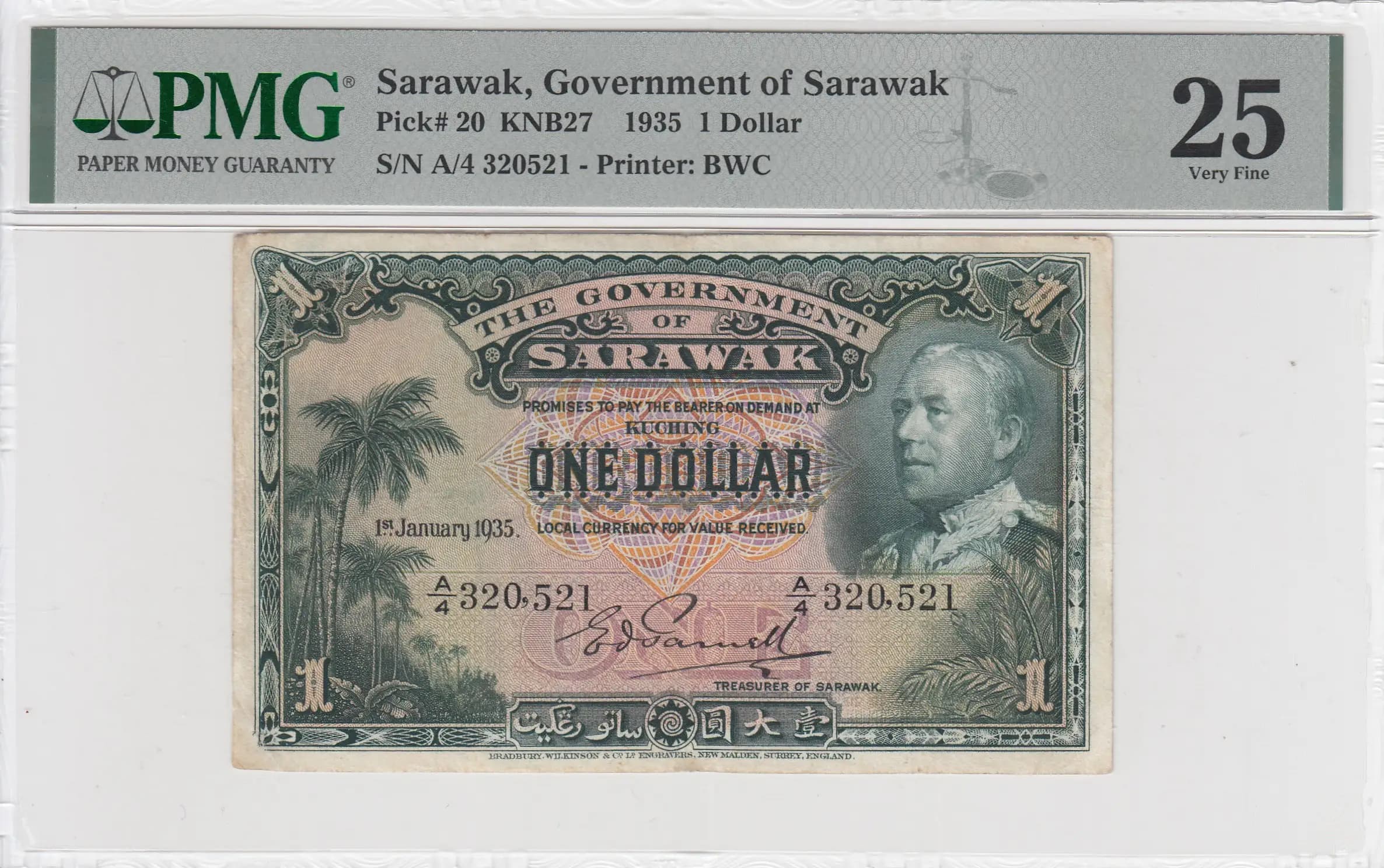
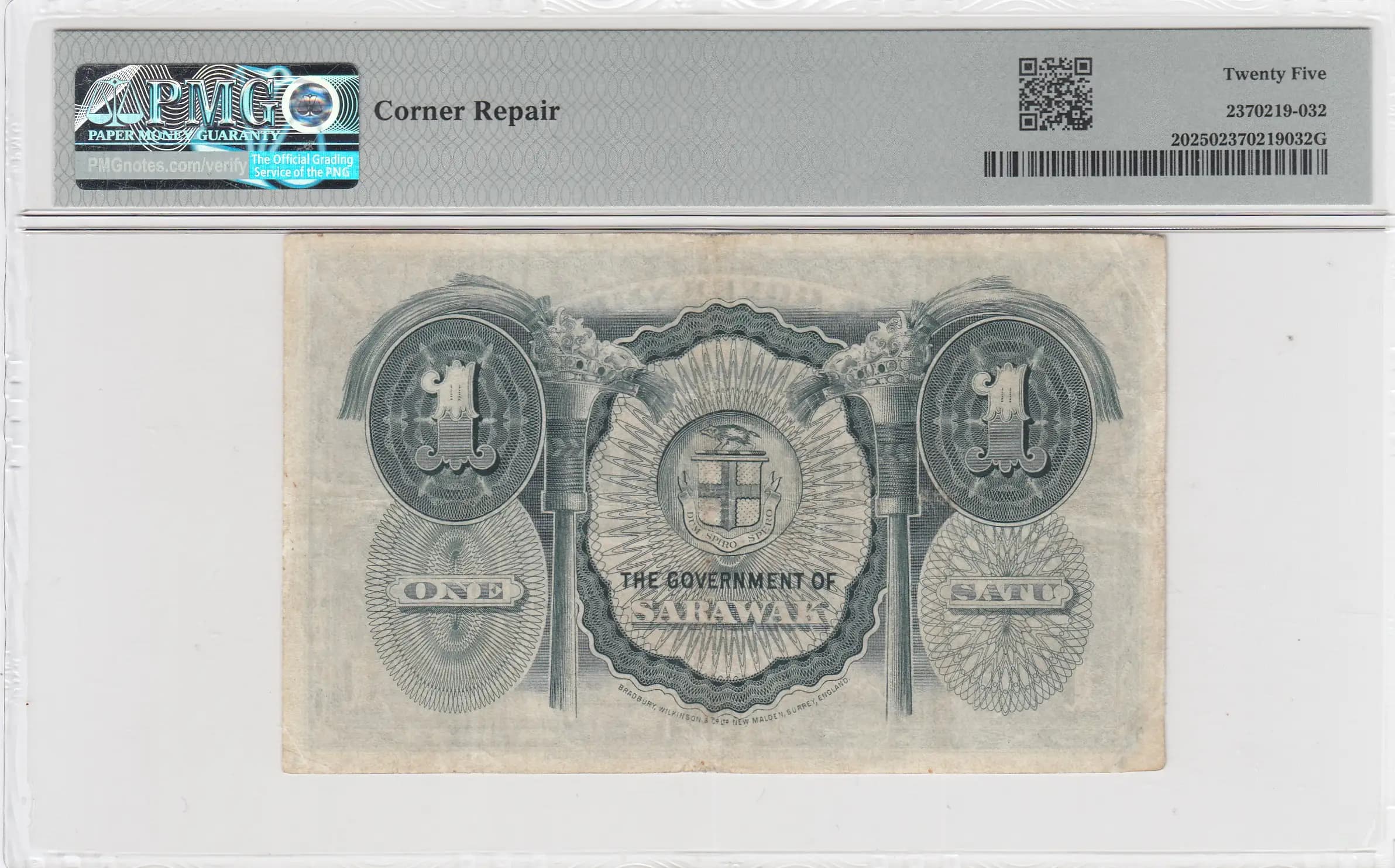
This is a 1935 Sarawak Government one dollar note (Pick P-20) graded PMG 25 (Very Fine), representing an early issue of Sarawak's government currency. The note features attractive period engraving with a portrait of a dignified gentleman in formal dress on the obverse, complemented by a palm tree motif symbolizing the region, while the reverse displays a symmetrical design with the Government of Sarawak coat of arms. The PMG 25 grade reflects visible aging with foxing and corner repair, yet the note retains strong eye appeal with clear impressions and good color retention in its green, black, and red palette.
Common. While the 1935 Sarawak one dollar note possesses historical significance as an early government issue, it was produced in substantial quantities for circulation, evidenced by multiple examples regularly appearing on the market. eBay transaction data spanning 2010-2023 shows consistent availability with prices ranging from $56 to $2,938 depending on grade, with numerous Fine and VF examples selling in the $150-$400 range. The PMG 25 grade represents a mid-range condition that has sold historically for $160-$410, indicating adequate supply at this grade level. The note is neither scarce nor difficult to locate for collectors.
This note was issued on January 1, 1935, during the period of the Sarawak Raj under the White Rajah system, when Sarawak maintained its own currency separate from British Malaya. The denomination promise to pay 'at Kuching' references the capital city and the note's role as local currency guaranteed by the Treasurer of Sarawak. The formal portrait and bilingual inscriptions (English and Malay) reflect Sarawak's unique position as a semi-autonomous British protectorate with its own government apparatus, while the palm tree imagery emphasizes the region's tropical identity and economic character.
The obverse presents a formal right-facing portrait of a mustachioed gentleman in Victorian-era formal dress, positioned on the right side of the note. The left side features a distinctive palm tree, a botanical symbol of Sarawak's tropical geography and natural wealth. The design is framed by ornate decorative scrollwork and flourishes in the borders, with corner ornaments typical of early 20th-century banknote engraving. The reverse employs a classical symmetrical layout with two oval medallion frames containing the numeral '1' flanking a central coat of arms of the Government of Sarawak, which incorporates a shield with cross symbol and is surrounded by radiating ornamental patterns. The overall aesthetic reflects British Commonwealth design traditions adapted to Sarawak's local context.
FRONT: 'THE GOVERNMENT OF SARAWAK' / 'PROMISES TO PAY THE BEARER ON DEMAND AT KUCHING' / 'ONE DOLLAR' / 'LOCAL CURRENCY FOR VALUE RECEIVED' / '1st January 1935' / 'TREASURER OF SARAWAK' / Serial numbers: 'A/4 320,521' and 'A 320,521'. Additional text in Chinese/Malay characters appears to designate local currency for Sarawak. BACK: 'THE GOVERNMENT OF SARAWAK' / 'ONE' (English) / 'SATU' (Malay, meaning 'One').
This note was produced using intaglio (engraved steel plate) printing, the standard security printing method of the period. The fine line work visible in the portrait, decorative borders, and numeral medallions demonstrates classical banknote engraving technique. The red overprinted security text on the obverse indicates a secondary printing pass applied after the primary intaglio printing. The note was produced by security printers serving the British Commonwealth; Sarawak notes of this era were typically printed by British banknote manufacturers such as Waterlow & Sons or De La Rue, though specific attribution requires additional documentation.
This is the standard P-20 variety (not the scarcer P-20s specimen note variant). The serial number format 'A/4 320,521' and 'A 320,521' suggests this is from the first printing run with the A-series prefix. The note shows the standard design without significant overprints or local modifications. PMG population data indicates two catalogued variants exist for this Pick number (P-20 and P-20s), with this example being the regular circulating issue.