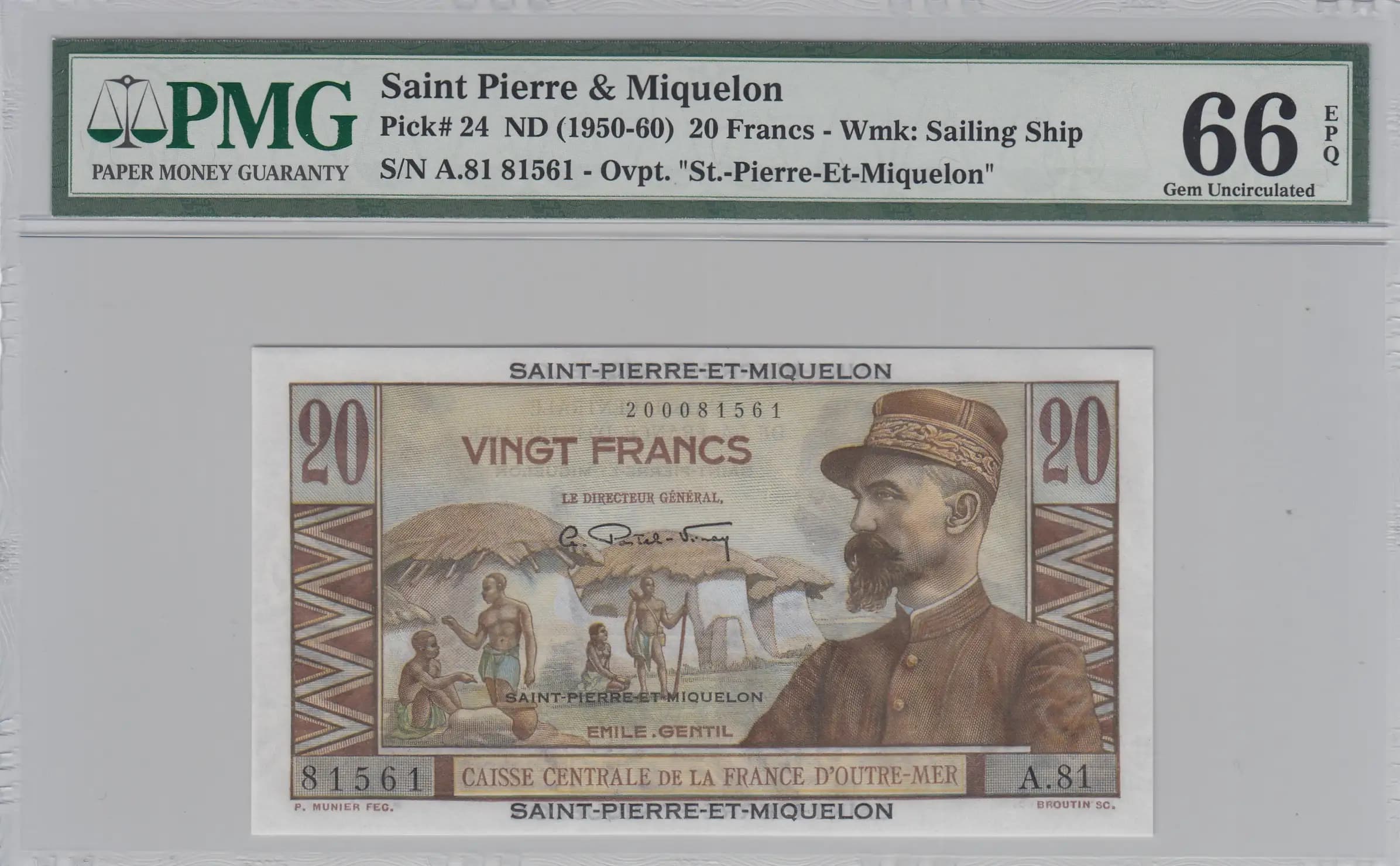
20 francs 1950
About This Note
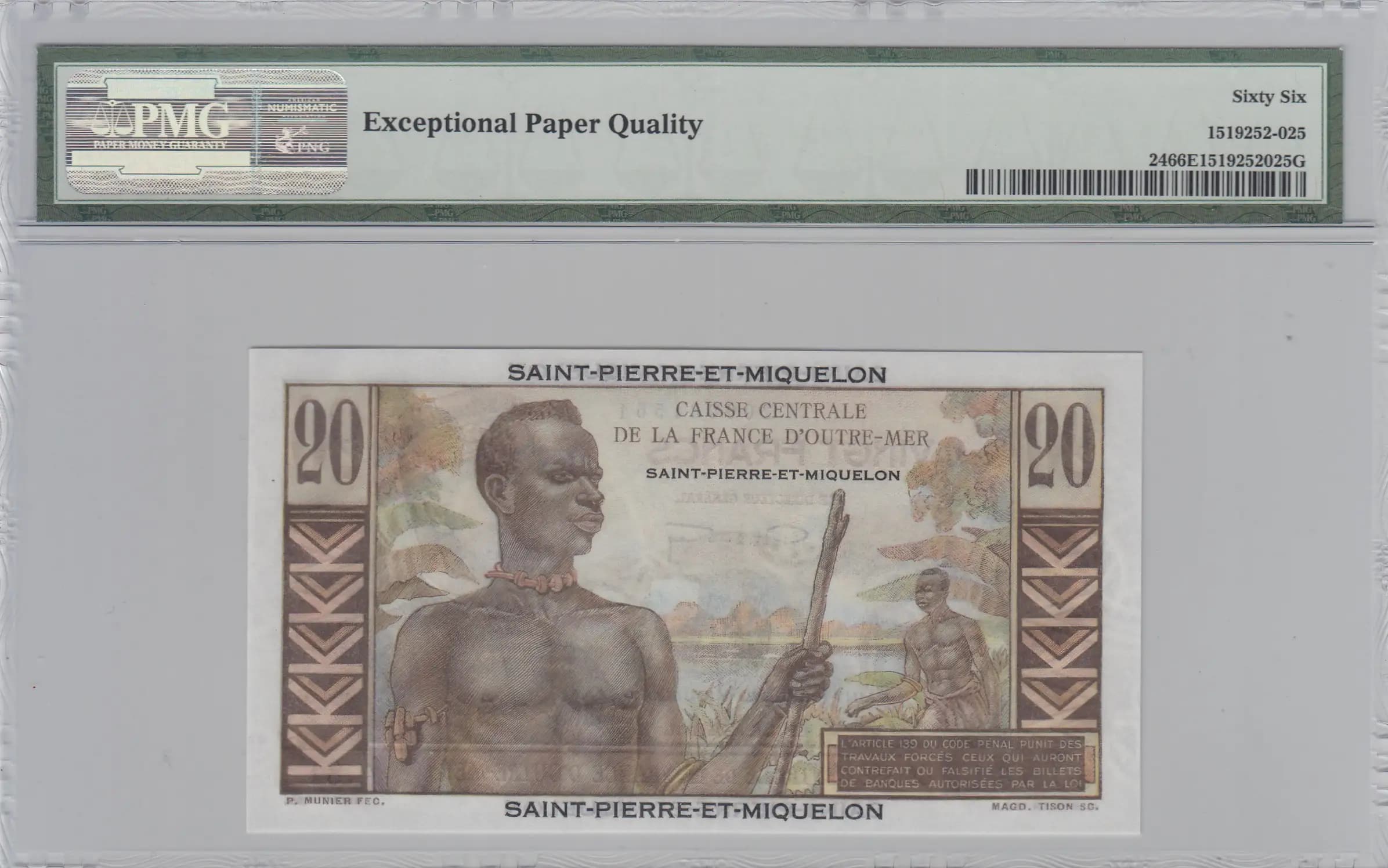
This is a PMG 66 EPQ example of the 1950 Saint Pierre & Miquelon 20 Francs (Pick P-24), issued by the Caisse Centrale de la France d'Outre-Mer. The note displays exceptional preservation with pristine paper quality, vibrant sepia and cream tones, and sharp fine-line engraving throughout both obverse and reverse. The illustrated vignettes depicting colonial-era figures and maritime scenes, combined with the near-perfect condition grade, make this an attractive example for collectors of French overseas currency and colonial-period banknotes.
Common. The Saint Pierre & Miquelon 20 Francs P-24 issue of 1950 was a standard circulation note produced in substantial quantities for use in the territory. While the PMG 66 EPQ grade represents excellent condition, the underlying note type itself does not exhibit characteristics of rarity—there were no short print runs, the issuing authority (Caisse Centrale de la France d'Outre-Mer) operated throughout the period, and this denomination and year combination appears regularly in dealer inventories and auction results. Colonial-era French overseas currency does attract collector interest, but this particular note remains relatively available in the market, especially at lower grades. The high technical grade reflects exceptional preservation rather than inherent scarcity of the base note.
This 1950 banknote represents the post-World War II period of French overseas administration, issued during a transitional era when France was reasserting control over its colonial territories following the German occupation. The Caisse Centrale de la France d'Outre-Mer (Central Treasury of Overseas France) served as the monetary authority for French overseas possessions, and the depicted colonial scenes—featuring indigenous figures, maritime activity, and settlement imagery—reflect the economic realities and visual propaganda of French colonial administration in mid-twentieth-century Saint Pierre & Miquelon. The artistic style and engravers' signatures (Munier, Broutin, Tison) indicate production by a major European security printing house, consistent with France's post-war efforts to establish secure currency systems across its territories.
The obverse features a right-facing profile portrait of a bearded man wearing a brown hat with a rope or cord band, positioned on the right side of the note, with an elaborate colonial vignette on the left depicting multiple figures in a settlement or trading post context, some minimally clothed, representing indigenous populations of the Saint Pierre & Miquelon region. The reverse displays an upper-positioned profile portrait facing left (likely representing a colonial administrator or historical figure) above a maritime scene featuring a prominent native figure holding a paddle or oar, with water and settlement structures visible in the background, suggesting the maritime and fishing heritage central to the islands' economy. Both sides feature decorative geometric chevron and triangular border patterns along the left and right edges. The cream and beige background with sepia and rust-brown illustration tones creates a unified colonial-era aesthetic. The engraving credits indicate work by P. Munier (engraver) and two different sculptors (Broutin for the obverse, Magd. Tison for the reverse), suggesting this was a high-quality production by a specialized security printer.
FRONT SIDE: 'SAINT-PIERRE-ET-MIQUELON' (Saint Pierre and Miquelon); 'VINGT FRANCS' (Twenty Francs); 'LE DIRECTEUR GÉNÉRAL' (The Director General); 'CAISSE CENTRALE DE LA FRANCE D'OUTRE-MER' (Central Treasury of Overseas France); 'EMILE GERTIL' (signature); 'A.81' (plate or batch identifier); 'P. MUNIER FEC.' (P. Munier engraved it); 'BROUTIN SC.' (Broutin sculpted it); Serial number: 20000815671. BACK SIDE: 'SAINT-PIERRE-ET-MIQUELON' (Saint Pierre and Miquelon); 'CAISSE CENTRALE DE LA FRANCE D'OUTRE-MER' (Central Treasury of Overseas France); 'L'ARTICLE 139 DU CODE PÉNAL PUNIT DES TRAVAUX FORCÉS CEUX QUI AURAIENT CONTREFAIT OU FALSIFIÉ LES BILLETS DE BANQUES AUTORISÉS PAR LA LOI' (Article 139 of the Penal Code punishes with forced labor those who would counterfeit or falsify banknotes authorized by law); 'P. MUNIER FEC.' (P. Munier engraved it); 'MAGD. TISON SC.' (Magd. Tison sculpted it).
Intaglio engraving (recess printing) was the dominant technique, as evidenced by the fine, detailed line work visible throughout both sides, the sharp portrait profiles, and the intricate geometric border patterns. The multi-artist credits (engravers and sculptors named) indicate traditional banknote production methodology where separate plates were created by specialized craftsmen. The vibrant color application and precise registration between colors suggest either multi-pass intaglio printing or a combination of intaglio with surface printing for background tones. The exceptional clarity and depth of the vignette scenes, the fine hairline details in the portraits, and the consistent ink density across the note's surface are characteristic of professional European banknote production, likely executed by a major French security printer such as the Banque de France's printing facilities or an affiliated contractor.
Per PMG population data, two variants exist for this Pick number: P-24 and P-24s (both with Sailing Ship watermark). The visible serial number prefix 'A.81' and the signature of 'EMILE GERTIL' as Director General represent specific characteristics of this printing. The engravers' marks 'P. MUNIER FEC.' and 'BROUTIN SC.' (obverse) and 'MAGD. TISON SC.' (reverse) indicate this specimen belongs to the standard engraved variety. Without access to comparative watermark imagery or detailed PMG census records distinguishing P-24 from P-24s, the most probable classification based on standard cataloging for this issue is P-24 (the primary listing). Collectors should verify the specific watermark (sailing ship) against the note in hand to confirm the exact variant designation.