50 centimes 1919
About This Note
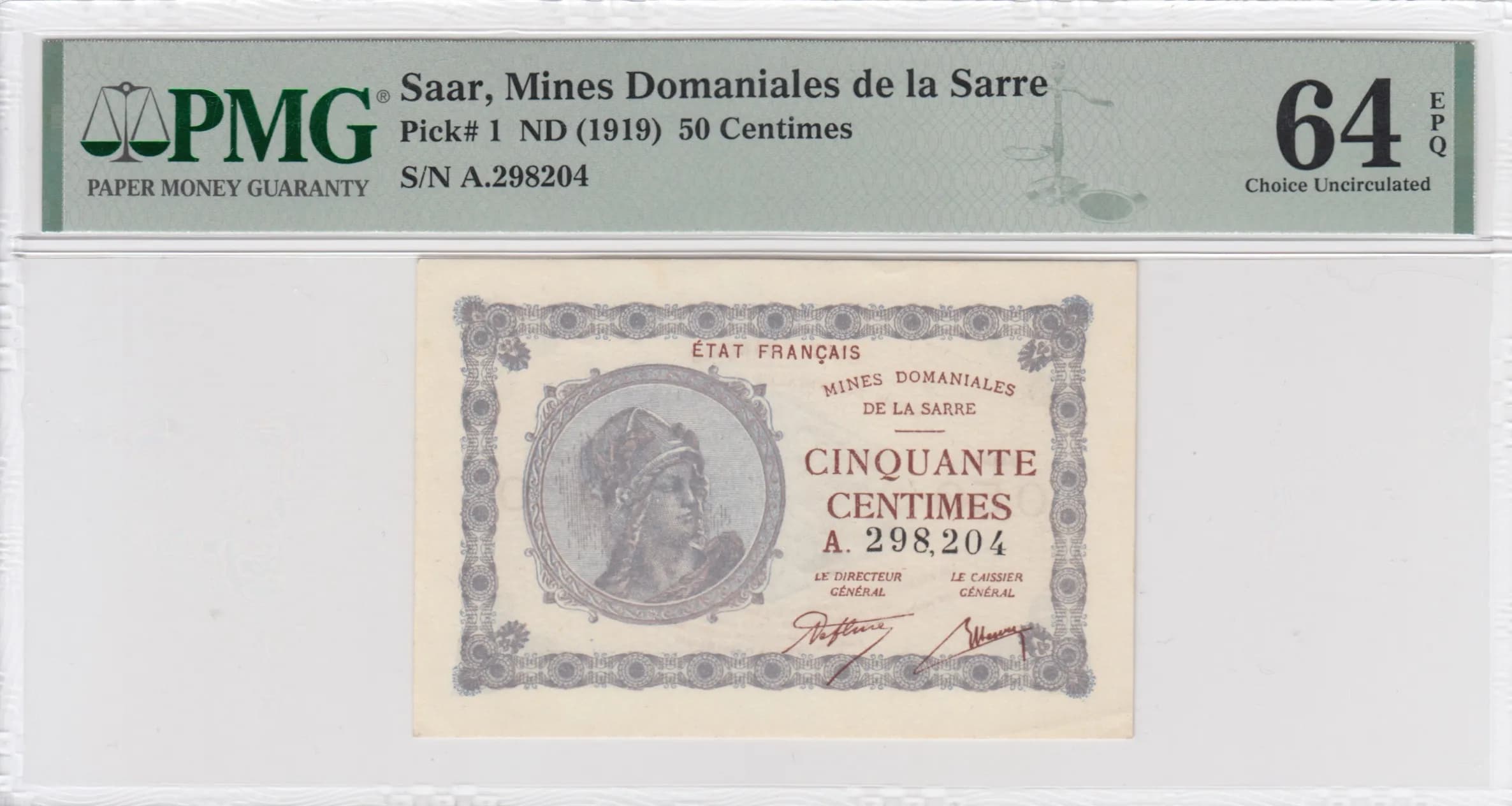
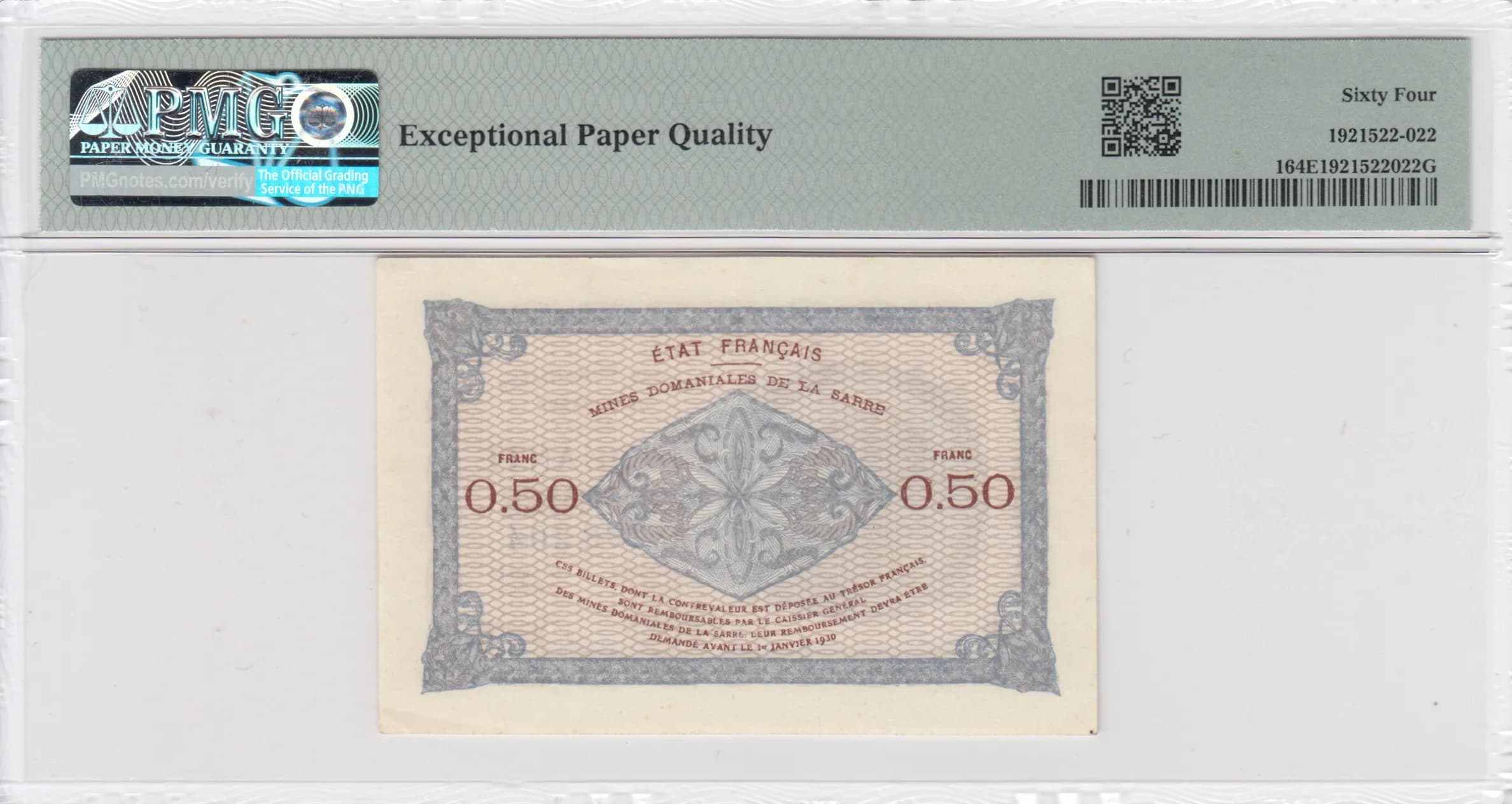
This is an exceptional PMG 64 EPQ example of the 50 centimes banknote issued by the Mines Domaniales de la Sarre in 1919. The note displays pristine uncirculated condition with sharp printing, clean margins, and no visible wear or imperfections. The classical engraved design featuring an ornate portrait medallion on the front and elaborate diamond-shaped ornamental centerpiece on the reverse exemplifies the fine security printing standards of this short-lived emergency currency.
Common. The Mines Domaniales de la Sarre issued these notes in substantial quantities to facilitate mining operations during 1919-1920. While the issuer was short-lived and the note is out of circulation for nearly a century, the denomination (50 centimes) was not produced in limited quantities. The relatively straightforward availability of these notes in the collector market, combined with their historical significance rather than extreme scarcity, places them in the common category. PMG 64 EPQ represents an exceptional condition grade that adds value, but the underlying note itself is not rare.
Issued under French authority following the Treaty of Versailles, the Mines Domaniales de la Sarre banknotes represent a unique monetary instrument used to facilitate operations of French-controlled Saar coal mines during the League of Nations mandate period (1920-1935). The inscription 'ÉTAT FRANÇAIS' (French State) and the redemption deadline of January 1, 1920, printed directly on the reverse, underscore the provisional nature of this currency, which was intended as a temporary medium of exchange for mine workers and contractors in the disputed Saar Basin region.
The note features a classical allegorical portrait in profile, wearing a crown or ceremonial headdress, facing rightward within an ornate circular medallion frame on the obverse. The portrait represents the personification of French administrative authority over the Saar region. The frame is surrounded by an elaborate geometric and floral decorative border featuring repeating ornamental medallions in a classical style. The reverse displays a large central diamond-shaped ornamental cartouche with floral and geometric embellishments, surrounded by a fine repeating wave or mesh pattern background. Decorative corner ornaments anchor all four corners of the note. The color scheme employs cream-off-white backgrounds with gray, purple-mauve, and light blue-green tones, with red-brown text providing strong contrast. The overall aesthetic reflects late 19th/early 20th-century classical engraved banknote design conventions.
FRONT SIDE: 'ÉTAT FRANÇAIS' (French State); 'MINES DOMANIALES DE LA SARRE' (Saar State Mines); 'CINQUANTE CENTIMES' (Fifty Centimes); Serial number 'A. 298204'; 'LE DIRECTEUR GÉNÉRAL' (The General Director); 'LE CAISSIER GÉNÉRAL' (The General Cashier). BACK SIDE: 'ÉTAT FRANÇAIS' (French State); 'MINES DOMANIALES DE LA SARRE' (Saar State Mines); Denomination markers '0.50 FRANC' (0.50 Franc) on left and right; Legal text: 'The banknotes of the Saar State Mines whose operation is devoted to the French Treasury whose issuance was authorized by the general cashier must be effectively reimbursed'; 'JEAN BRADE BEFORE JANUARY 1, 1920' (redemption officer and deadline).
Steel engraving and intaglio printing, employing fine line work and cross-hatching to create depth, security features, and the ornate decorative patterns. The precision of the portrait rendering, the complexity of the border designs, and the fine geometric mesh pattern on the reverse are characteristic of high-security banknote production. The sharp printing quality and crisp edge definition visible in this specimen indicate professional security printing, likely by a specialist European banknote printer operating under French Treasury supervision during the post-World War I period.
Serial number A. 298204 indicates this is from the first series (A-prefix). Known varieties of this Pick 1 issue include different serial number prefixes (A, B, C sequences) reflecting multiple printing batches. The signature line for 'JEAN BRADE' on the reverse appears consistent with the standard issue. No major overprints, date variations, or error varieties have been documented for this Pick number. The specific serial number prefix and sequence may be of interest to specialized collectors of Saar or French emergency currency.