75 000 000 rublei 1924
About This Note
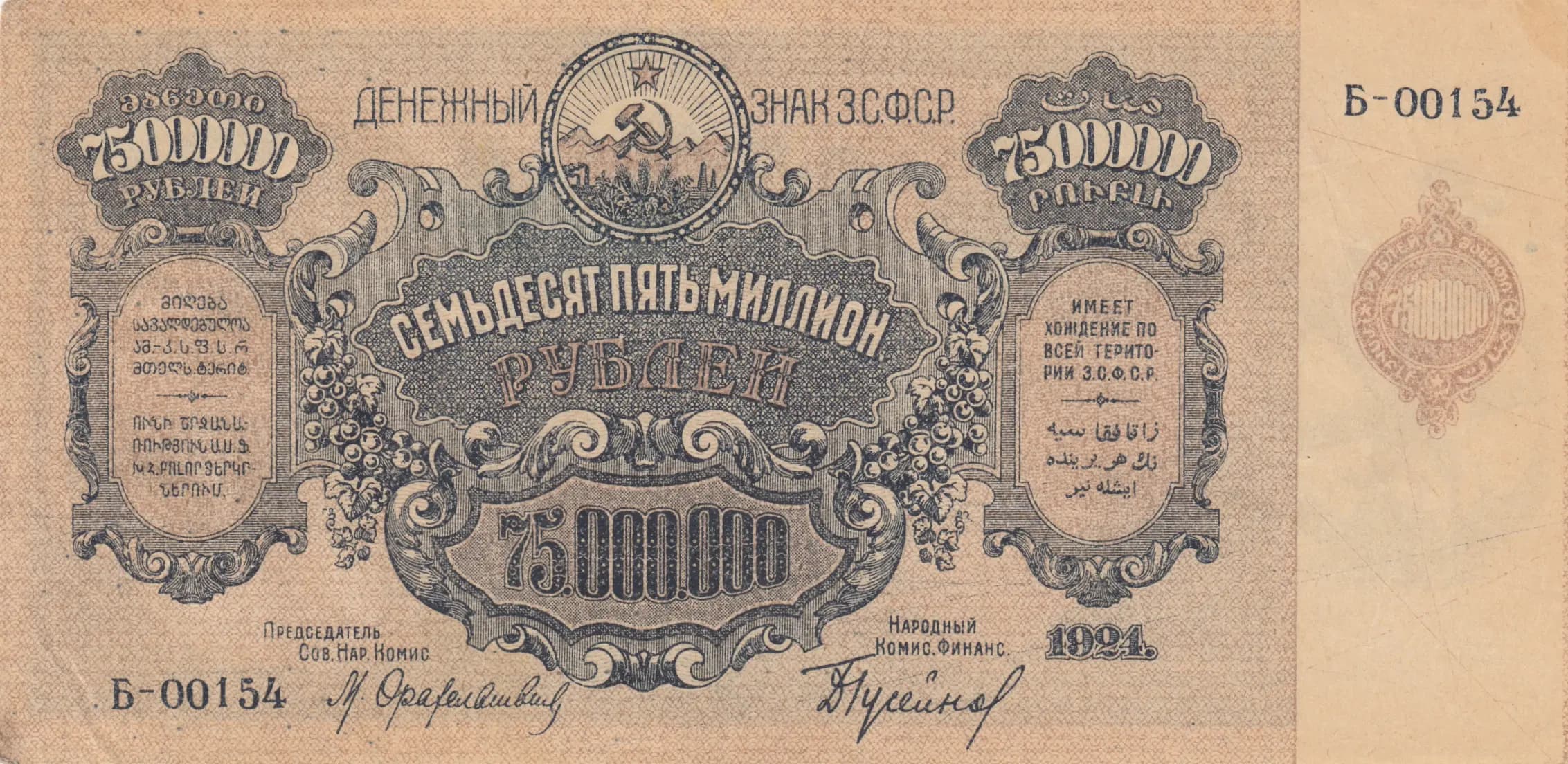
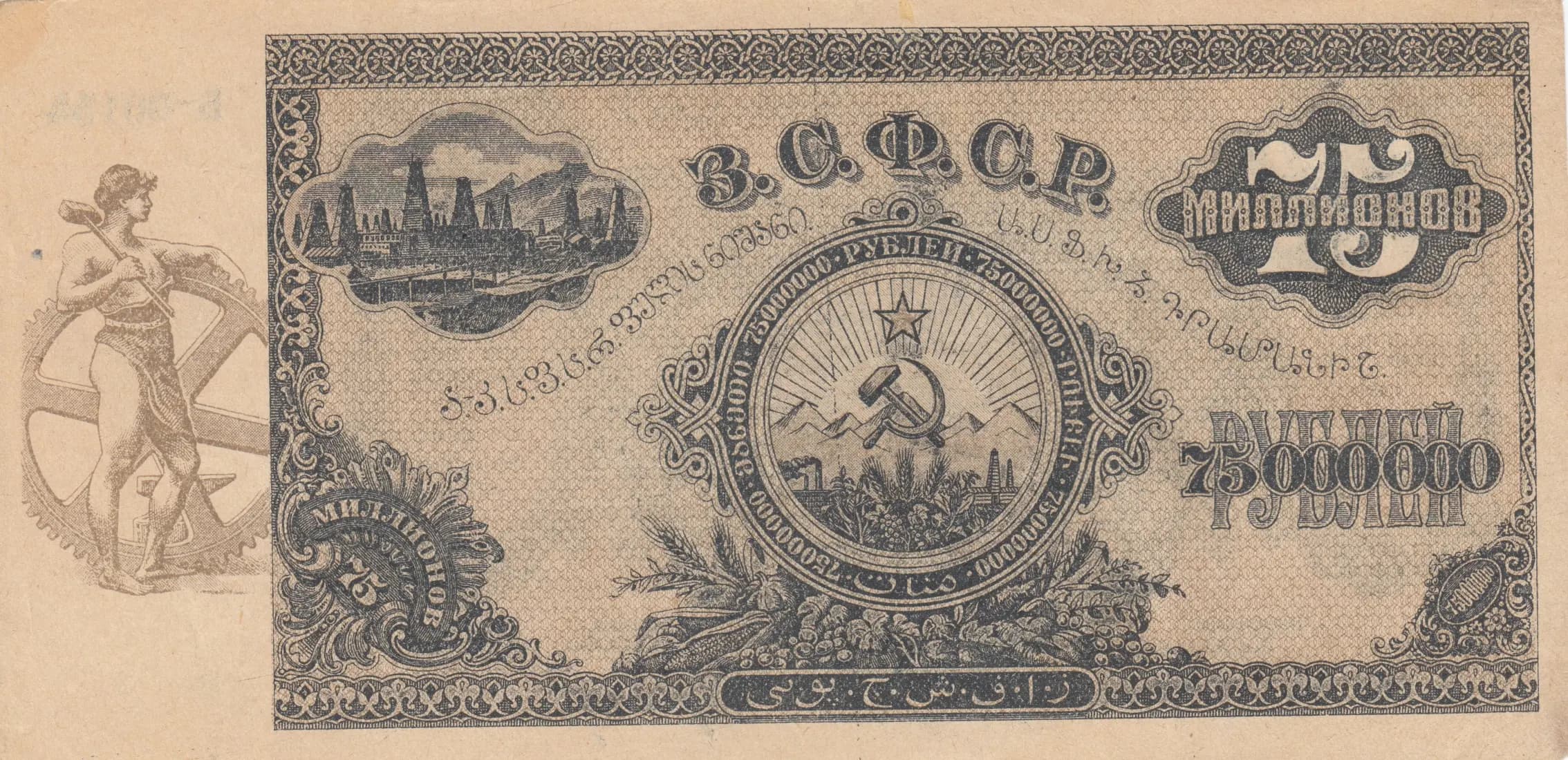
This is a 75,000,000 ruble note from the Transcaucasian Socialist Federal Soviet Republic issued in 1924, representing one of the hyperinflation-era Soviet currencies. The note displays classic early Soviet design with an ornate hammer and sickle emblem in a radiating sunburst medallion, fine engraved linework, and text in multiple scripts (Russian, Georgian, and Arabic), reflecting the multi-ethnic character of the Transcaucasus region. In VF condition, the note exhibits age-appropriate tan/beige patina, visible creasing and fold marks, and foxing consistent with a century-old historical artifact.
Common. The Transcaucasian Socialist Federal Soviet Republic issued significant quantities of currency during the 1924 hyperinflation period, and 75,000,000 ruble denominations were produced in large print runs to meet circulation demands. No historical evidence suggests this Pick number (P-S635b) was recalled, had an extremely limited issue, or was produced only briefly. While age and natural attrition have reduced absolute numbers in circulation, such notes remain readily available in the numismatic market at modest valuations, consistent with common hyperinflation-era Soviet currency.
This note was issued during the period of Soviet hyperinflation following the Russian Civil War, when the Transcaucasian Socialist Federal Soviet Republic (Z.S.F.S.R./Z.O.F.S.R.) functioned as a union republic from 1922-1936. The inclusion of Georgian and Arabic scripts alongside Russian reflects the diverse populations of Georgia, Azerbaijan, and Armenia within this political entity. The prominent hammer and sickle symbol and references to the Council of People's Commissars underscore the revolutionary communist ideology and centralized economic control that characterized early Soviet monetary policy.
The obverse (front) features a central oval medallion containing the state emblem—the hammer and sickle—surrounded by radiating sunburst lines, a dominant motif of early Soviet currency design. Large ornamental cartouches in the upper corners display the numerical denomination (750,000), with additional text in an elaborate frame beneath the central medallion. The reverse depicts an allegorical classical male figure on the left side representing labor or industrial production, a common theme in Soviet socialist realism iconography. An architectural vignette in the upper left-center shows an industrial or civic building with smokestacks, symbolizing Soviet industrial advancement. Both sides are framed with intricate linework and classical decorative elements. The inclusion of text in Russian, Georgian, and Arabic scripts reflects the note's intended circulation across the multi-ethnic Transcaucasian republics. The note's denomination appears both numerically (750,000/25,000,000) and spelled out in words, typical of high-value inflation-era notes.
FRONT SIDE: 'ДЕНЕЖНЫЙ ЗНАК З.С.ФСР.' (Money sign of the Z.S.F.S.R.); '750000 РУБЛЕЙ' (750,000 rubles) appearing twice in decorative cartouches; 'СЕМЬСЕСЯТЬМИЛЛИОН РУБЛЕЙ' (Seventy million rubles); 'ИМЕЕТ ХОЖДЕНИЕ ПО ВСЕЙ ТЕРРИТОРИИ З.О.С.Р.' (Has circulation throughout the entire territory of Z.O.S.R.); 'ПРЕДСЕДАТЕЛЬ СОВ.НАР.КОМИС' (Chairman of Council of People's Commissars); 'НАРОДНЫЙ КОМИС.ФИНАНС.' (People's Commissar of Finance); Serial number 'Б-00154' and date '1924'. Georgian and Arabic script texts appear on left and right sides respectively. BACK SIDE: 'З.О.Ф.С.Р.' (Z.O.F.S.R.); 'МИЛЛИОН' (Million); '25000000 РУБЛЕЙ' (25,000,000 rubles); 'ПЯТИДЕСЯТ МИЛЛИОН' (Fifty million). Armenian/Georgian and Arabic script texts appear in upper left and lower left areas.
The note was produced using intaglio engraving and letterpress printing techniques characteristic of Soviet currency production in the 1920s. The fine linework, intricate borders, decorative frames, and detailed ornamental patterns visible throughout are consistent with copper or steel plate engraving. The uniform tan/beige coloration and black impression indicate single-color printing on aged paper stock. This note was likely printed by the Gosgrafiya (State Printing Works) or a regional Soviet printing facility, though specific printer attribution for Transcaucasian issues may vary.
The observed specimen carries serial number Б-00154, indicating a relatively low serial number from the printing run. The variety designation 'P-S635b' in the Pick catalog likely denotes a specific signature or design variant; the 'b' suffix suggests this is a secondary variety of Pick catalog #S635. The multi-script inscription layout (Russian, Georgian, and Arabic) is characteristic of Transcaucasian issues and distinguishes them from contemporary Russian RSFSR notes. Collectors should note that signature varieties and serial number ranges may exist for this denomination, though the low serial number of this example suggests it is from an early printing.