500 rublei 1919
About This Note
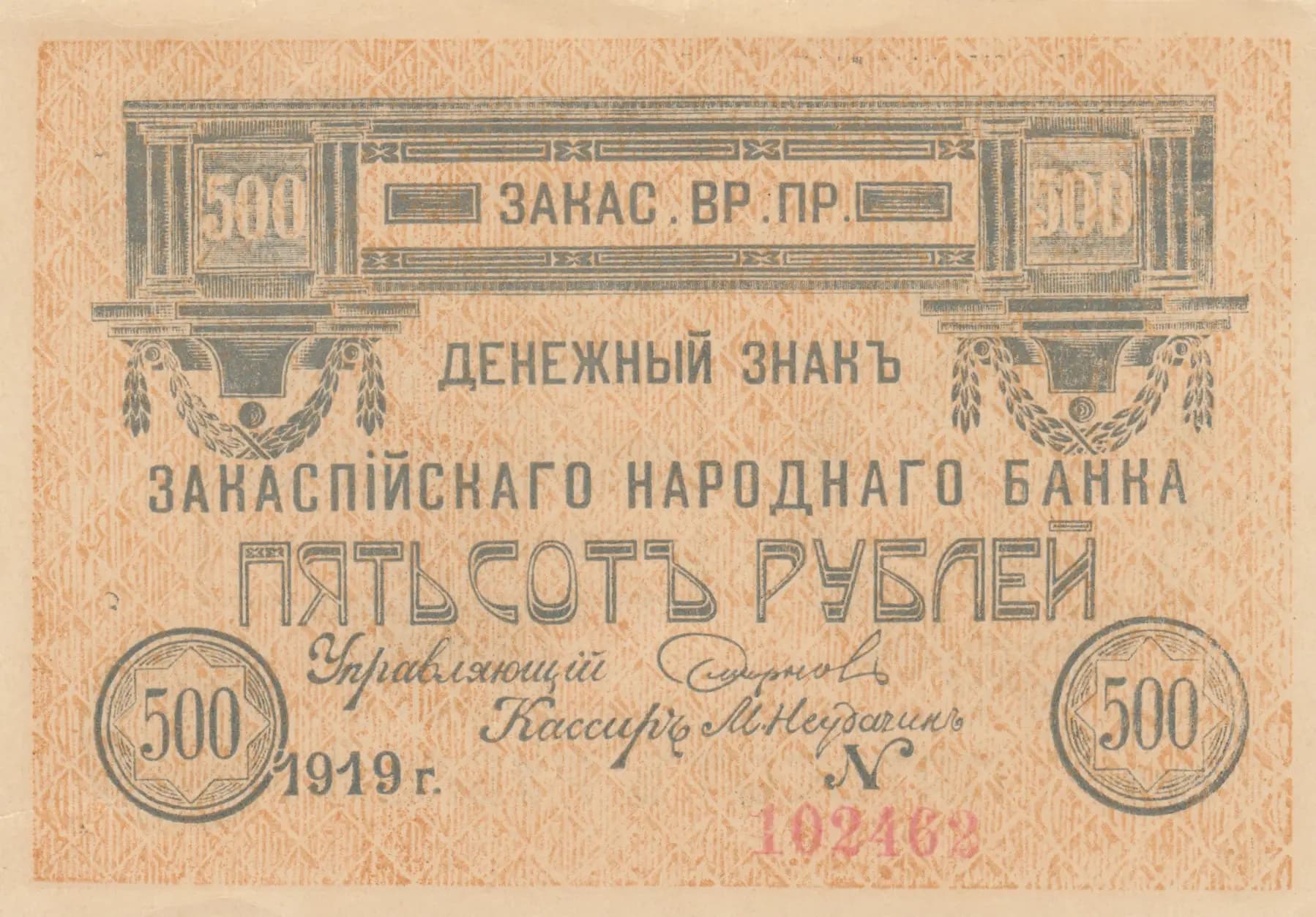
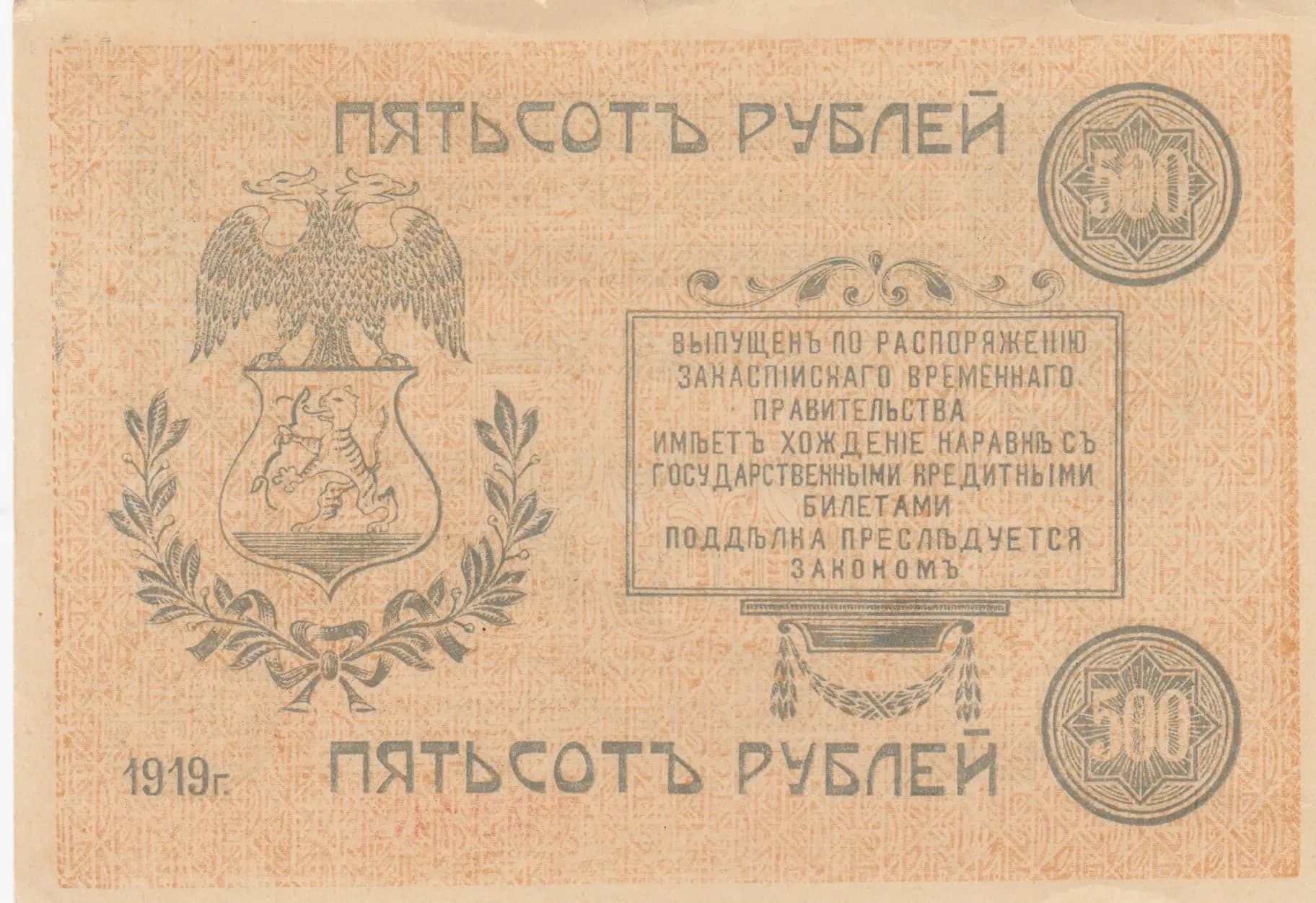
This 500 Rublei note from 1919 represents a fascinating piece of Russian Civil War-era currency issued by the Transcaspian National Bank, a short-lived authority during the tumultuous post-revolutionary period. The note exhibits classical Imperial Russian design elements including a double-headed eagle and ornate decorative borders rendered in fine line engraving, with warm peach and tan toning consistent with authentic aging. In AU condition, this note shows expected age-related patina including foxing and creasing while maintaining excellent legibility and structural integrity, making it a desirable example of this scarce regional issue.
Scarce. The Transcaspian National Bank operated only during the Russian Civil War period (1918-1920) in a geographically remote region, and its authority was short-lived and territorially limited. Unlike mainstream Imperial and Soviet issues with large print runs, Transcaspian notes were produced in far smaller quantities. The P-S catalog designation and limited collector demand indicate this is not a common circulation issue. However, it is not 'very rare'—surviving examples exist and appear in specialist collections focused on Russian Civil War currency. The AU condition grade places this in the upper range for surviving examples of this type.
The Transcaspian National Bank emerged during the Russian Civil War as part of the Temporary Government of the Zanapsk/Transcaspian region, a White Russian controlled territory in Central Asia. The note's design deliberately invokes Imperial Russian authority through the double-headed eagle and formal typography, while the explicit statement that the currency circulates equally with State Credit Notes reflects the desperate attempt of anti-Bolshevik authorities to maintain economic legitimacy. This issue represents the final gasp of Imperial-era banking institutions, as the Bolsheviks ultimately consolidated control over all monetary issuance by the early 1920s.
This note exemplifies the ornate neo-classical design aesthetic of late Imperial Russian currency. The obverse features a symmetrical rectangular composition with Corinthian pilasters flanking the central text field, supporting an entablature decorated with classical garland swags. Two circular medallions containing the denomination '500' occupy the bottom corners. The reverse presents the Russian Imperial double-headed eagle, rendered with heraldic precision and surrounded by a laurel wreath symbolizing victory and legitimacy—a potent symbol intentionally retained by White Russian authorities to contest Bolshevik claims to state succession. Two geometric sunburst/star emblems appear in circular frames on the right margin. The overall composition emphasizes continuity with Imperial Russian monetary tradition rather than revolutionary iconography.
FRONT SIDE: 'ЗАНАС.ВР.ПР.' (Zanapsk Temporary Government, abbreviated); 'ДЕНЕЖНЫЙ ЗНАКЪ' (Money Sign/Banknote); 'ЗАНАСПИЙСКОГО НАРОДНАГО БАНКА' (Of the Transcaspian National Bank); 'ПЯТЬ СОТ Ь РУБЛЕЙ' (Five Hundred Rubles); 'Правящий Совѣтъ Кассиръ М.Нейдлиръ' (Ruling Council Cashier M. Neidlir); '1919 г.' (1919); Serial number '10246'. BACK SIDE: 'ПЯТЬ СОТ Ь РУБЛЕЙ' (Five Hundred Rubles, appears twice); 'ВЫПУЩЕНЪ ПО РАСПОРЯЖЕНИЮ ЗАНАСПИЙСКАГО ВРЕМЕННАГО ПРАВИТЕЛЬСТВА ИМѢЕТЪ ХОЖДЕНИЕ НАРАВНѢ СЪ ГОСУДАРСТВЕННЫМИ КРЕДИТНЫМИ БИЛЕТАМИ ПОДДѢЛЬНА ПРЕСЛѢДУЕТСЯ ЗАКОНОМЪ' (Issued by order of the Transcaspian Temporary Government. Has equal circulation with State Credit Notes. Counterfeiting is prosecuted by law.); '1919г.' (1919).
Fine line engraving throughout, characteristic of high-security banknote production. The intricate decorative borders, detailed eagle rendering, and precise typography indicate professional steel plate engraving. The subtle color variation between peach/tan base and gray-green printing suggests offset or intaglio printing on tinted security paper, a standard technique for Imperial and early Soviet-era notes. The printer attribution is not definitively established for Transcaspian issues; production may have occurred at existing Imperial printing facilities seized by White Russian forces.
This example is identified by Pick catalog number P-S1139, specifically the 500 Rublei denomination of 1919 from the Transcaspian National Bank. The signature of Cashier M. Neidlir and the serial number 10246 are noted. No overprints are visible. Known varieties of this Pick number may include different signature combinations and serial number ranges, though detailed variety catalogs for Transcaspian issues are less extensively documented than for mainstream Russian issues. Further variety information would require consultation of specialized Russian Civil War currency references or the Pick catalog's supplementary notes on this issuer.