50 rublei 1919
“South Russia”
About This Note
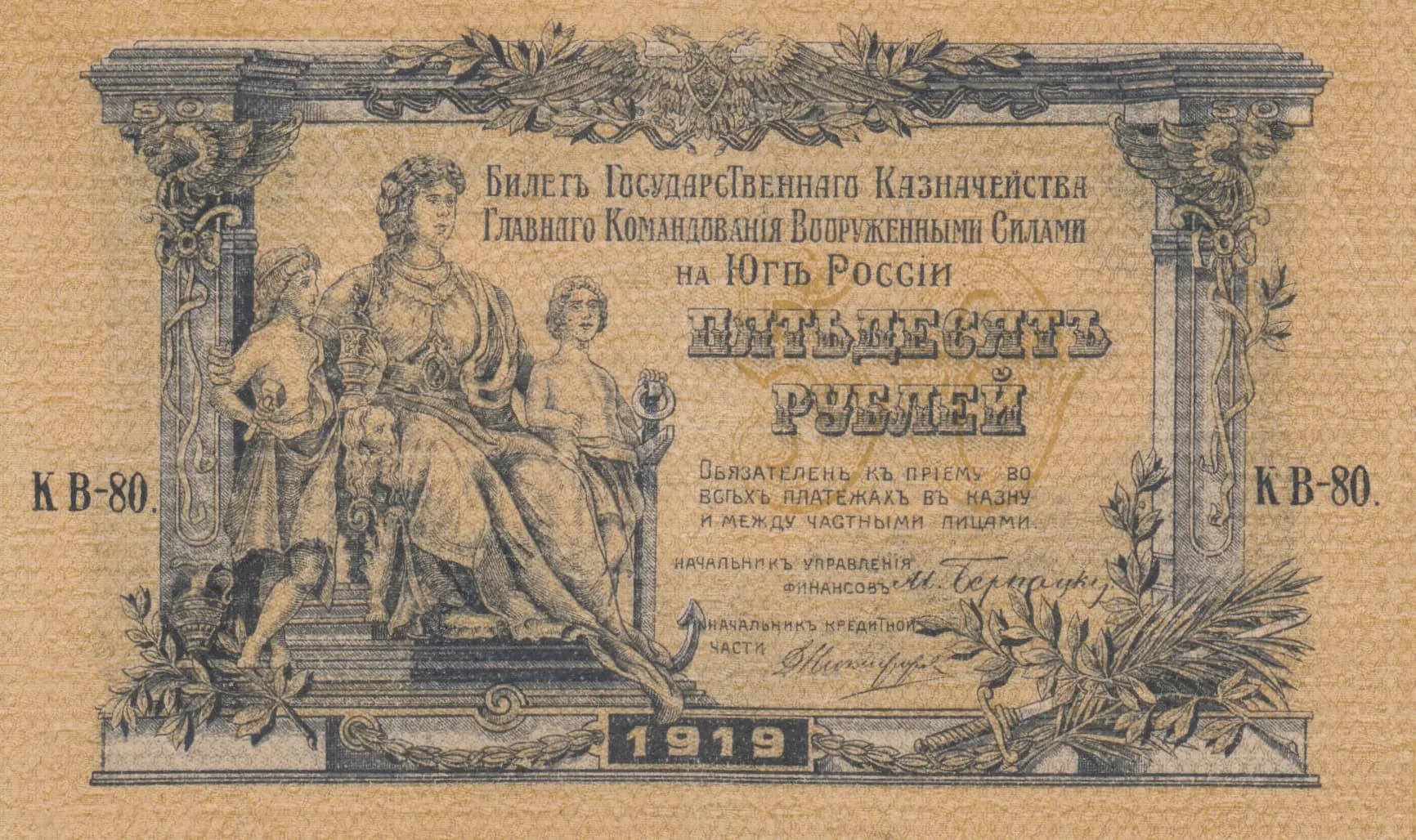
A handsome example of a 50 Rublei note issued in 1919 by the White Russian forces during the Russian Civil War, specifically by the State Treasury of the High Command of the Armed Forces in South Russia. The note displays exceptional preservation with clear, crisp engraving throughout and an attractive tan/beige patina consistent with age; no significant damage, tears, or creasing is evident. The ornate classical design featuring allegorical figures, imperial eagles, and elaborate architectural borders exemplifies the refined aesthetic of Russian Civil War era currency and represents an important piece of anti-Bolshevik monetary history.
Common. This note was issued in substantial quantities by the White Russian authorities in 1919 as part of their monetary system during the Civil War. While individual specimens have become scarcer over a century due to historical attrition, the denomination (50 rubles) and the relatively stable administration that issued it mean surviving examples are not particularly difficult to locate in the collector market. EF condition examples are more desirable than lower grades but do not command premium prices that would indicate rarity. The Pick catalog's inclusion and straightforward designation (P-S422a without variety notation) suggests this is a standard, commonly encountered issue rather than a limited or recalled variant.
This note was issued during the Russian Civil War (1918-1922) by the White Russian government in southern Russia, when multiple competing authorities issued their own currency as the Bolshevik Revolution fragmented the former Russian Empire. The prominent double-headed imperial eagle and classical allegorical imagery reflect the White movement's continued allegiance to imperial Russian traditions and legitimacy, contrasting sharply with Bolshevik monetary designs. The reference to the 'Main Command of the Armed Forces in Southern Russia' (typically associated with General Denikin's White Army) dates this to the period when anti-Bolshevik forces controlled significant territory in southern Russia before their ultimate defeat.
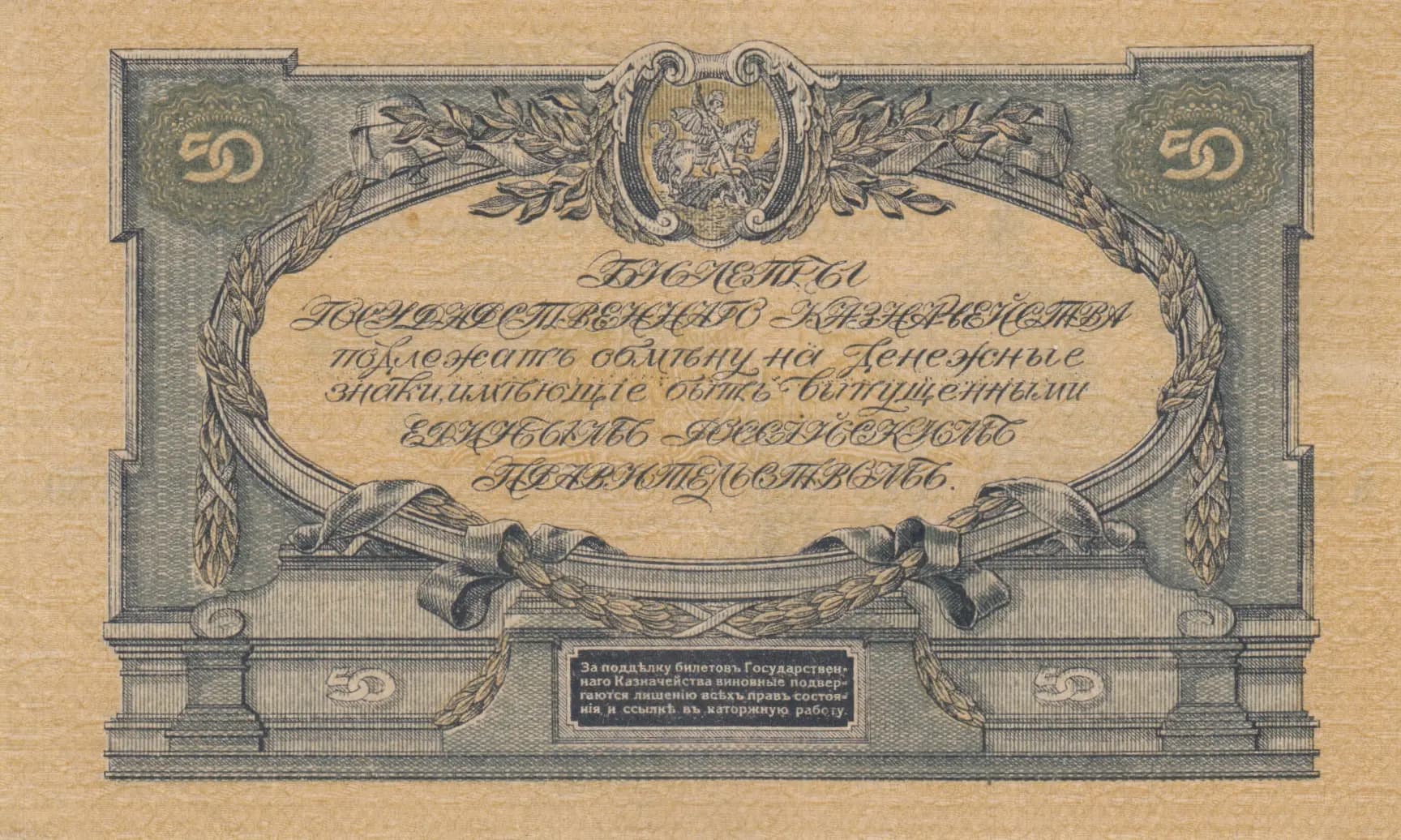
The front features a classical allegorical composition representing Russia or state authority as a seated female figure in draped classical garments, accompanied by a child and cherub figures in the lower portion, rendered in the neoclassical style common to imperial Russian currency. The design is framed by an elaborate architectural border featuring Corinthian columns with ornate capitals, a decorative cornice, and laurel wreaths—symbols of victory and authority. The imperial double-headed eagle with spread wings and crown appears prominently at the top center, affirming the note's connection to Russian imperial legitimacy. The back showcases a symmetrical design centered on an imperial eagle within an ornamental oval cartouche, flanked by laurel wreaths and surrounded by an intricate rectangular frame with corner ornaments. The overall composition emphasizes imperial legitimacy and classical Russian aesthetics, deliberately contrasting with Bolshevik monetary designs of the period.
FRONT SIDE: Main inscription reads 'Ticket of the State Treasury of the Main Command of the Armed Forces in Southern Russia' (Билет Государственнаго Казначейства Главнаго Командования Вооруженными Силами на Юго России). Denomination: 'FIFTY RUBLES' (ПЯТЬДЕСЯТ РУБЛЕЙ). Legal tender clause: 'Obligatory for acceptance in all payments to the treasury and between private persons' (Обязателен к приему во всех платежах и в казну и между частными лицами). Signature lines indicate 'Head of Financial Administration' and 'Head of Credit Section.' Serial identifier: KB-80, Year: 1919. BACK SIDE: Complex legal text regarding the nature of the ticket as State Treasury currency subject to general monetary circulation. Warning text: 'For counterfeiting tickets of the State Treasury, the guilty parties are subject to deprivation of all rights and exile to labor' (За подделку билетов, Государственного Казначейства виновые подвергаются лишению всех прав и ссылке в которую работу). Corner ornaments display the Cyrillic letter 'Д' (D).
Intaglio engraving (copperplate/steel plate printing), a traditional and security-conscious method used for high-value currency. The fine line engraving visible throughout both sides, the precise detail in the allegorical figures, architectural elements, and the sharp definition of the eagle emblem are characteristic of intaglio work. Multiple passes and careful register demonstrate professional security printing standards. The intricate border designs and layered decorative elements served both aesthetic and anti-counterfeiting purposes. While the specific printer for this issue is not documented in standard catalogs, the quality suggests production by a capable Russian printing facility under White Russian administration, likely in southern Russia during 1919.
This note is cataloged as Pick-S422a, with the 'a' designation potentially indicating a specific variety, though without access to detailed variety information for this Russian Civil War issue, the precise distinction (possibly signature variants, serial number prefixes, or minor design differences) cannot be definitively stated. The serial identifier 'KB-80' visible on this specimen should be noted. Russian Civil War currency from South Russia sometimes shows minor variations in printing quality, signature combinations, and serial number formats depending on the specific printing location and date of issue within the 1919 period. Collectors should cross-reference examples with the specialized Russian Civil War currency catalog for confirmation of variety status.