50 kopeek 1915
Market Prices
41 salesAbout This Note
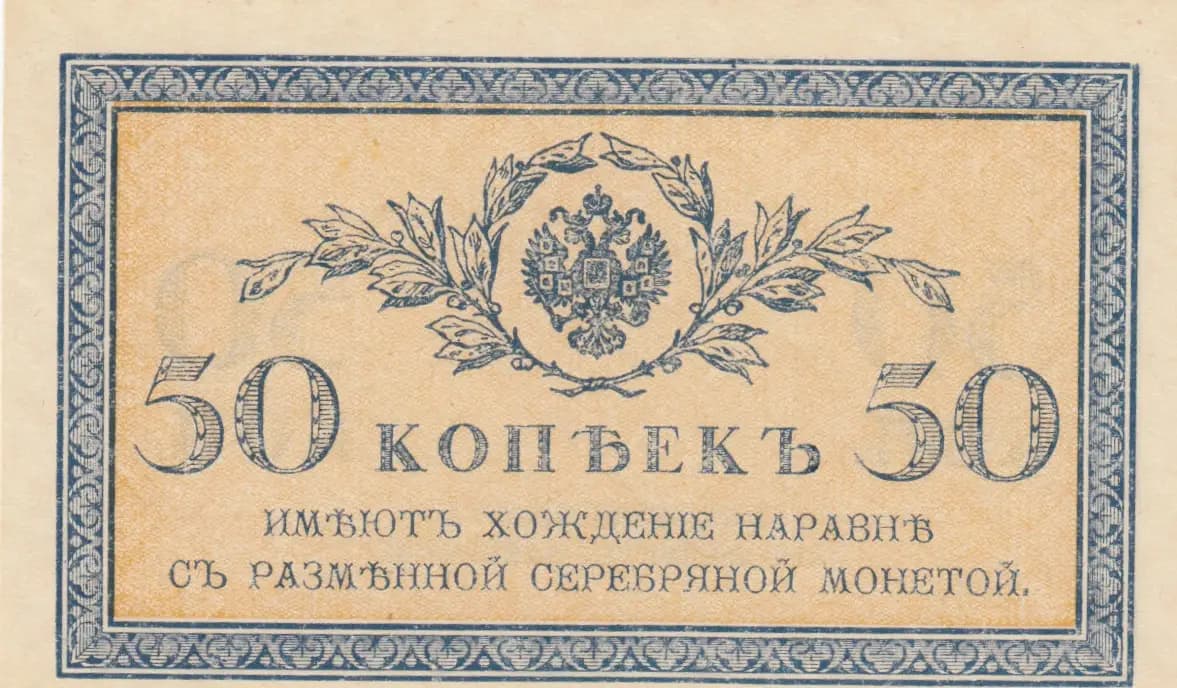
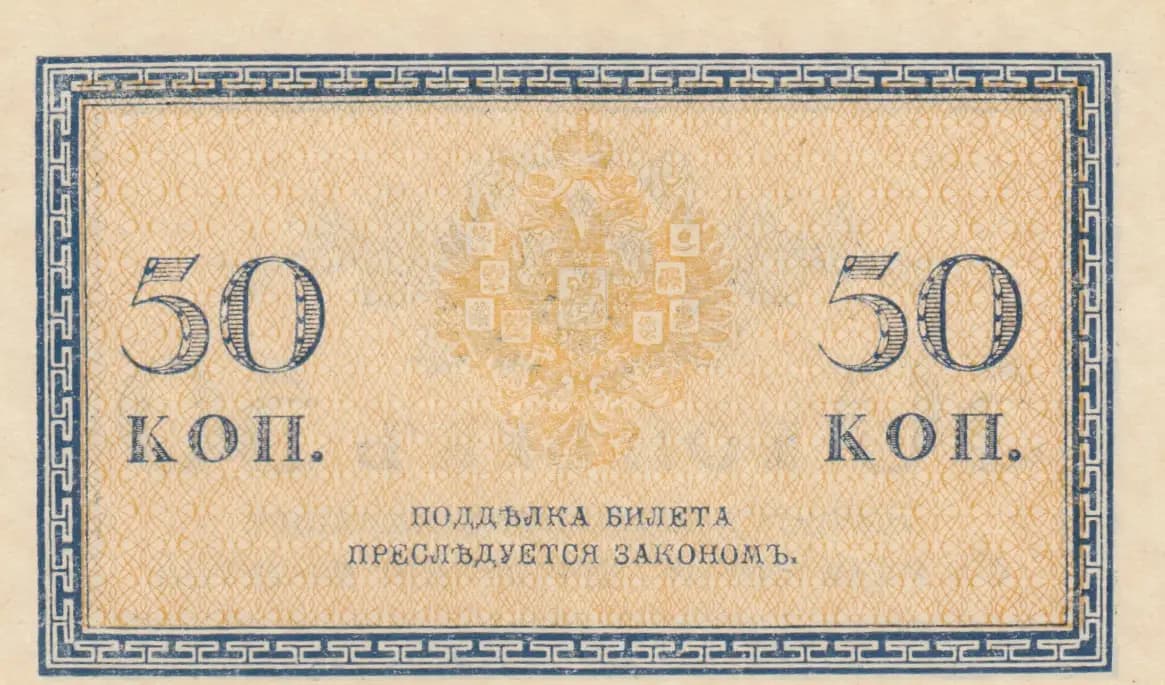
This is an exceptionally well-preserved 1915 Russian 50 kopeck note in uncirculated condition, featuring the iconic imperial double-headed eagle crowned with the Romanov insignia at its center. The cream and blue color scheme with decorative guilloche borders and Greek key pattern elements demonstrates the refined security printing standards of late Imperial Russia. The note exhibits no signs of wear, creasing, or deterioration, making it an attractive example of early 20th-century Russian monetary instruments during the final years of the Empire.
Common. Secondary market data from eBay transactions spanning 2009-2025 demonstrates consistent, relatively abundant availability with frequent sales across all condition grades. Uncirculated examples have sold consistently in the $2-$5 range historically (2010-2017), with even PMG-graded specimens (UNC and higher) typically not exceeding $70, while the vast majority of transactions fall below $10. The large number of recorded sales (40+ transactions) over a 15-year period indicates this is a frequently encountered note among collectors. The 1915 50 kopeck appears to have had a substantial original print run and survives in quantity today.
Issued in 1915 during World War I, this 50 kopeck note represents the Russian Empire's currency system under Tsar Nicholas II, with the imperial coat of arms prominently displayed as a symbol of state authority. The inscriptions explicitly reference the note's legal tender status and its relationship to silver coin backing, reflecting the Empire's commitment to currency stability during the tumultuous war years. This particular note was issued just two years before the Russian Revolution would fundamentally transform the nation's political and monetary systems.
The obverse features a symmetrical composition centered on the Imperial Russian coat of arms—a crowned double-headed eagle with scepter and orb, flanked by laurel wreaths symbolizing power and honor. The design is framed by ornamental borders incorporating guilloche patterns in blue on a cream and tan background, with large blue denomination numerals '50' positioned on both lateral margins. The reverse maintains the same color palette and symmetrical design philosophy, with a watermarked or faint coat of arms visible in the center background, bordered by a distinctive Greek key pattern in blue. All text appears in pre-revolutionary Cyrillic script with the historical characters (Ѣ for yat, Ѵ for izhitsa) typical of early 20th-century Russian typography.
FRONT SIDE: '50' (denomination, appears twice on left and right margins); 'КОПЬЕКЪ' (kopeck); 'ИМѢЮТЪ ХОЖДЕНИЕ НАРЯДѴ СЪ РАЗМѢННОЙ СЕРЕБРЯНОЙ МОНЕТОЙ' (translates to 'Have circulation alongside exchangeable silver coin' - indicating the note's convertibility to silver currency). BACK SIDE: '50' and 'КОП.' (kop./kopeck abbreviation, appears twice on left and right margins); 'ПОДДЪЖКА БИЛЕТА ПРЕДПОЛАГАЕТСЯ ЗАКОНОМ' (translates to 'The support of the note is provided by law' - affirming legal backing for the currency).
This note was produced using intaglio printing (engraving), the dominant security printing method for Russian Imperial currency of this period. The technique enabled the fine detail visible in the coat of arms, decorative border elements, and guilloche patterns that served as anti-counterfeiting measures. Russian Imperial notes of this era were typically produced by the State Printing Works in St. Petersburg (Petrograd), though some sources indicate involvement of the Russian-American Printing Company. The multi-color nature of the design (blue and gold/tan underprint) required multiple passes and careful registration.
Pick catalog lists this as P-31 for the 1915 issue without noted major varieties in standard references. The note may exist with minor variations in serial number ranges, typography details, or printer's marks typical of Imperial Russian currency production runs, but no significant varieties (such as different signatures, overprints, or emergency issues) are documented for this specific denomination and year. Collectors should note the presence of pre-revolutionary Cyrillic characters (Ѣ, Ѵ) as confirmation of authentic 1915-era production rather than later Soviet reprints.