50 000 rublei 1921
About This Note
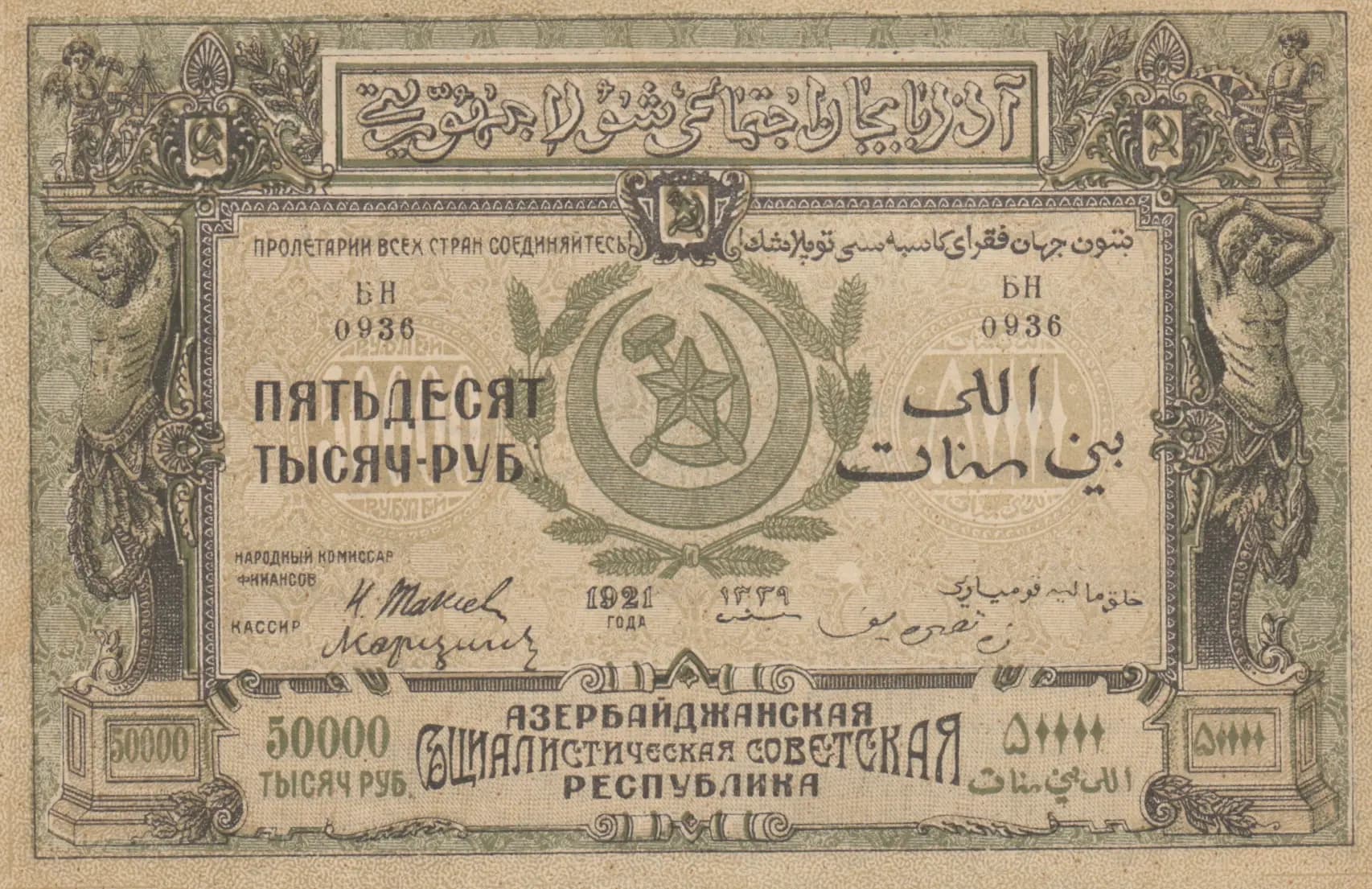
This 50,000 ruble banknote from the Azerbaijan S.S.R. (1921) exemplifies early Soviet currency design with its bilingual Russian-Persian text, reflecting Azerbaijan's unique position within the Soviet Union. The note features a striking central red star within a wheat wreath—potent Communist imagery—flanked by classical allegorical female figures in ornate frames. In AU condition, this note displays light aging consistent with its century-old provenance, with minor yellowing and creasing but no significant damage, making it a well-preserved example of a regionally-issued Soviet denomination.
Common. This denomination and issuing authority represent standard early Soviet regional currency production. The Azerbaijan S.S.R. issued multiple denominations in 1921, and the 50,000 ruble note was part of routine monetary circulation during the period. Print runs for regional Soviet notes of this era were substantial, as they served essential functions in the newly-consolidated republic's economy. The AU condition grade is more desirable than heavily circulated examples, but the note itself is not scarce. No documented recall or short-lived status significantly impacts availability. Most collectors can acquire examples of this Pick number without exceptional difficulty, placing it firmly in the common category.
Issued during the formative years of the Azerbaijan Socialist Soviet Republic (established 1920), this banknote represents the early Soviet period's experimental monetary system when regional republics issued their own currency. The bilingual Russian-Persian inscriptions and the dominant red star with hammer-and-sickle symbolism reflect the Bolshevik consolidation of the Caucasus region and the emphasis on proletarian internationalism expressed in the 'Workers of the World, Unite!' motto. The note's assertion that it 'has circulation equal to Russian monetary signs' underscores Moscow's efforts to integrate regional economies under Soviet control during the civil war era.
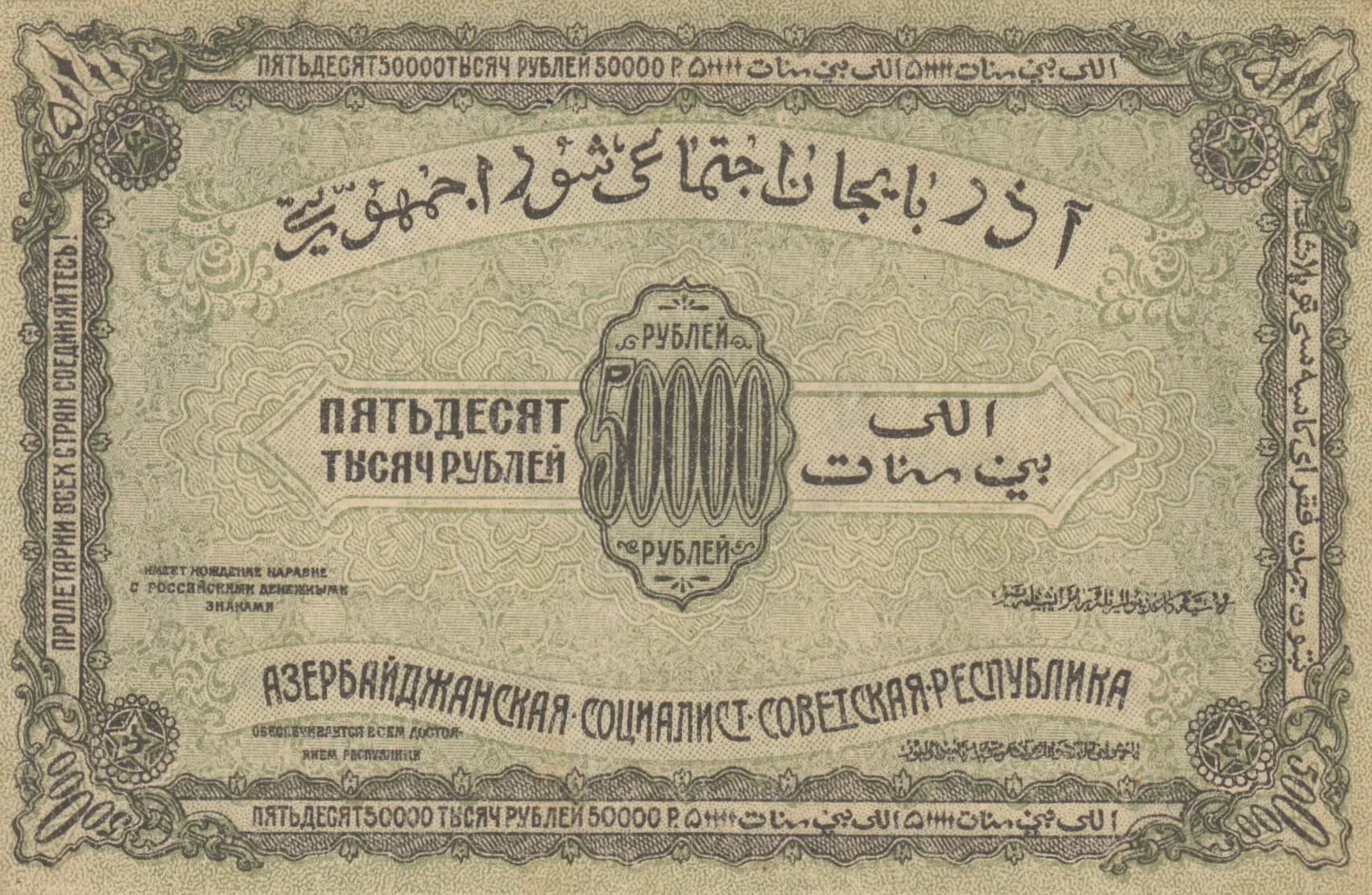
The obverse (front) features a symmetrical classical design with allegorical female figures representing Liberty or Progress positioned in ornate decorative frames on either side of the composition. The dominant central motif is a red five-pointed star enclosed within a circular wreath of wheat or grain sheaves, symbolizing agricultural labor and Soviet power. This wreath incorporates hammer and sickle imagery within or adjacent to the star—the primary emblem of the Soviet state. The design employs ornate neoclassical borders with laurel wreaths, floral scrollwork, and architectural ornamental elements in the corners, creating a formal, authoritative appearance typical of early Soviet state currency. The reverse (back) emphasizes the denomination prominently displayed in large numerals (50000) within an ornamental rectangular frame, with the sovereignty declaration and bilingual text in Russian Cyrillic and Persian/Farsi script, reflecting Azerbaijan's linguistic and cultural composition. The color palette of olive green, tan, cream, and brown provides sophisticated tonal variation across both sides.
FRONT SIDE: 'ПРОЛЕТАРИИ ВСЕХ СТРАН СОЕДИНЯЙТЕСЬ' = 'Workers of the World, Unite!' | 'ПЯТЬДЕСЯТ ТЫСЯЧ РУБ' = 'Fifty Thousand Rubles' | '1921 ГОДА' = 'Year 1921' | 'АЗЕРБАЙДЖАНСКАЯ СОЦИАЛИСТИЧЕСКАЯ СОВЕТСКАЯ РЕСПУБЛИКА' = 'Azerbaijan Socialist Soviet Republic' | 'НАРОДНЫЙ КОМИССАР ФИНАНСОВ' = 'People's Commissar of Finance' | 'КАССИР' = 'Cashier' | Signature: 'Н Маркул' = 'N. Markul' | Serial number: 'ВН 0936' (Cyrillic) | '50000 ТЫСЯЧ РУБ' = '50000 Thousand Rubles' | Persian/Farsi text includes denomination and administrative notations. BACK SIDE: 'ПЯТЬДЕСЯТ ТЫСЯЧ РУБЛЕЙ 50000 Р' = 'Fifty Thousand Rubles 50000 R' | 'ПРОЛЕТАРИИ ВСЕХ СТРАН СОЕДИНЯЙТЕСЬ' = 'Workers of the World, Unite!' | 'имеет хождение наравне с российскими денежными знаками' = 'has circulation equal to Russian monetary signs' | Bilingual text repeated with Persian/Farsi script providing parallel inscriptions.
This note employs intaglio (engraved) printing, evidenced by the fine, intricate line work visible throughout the design, particularly in the ornamental borders, allegorical figures, and decorative patterns. The precision of the classical figural work and the delicate rendering of the wheat wreath and architectural elements are characteristic of high-quality intaglio production. Multiple color printing was used to achieve the olive green, tan, cream, and brown hues. While the specific printer is not definitively documented in the visual analysis, early Soviet regional currency from 1921 was typically produced by state-controlled printing facilities; the Azerbaijan S.S.R. may have utilized printing works in Baku or contracted Moscow's facilities. The ornamental security features, including the dense engraved patterns and the naturalistic rendering of the allegorical figures, provided protection against contemporary counterfeiting methods.
The serial number prefix 'ВН 0936' (BH 0936 in transliteration) is visible on the front; serial number variations and signature varieties are typical for Soviet regional notes of this period. The signature 'Н Маркул' (N. Markul) identifies the People's Commissar of Finance for this issue. Different serial prefixes and potentially different signature variants may exist for this Pick number (P-S716), as multiple officials may have signed during the note's production run. The bilingual Russian-Persian text is a consistent design feature rather than a variety indicator. Researchers should cross-reference documented signature and serial varieties in the Soviet numismatic literature to identify specific subtypes, though such granular variety information for Azerbaijan S.S.R. notes remains less extensively catalogued than for Russian RSFSR currency of the same period.