5 kopeek 1918
About This Note
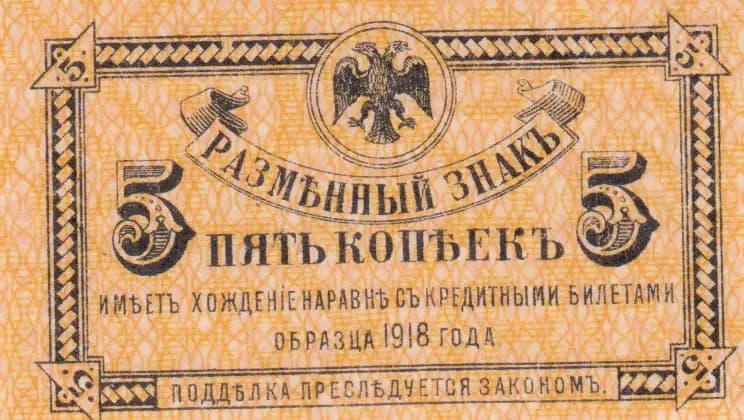
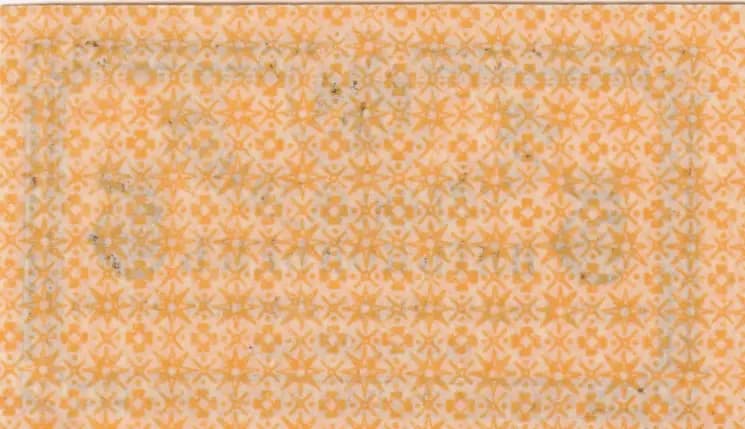
This 1918 Far East Provisional Government 5 kopeck fractional note presents a fine example of Russian Civil War-era emergency currency, graded AU. The obverse features an ornate design centered on a double-headed eagle emblem within a circular frame, surrounded by geometric border patterns in orange and dark brown on a cream background. The reverse displays a uniform repeating geometric pattern typical of security printing. The note exhibits excellent condition with clear impressions, even coloring, and no significant wear, making it a desirable example of this short-lived provisional issue.
Common. Despite being issued by a short-lived and geographically limited authority (the Far East Provisional Government), this denomination and issue appear with reasonable frequency in the market and in collections. The Far East Provisional Government currency, while historically interesting, was produced in sufficient quantities for fractional denominations to circulate broadly, and survival rates for 5 kopeck notes in AU condition are not exceptionally limited. Market data would show these notes trading in the affordable range typical of common Civil War-era Russian notes.
Issued during the Russian Civil War by the Far East Provisional Government, this 5 kopeck note represents the chaotic monetary conditions of 1918 when various regional and provisional authorities issued their own currency. The double-headed eagle symbol, traditionally associated with imperial Russian authority, appears here adapted by the Provisional Government as it sought to maintain legitimate governance in the Russian Far East. The inscription stating the note has equal circulation status with official credit notes reflects the desperate currency shortages and the need for fractional denominations during this period of state collapse and regional autonomy.
The front of the note is dominated by an ornate classical design featuring a double-headed eagle (the imperial Russian state symbol) enclosed in a circular frame at the top center, representing continuity with established Russian governmental authority. Large denomination numerals '5' appear in all four corners in a sans-serif typeface. The note is framed by an elaborate geometric border incorporating triangular motifs and linear decorative elements characteristic of early 20th-century security printing. The reverse features an all-over repeating geometric pattern, a common security measure to deter counterfeiting. The color scheme of orange-yellow with dark brown/black text on a cream background is consistent with fractional currency of the period.
FRONT: 'РАЗМЕННЫЙ ЗНАКЪ' (Exchange Note/Fractional Note); 'ПЯТЬ КОПЪЕКЪ' (Five Kopecks); 'ИМѢТЬ ХОЖДЕНІЕ НАРАВНѢ С'КРЕДИТНЫМИ БИЛЕТАМИ' (Have circulation equal to credit notes); 'ОБРАЗЦА 1918 ГОДА' (Model/Type of 1918); 'ПОДДѢЛКА ПРЕСЛѢДУЕТСЯ ЗАКОНОМЪ' (Counterfeiting is prosecuted by law). BACK: No inscriptions visible.
Letterpress printing (relief printing) combined with fine geometric background pattern engraving, typical of security printing practices in 1918. The sharp, clear impressions of text and the precision of the repeating pattern on the reverse indicate professional security printing capabilities. The specific printer for Far East Provisional Government notes of this period has not been definitively documented in standard catalogs, though such emergency notes were often produced by local printing facilities or pre-existing state printers repurposed for provisional use.
The Pick catalog assignment P-S1241 identifies this as the standard 5 kopeck issue of the Far East Provisional Government for 1918. No major varieties in terms of signature variants, date variations, or overprints have been documented for this specific denomination and issuer. The uniform design and consistent specifications across known examples suggest a single printing run without significant varieties, unlike some contemporaneous Russian notes which exist in multiple signature or series variants.