5 kopeek 1915
Market Prices
30 salesAbout This Note
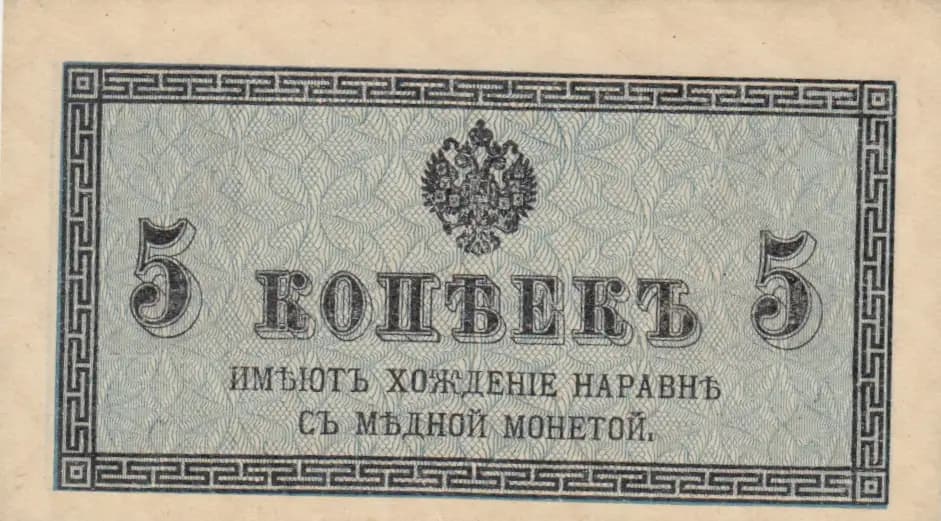
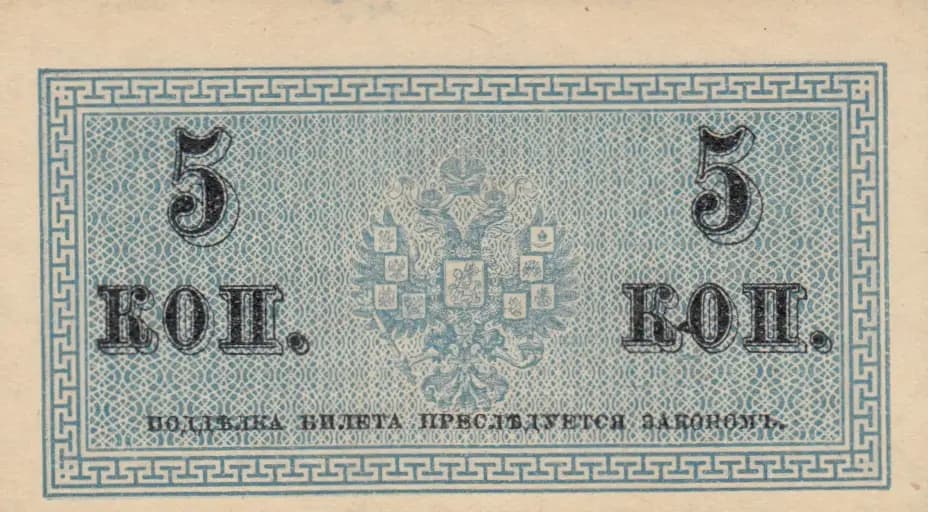
This 1915 Russian Imperial 5 kopeck note is presented in AU condition, displaying the characteristic light greenish-gray obverse and light blue-gray reverse typical of this regular issue. The note features crisp printing of the double-headed Imperial eagle at center, clear inscriptions in period Cyrillic typography, and decorative Greek key borders. Minimal wear and age-appropriate discoloration suggest careful preservation of this early 20th-century Russian emergency currency.
Common. eBay market data shows consistent sales across multiple condition grades, with typical prices ranging from $1-$12.50 for ungraded notes and up to $66 for PMG 66 certified examples. AU specimens regularly appear on the market at modest prices ($3-$7.50 range historically), indicating substantial surviving quantities. This was a regular wartime issue with significant print run, and the denomination remains readily available to collectors.
Issued during the final years of the Russian Empire, this 5 kopeck note represents the small-denomination paper currency necessitated by World War I and the drain on copper coin supplies. The Imperial double-headed eagle coat of arms depicted at the center symbolized the authority of the Tsar's government, while the text warning against counterfeiting reflects the serious counterfeiting problems that plagued Russian wartime currency. These notes were officially declared to have equal circulation value to copper coins, as stated in the front inscription.
The obverse features the Russian Imperial coat of arms—a double-headed eagle with crown—positioned prominently at the upper center, rendered in black against a light greenish-gray background with fine crosshatch security pattern. Denomination numerals '5' appear in all four corners. The reverse displays the same Imperial coat of arms at center in lighter tones against a light blue-gray background with similar geometric patterning. Both sides are framed with an ornamental Greek key border. The typography uses formal serif fonts appropriate to official Imperial currency, with text in Cyrillic script. No portraits appear on this denomination; the heraldic eagle serves as the sole figurative element.
Obverse: '5' (denomination numerals, top left and right); 'КОПЪЕКТ' (Kopeck); 'ИМЪЮТЪ ХОЖДЕНИЕ НАРАВНЪ СЪ МЪДНОЙ МОНЕТОЙ.' (Have circulation equal to copper coins). Reverse: '5' (denomination numerals, top left and right); 'КОП.' (Kop./Kopeck abbreviation, left and right); 'КАССИРША БИЛЕТА ПРЕСЛЕДУЕТСЯ ЗАКОНОМ.' (Counterfeiting of this note is prosecuted by law). Note: Text uses pre-1918 Russian orthography including the hard sign (ъ) and soft sign (ь).
Letterpress printing with security enhancements. The fine crosshatch and geometric grid patterns visible throughout the note represent anti-counterfeiting measures typical of Russian Imperial currency production. The use of dual-color printing (black text and borders on colored underprints) and the precise registration of the decorative borders indicate production by the Russian Imperial State Security Printing Office, which handled high-security government currency production during this period.
This note is cataloged as Pick P-27 for the 1915 regular issue. Known varieties for Russian Imperial emergency currency of this period may include differences in paper tone (greenish-gray vs. blue-gray variations noted in visual analysis) and potentially signature or control mark variations, though specific variety designation typically requires examination of serial numbers, signatures, and control marks not clearly identifiable in the provided images. The visual analysis documents the standard design with Imperial eagle in both obverse and reverse positions.