30 000 = 3 rublei 1922
“Central Asia”
About This Note
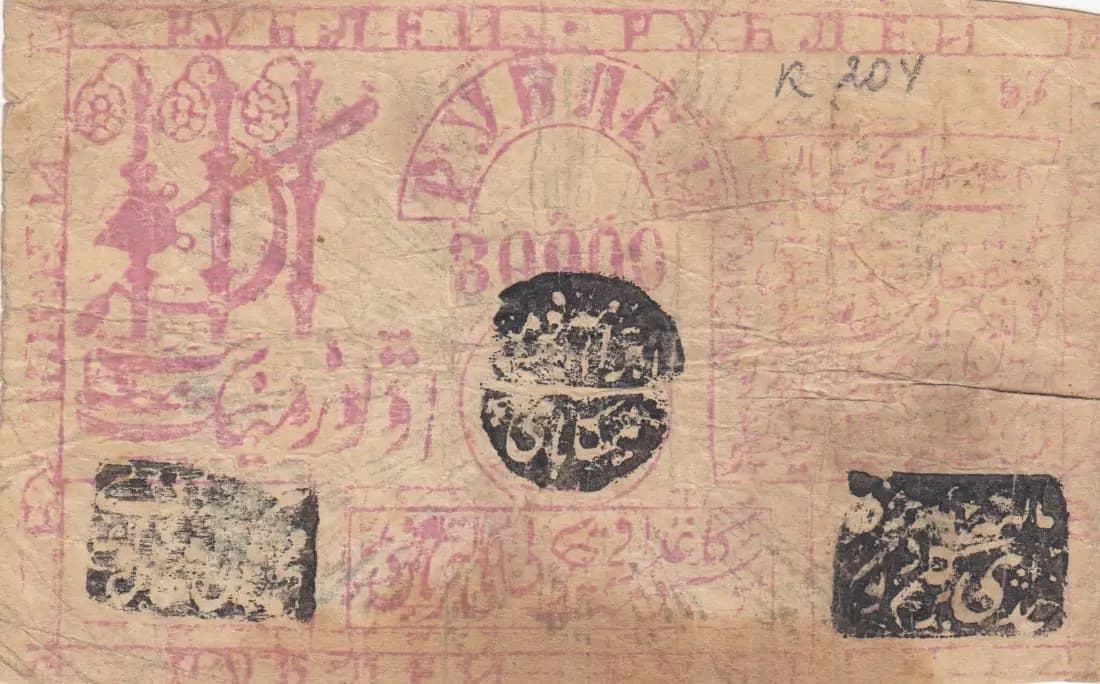
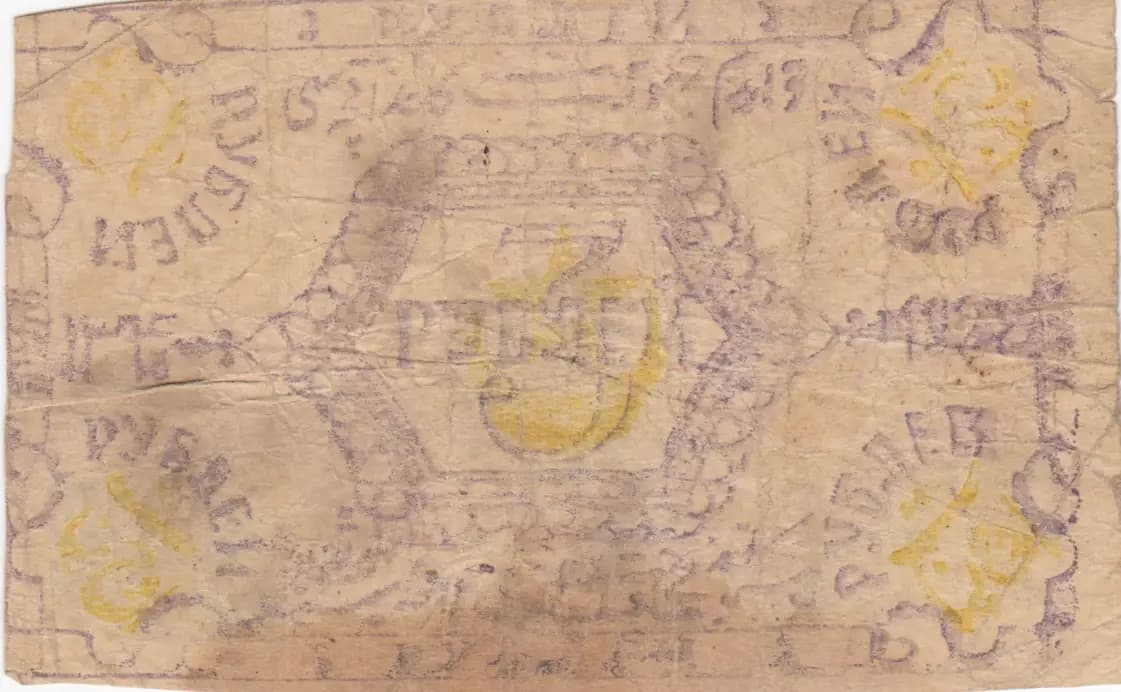
This is a 30,000 rublei (3 rublei) note from the Khorezm Peoples Soviet Republic issued in 1922, representing an early Soviet Central Asian currency during the transitional period following the Russian Civil War. The note displays the ornate Art Nouveau styling characteristic of early 1920s Soviet design, with elaborate pink/magenta decorative borders on the obverse and golden corner emblems on the reverse. In Fair condition, the note shows extensive wear with multiple official stamp impressions, significant creasing, and heavy fading of the reverse text, making it a historically significant yet well-circulated example of this geographically and politically important issuer.
Common. The Khorezm Peoples Soviet Republic operated for only four years (1920-1924) before absorption into the USSR, and while notes from this issuer are geographically interesting to collectors of Central Asian currency, they were produced in sufficient quantities for circulation. The Fair condition and evidence of heavy circulation (three stamp impressions, extensive wear, fading) suggest this note was widely distributed and used. No historical evidence indicates a particularly small print run or immediate recall that would elevate this denomination to scarce or rare status. Notes from defunct Soviet republics are moderately collected but not premium-priced in current markets.
The Khorezm Peoples Soviet Republic (1920-1924) was a short-lived Soviet client state in Central Asia, and this banknote reflects the region's brief autonomy before incorporation into the USSR. The elaborate circular seal on the obverse and symmetrical corner emblems on the reverse demonstrate the republic's attempt to establish visual legitimacy and sovereignty through formal numismatic design. The three official black stamp impressions visible on the front are characteristic of Soviet-era currency handling and administrative processing during a period of political flux and currency standardization across the former Russian Empire.
The obverse features an ornate decorative border in pink/magenta with elaborate floral and geometric scrollwork typical of Art Nouveau styling. A large circular central seal or state emblem in black with white details serves as the primary focal point, likely representing the authority of the Khorezm Peoples Soviet Republic. Three black rectangular official stamps or seals are impressed across the lower portion, indicating administrative handling and validation. The reverse displays a symmetrical composition with four large yellow/golden ornamental coat of arms or heraldic emblems positioned at the cardinal points of the design, framed by elaborate scrollwork borders. The center area contains faded purple/violet text and decorative elements rendered in multi-color printing. The overall aesthetic reflects the transitional design philosophy of early Soviet Central Asian currencies, balancing traditional ornamental styling with emerging Soviet symbolic authority.
Front: 'R 20V' appears as a reference or catalog marking. Back: Cyrillic text present throughout but heavily faded and illegible in current condition, preventing accurate transcription. The text likely contains denomination information, issuer identification, and standard monetary authority declarations typical of Soviet-era banknotes, but specific wording cannot be reliably determined from the visual evidence.
The note employs multi-color lithography, evidenced by the distinct color layers visible on both sides—pink/magenta, cream, black, yellow/gold, and purple/violet. The ornate decorative borders and elaborate scrollwork patterns are characteristic of early 20th-century lithographic production. The multiple official stamp impressions appear to be applied post-printing via additional stamping or seal impression. The printer is not definitively identified in standard catalogs for this specific Pick number, though early Soviet banknotes were often produced by various regional printing facilities or inherited Russian Imperial printing works.
The presence of three distinct black rectangular stamp impressions on the obverse is notable and may represent administrative varieties based on processing location or date of handling. Without visible serial numbers, signature varieties, or date markings clearly legible in the current images, specific variety identification is limited. The heavy fading of the reverse text and inscriptions prevents confirmation of any overprint varieties or signature combinations. Collectors should note that the stamp impressions themselves, while common on circulated Khorezm currency, may indicate different post-printing processing batches, though this would require comparison with other examples to establish as a recognized catalog variety.