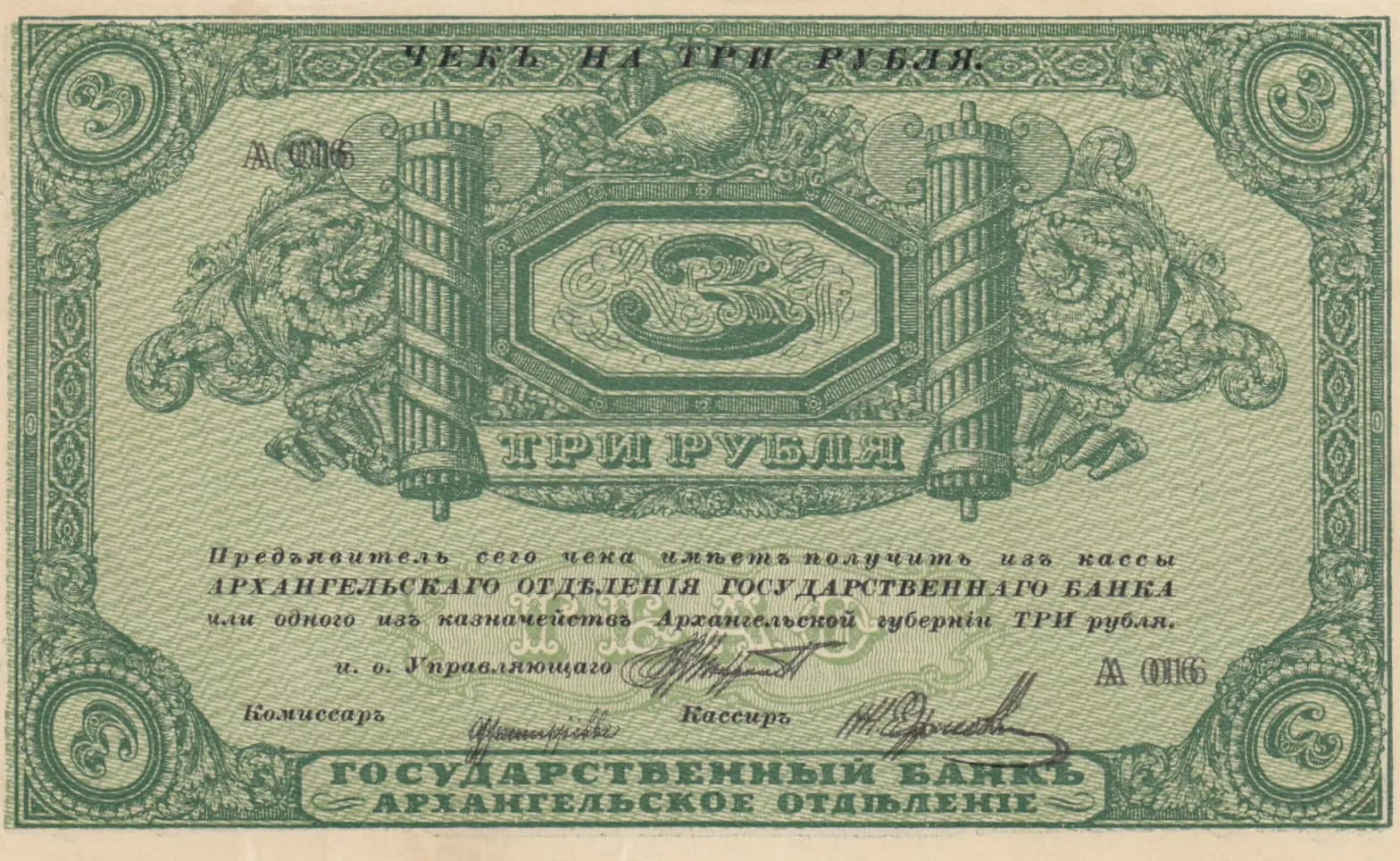
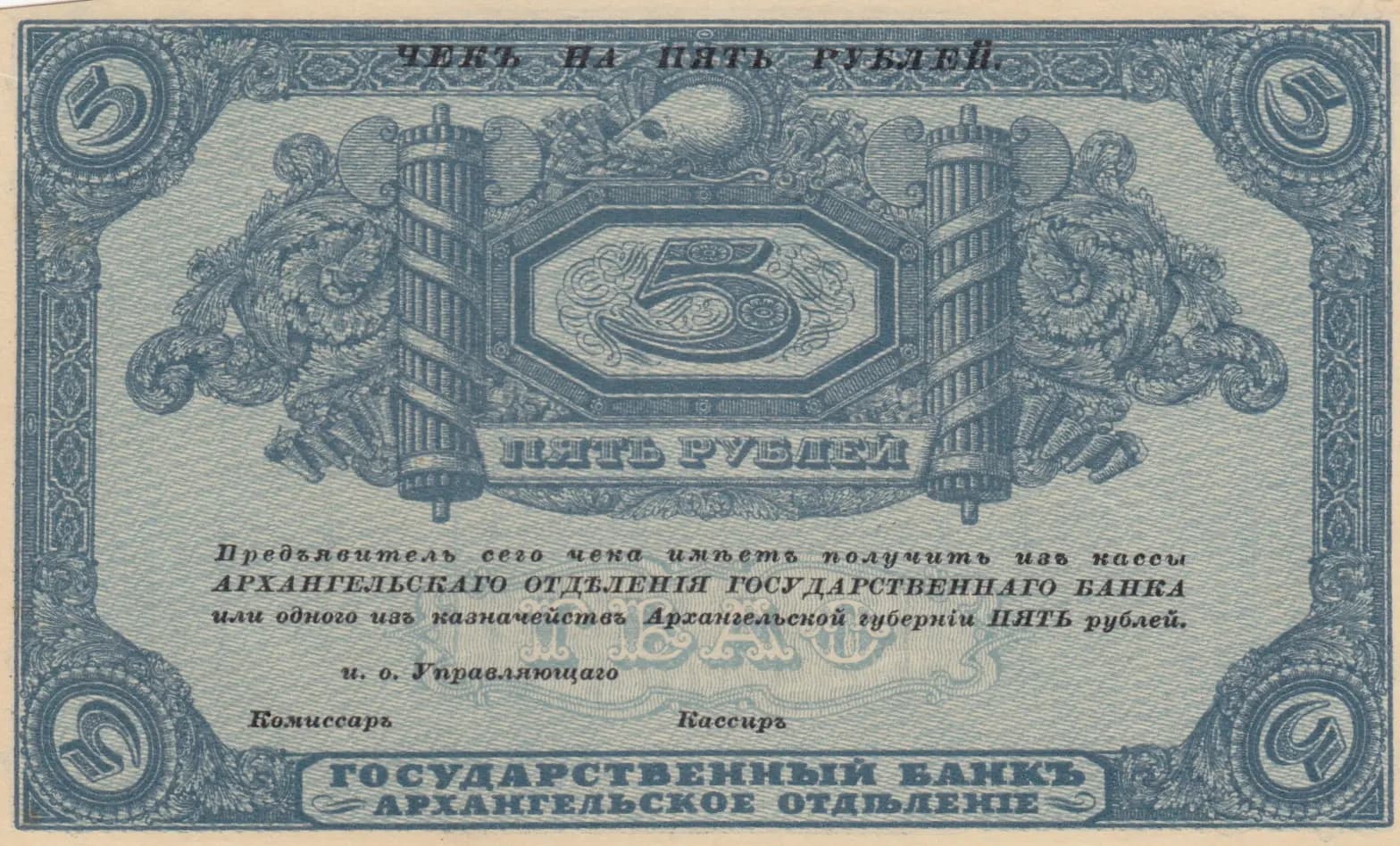
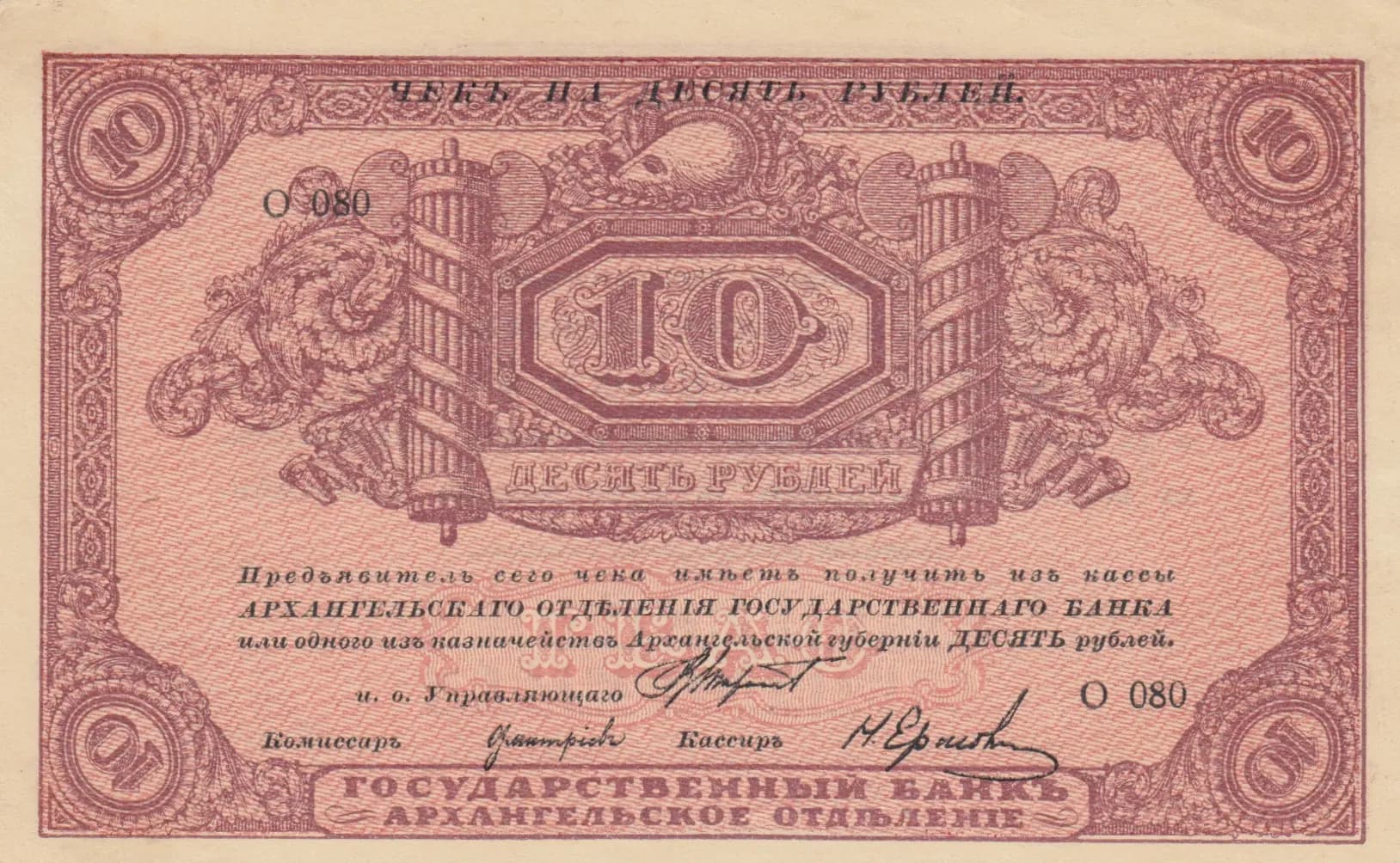
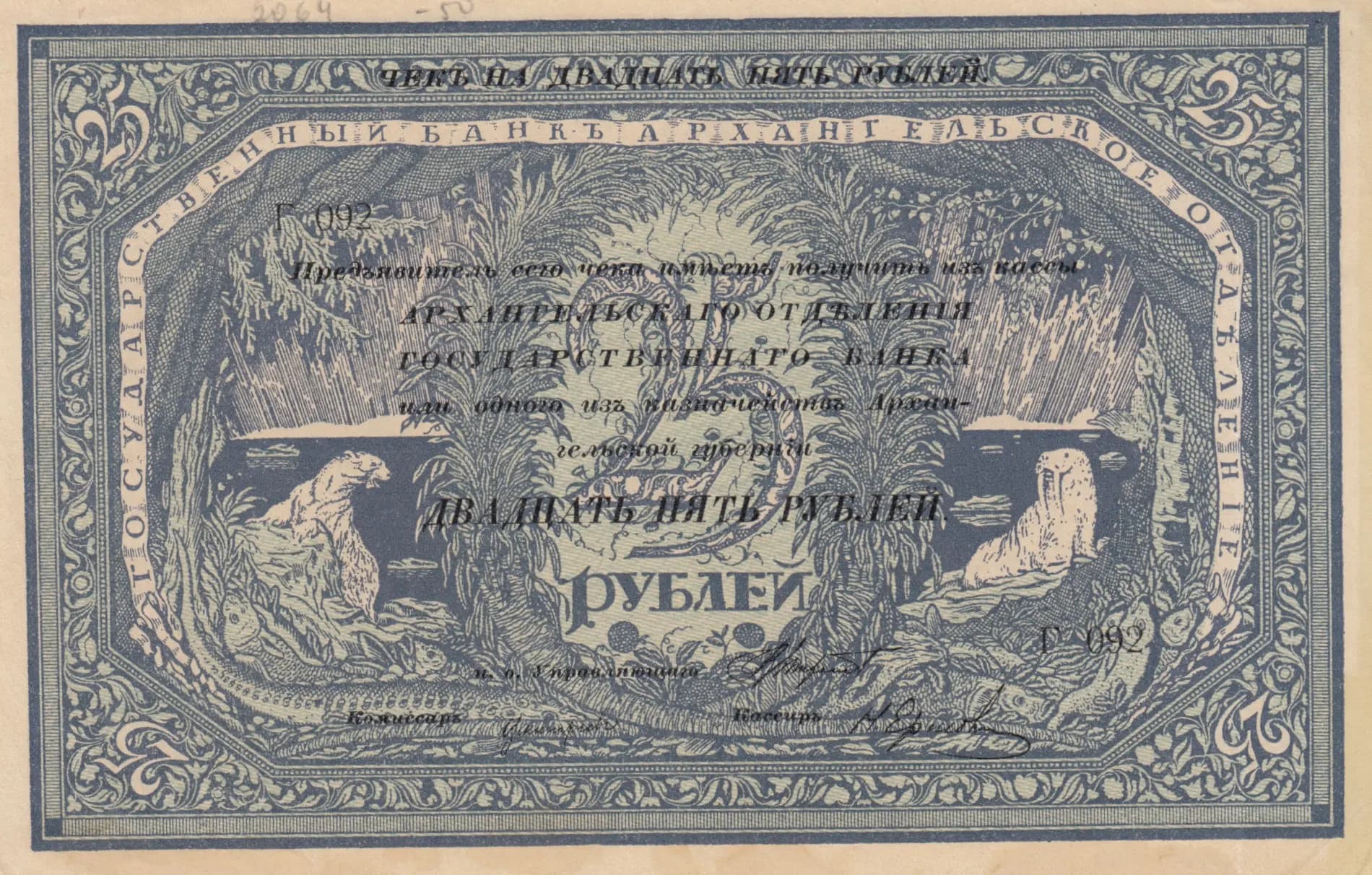
3 rublja 1920
About This Note
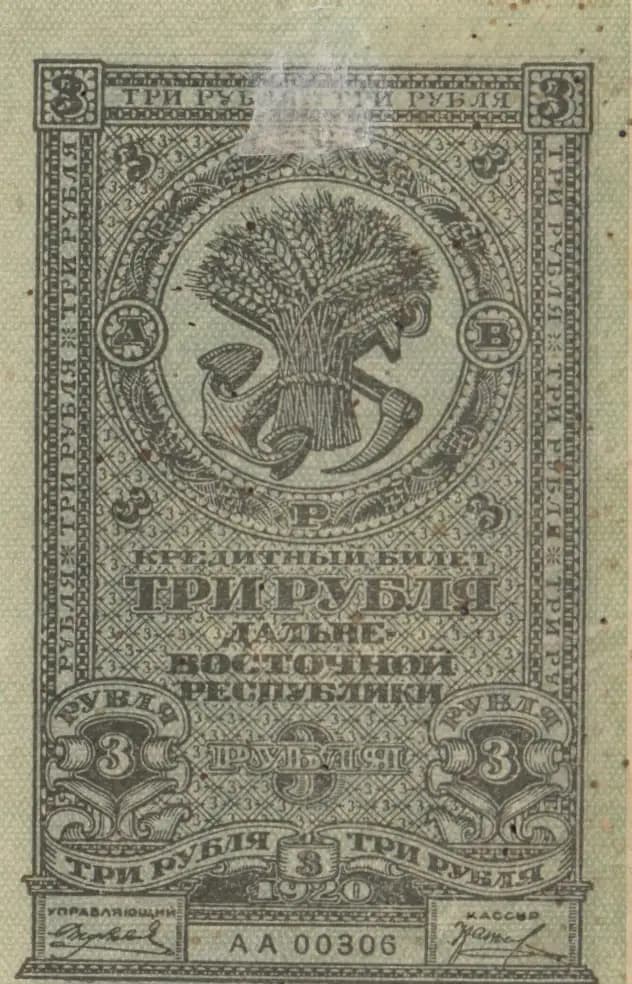
This 3 Ruble banknote from the Far Eastern Republic (1920) presents an excellent example of early Soviet-era currency design with its ornate Art Nouveau-influenced border and central sheaf of wheat motif symbolizing agricultural prosperity. The note displays AU condition with visible aging characteristics including foxing and yellowed paper typical of a century-old circulated note, yet maintains good clarity of the dual-language Cyrillic inscriptions and official signatures. The sheaf of grain imagery reflects the Far Eastern Republic's economic emphasis and makes this a distinctive regional variant of the Russian ruble series.
Common. The Far Eastern Republic issued banknotes in reasonable quantities during its operational period (1920-1922), and this 3 Ruble denomination was a standard circulation note. While notes from this specific issuer and period are less commonly encountered than mainstream Soviet issues, they do not command premium prices and appear regularly in collections and market offerings. The AU condition grade, while representing good preservation, does not significantly elevate value for what is fundamentally a common-grade issue.
Issued by the Far Eastern Republic (1920-1922), a short-lived buffer state between Soviet Russia and Japan, this note represents a transitional period in Russian monetary history. The 'РАСЧЕТНЫЙ БИЛЕТ' (settlement note) designation and emphasis on republican backing reflect the post-Civil War economic reorganization, while the agricultural symbolism of the wheat sheaf demonstrates the new Soviet state's ideological focus on productive labor and agricultural collectivization. The note's existence underscores the Far Eastern Republic's brief independence and its eventual reintegration into the Soviet Union.
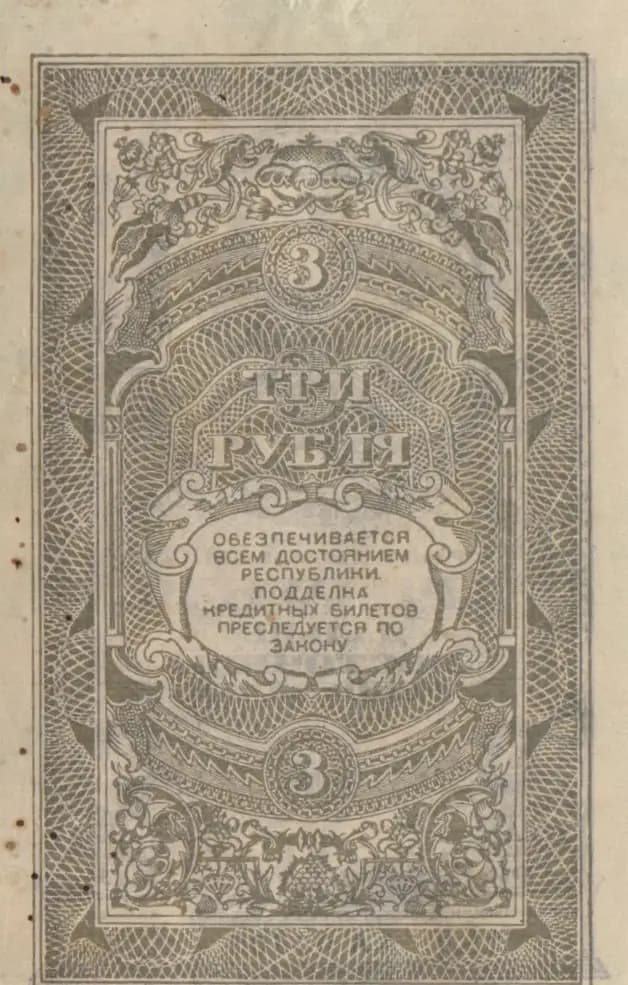
The obverse features an ornate rectangular border with geometric and foliate patterns framing a central circular medallion containing a sheaf of wheat or grain—a classical symbol of agricultural wealth and Soviet-era productive labor. Above the medallion sits a decorative arch with scrollwork typical of Art Nouveau styling. The note is dominated by tan and beige tones with brown and grey accents. The reverse presents a symmetrical design with the numeral '3' in circular medallions at top and bottom, enclosing an ornamental cartouche containing the guarantee text. Both sides feature crown-like ornamental elements, reflecting the imperial design traditions still present in early Soviet currency. The dual signatures of state officials flank the serial number on the obverse, providing authentication.
FRONT SIDE: ТРИ РУБЛЬ / Three Rubles; РАСЧЕТНЫЙ БИЛЕТ / Settlement Note; ПОСТОЯНОГО / Permanent; РЕСПУБЛИКИ / Republic; ТРИ РУБЛЯ / Three Rubles; ГОСУДАРСТВУЮЩИЙ / State; КАССИР / Cashier; АА 00306 / Serial Number. BACK SIDE: ТРИ РУБЛИ / Three Rubles; ОБЕСПЕЧИВАЕТСЯ ВСЕМИ ПОЛОЖЕНИЯМИ РЕСПУБЛИКИ / Is Guaranteed by All Assets of the Republic; ПРЕСЛЕДУЕТСЯ ПО ЗАКОНУ / Is Prosecuted by Law (referring to counterfeiting). Note: Some inscriptions in the visual analysis were identified as partially illegible due to image quality or wear.
This note was produced using letterpress printing, the standard technique for early 20th-century Russian currency. The relatively uniform ink application and clear reproduction of fine border details and Cyrillic text are characteristic of quality letterpress work. The design exhibits the multi-block printing typical of era-appropriate security printing, with separate plates for different design elements. Specific printer attribution for Far Eastern Republic notes of this period is often difficult to confirm, though Soviet state printing operations handled the production.
The serial number 'АА 00306' suggests an early print run designation. Varieties of this Pick S1202 note are primarily distinguished by serial number prefixes and signatures of authorizing officials. This example carries signatures consistent with Far Eastern Republic authority specimens. No overprints or major design varieties are evident from the visual analysis, though researchers should note that plate variations and signature combinations exist among recorded examples.