3 kopeiki 1915
Market Prices
14 salesAbout This Note
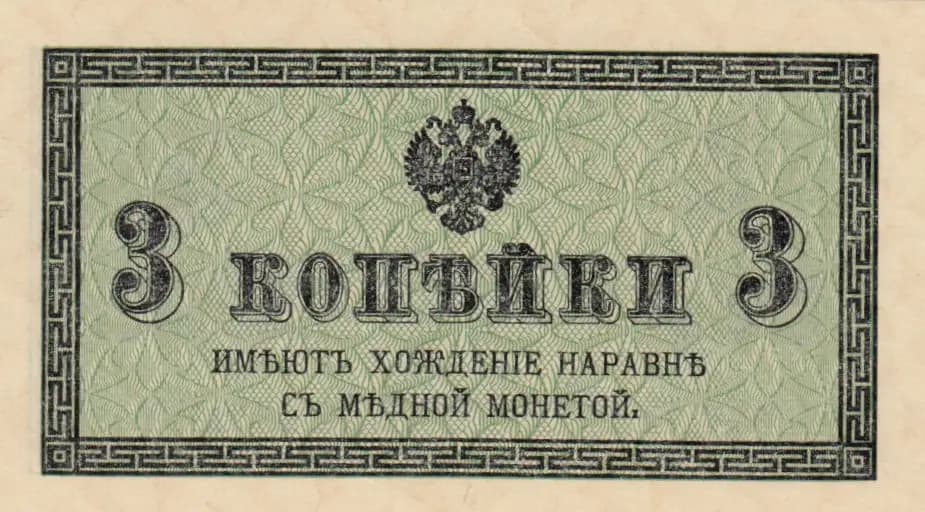
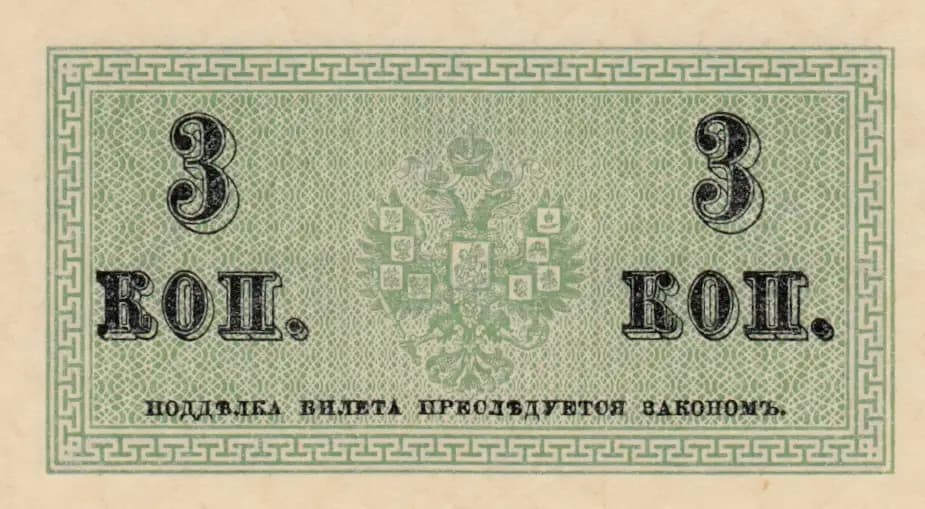
This is a Russian Empire 3 kopeck banknote from 1915 (Pick-26), rendered in pale green on a light green underprint with an intricate geometric pattern background. The note presents in uncirculated condition with crisp, unmarked surfaces, featuring the double-headed imperial eagle at the center of the obverse and ornamental imperial emblem on the reverse, both surrounded by decorative Greek key pattern borders. The note is notable for its historical significance as a regular-issue wartime currency and represents an interesting example of early 20th-century Russian monetary design with period-appropriate anti-counterfeiting measures.
Common. The eBay market data provided shows this note consistently selling in the $2-$15 range across multiple condition grades from 2013-2021, with UNC examples averaging $5-$7. These low price points and regular availability indicate strong, ongoing supply in the collector market. The 1915 3 kopeck note was part of a standard regular-issue series with substantial print runs during wartime. No evidence of scarcity, recall, or limited circulation exists for this Pick number.
This banknote was issued during World War I, a period of significant economic strain on the Russian Empire. The double-headed eagle with imperial crown depicted at the center of the obverse represents the Romanov dynasty's authority and sovereignty. The inscription warning of legal prosecution for counterfeiting reflects the Russian Empire's efforts to maintain monetary control during wartime, when currency fraud posed a particular threat to the economy.
The obverse features the Russian Imperial coat of arms — a double-headed eagle crowned with the imperial crown — centered at the top of the note. The eagle is rendered in fine detail and serves as the primary security symbol. The background throughout both sides employs an intricate geometric cross-hatch and leaf pattern in pale green, creating a visually complex anti-counterfeiting design. The reverse displays a stylized imperial emblem with crown and decorative flourishes rendered in lighter green at the center. Both sides are bounded by a consistent Greek key pattern border in black, providing a classical frame for the design. The denomination '3' appears in large ornamental numerals positioned in all four corners, rendered in an elaborate serif typeface typical of Imperial Russian currency design from this era.
OBVERSE: '3 КОПЕЙКИ' (3 kopecks) — the denomination in large ornamental numerals. 'ИМѢЮТЬ ХОЖДЕНIЕ НАРАВНѢ СЪ МѢДНОЙ МОНЕТОЙ.' — 'Have circulation equal to copper coins.' This statement established the note's legal tender status relative to metal coins. REVERSE: '3 КОН.' (3 kopecks abbreviated) — appears in the upper left and right corners. 'ПОДДЕЛКА БИЛЕТА ПРЕСЛѢДУЕТСЯ ЗАКОНОМЪ.' — 'Counterfeiting of banknotes is prosecuted by law.' This warning text emphasizes the legal consequences for currency fraud.
This note was produced using color lithography, a technique characteristic of Russian Imperial currency of the period. The color separation process created the pale green primary color with light green underprint, while the geometric pattern background and Greek key border were rendered with precision typical of high-security currency printing. The crisp detail visible in the eagle and ornamental elements, combined with the consistent color density observed across the uncirculated specimen, indicates professional currency printing by the Russian State Printing Works (Экспедиция заготовления государственных бумаг).
Without visible serial numbers or signatures clearly discernible in the visual analysis provided, no specific variety designation can be confirmed for this specimen. Russian 3 kopeck notes from 1915 may exist with minor variations in signature blocks or printer marks, but such details would require higher magnification or documented comparative analysis to identify definitively. The note conforms to the standard obverse and reverse design specifications cataloged as Pick-26.