3 & 10 kopeek 1915
“stamp money”
About This Note
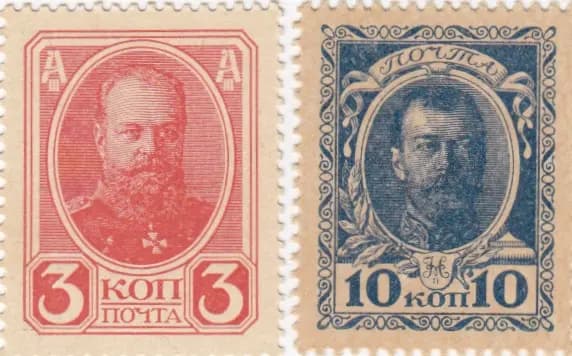
This is a pair of Russian Imperial stamp money notes from 1915, comprising denominations of 3 and 10 kopeck, presented in uncirculated condition with exceptional clarity and sharpness. The notes feature beautifully executed portrait engravings in oval frames with ornamental borders—the 3 kopeck in red/rose tones and the 10 kopeck in dark blue—both showcasing fine horizontal line engraving characteristic of premium Russian security printing. As emergency currency issued during World War I, these stamp money notes represent a fascinating historical artifact combining postage stamp aesthetics with monetary function, and their pristine UNC condition makes them particularly desirable to collectors of Russian numismatic rarities.
Common. Russian stamp money from 1915 was issued in substantial quantities as emergency currency, and surviving examples in uncirculated condition, while desirable to collectors, are not particularly scarce in the numismatic market. These notes represent a well-documented issue with stable collector demand and regular availability, rather than a scarce or rare variety.
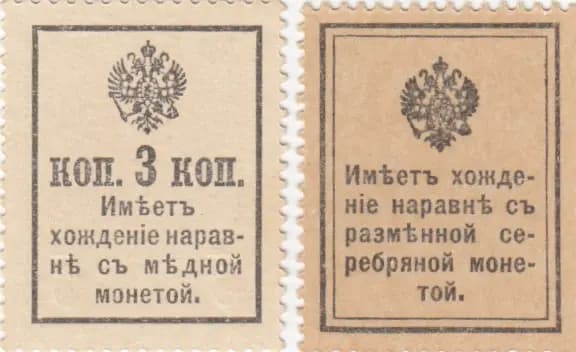
These stamp money notes were issued by the Russian Empire during 1915, a critical year in World War I when copper and small change became scarce due to military demands and economic disruption. The Imperial Russian double-headed eagle emblem prominently displayed on the reverse reinforces the state authority behind the issue, while the inscriptions promising circulation 'equal with copper coin' (3 kopeck) and 'equal with exchanged silver coin' (10 kopeck) underscore the government's attempt to manage currency circulation during wartime shortages. This emergency monetary issue reflects the economic pressures facing Imperial Russia in the final years before the 1917 Revolution.
These emergency notes feature Imperial Russian stamp money designs with portrait medallions of bearded male figures in formal military dress, likely depicting members of the Imperial family or notable statesmen, though specific identification from the visual analysis is not definitively possible. The portraits are enclosed in ornate oval frames with decorative flourishes, rendered entirely in fine horizontal line engraving for security purposes. The 3 kopeck note presents its portrait in warm red/rose tones on cream background, while the 10 kopeck note uses dark blue on cream, creating distinct visual differentiation between denominations. The reverse sides feature the Imperial Russian double-headed eagle emblem at the top, with legal inscriptions below stating the notes' official status as equivalent to their face value in metal currency, addressing public concern about accepting stamped paper as valid money.
FRONT (3 Kopeck): '3' (denomination numeral), 'КОП' (KOP - kopeck), 'ПОЧТА' (POCHTA - mail/post). FRONT (10 Kopeck): '10' (denomination numeral), 'КОП' (KOP - kopeck). REVERSE (3 Kopeck): 'КОП. 3 КОП.' (KOP. 3 KOP.), 'Имѣет хождение наравнѣ с мѣдной монетой.' (Has circulation equal with copper coin.). REVERSE (10 Kopeck): 'Имѣет хождение наравнѣ с размѣнной серебряной монетой.' (Has circulation equal with exchanged silver coin.)
Intaglio engraving (line engraving) throughout both the obverse and reverse. The fine, consistent horizontal line patterns visible across all design elements are characteristic of high-quality security printing from this period. The precision of the oval frame designs, portrait details, and eagle emblem indicate professional die engraving and printing by the Russian Imperial State Printing Works, which handled sensitive monetary and security printing for the Empire.
The primary variety distinction lies in the denomination and corresponding color scheme: the 3 kopeck (red/rose, Pick-20) and 10 kopeck (dark blue, Pick-21) represent two separate catalog issues. No variations in signatures, dates, or serial number prefixes are noted in the visual analysis. These appear to be standard examples of their respective Pick catalog entries without additional overprints or varietals.