250 000 rublei 1922
About This Note
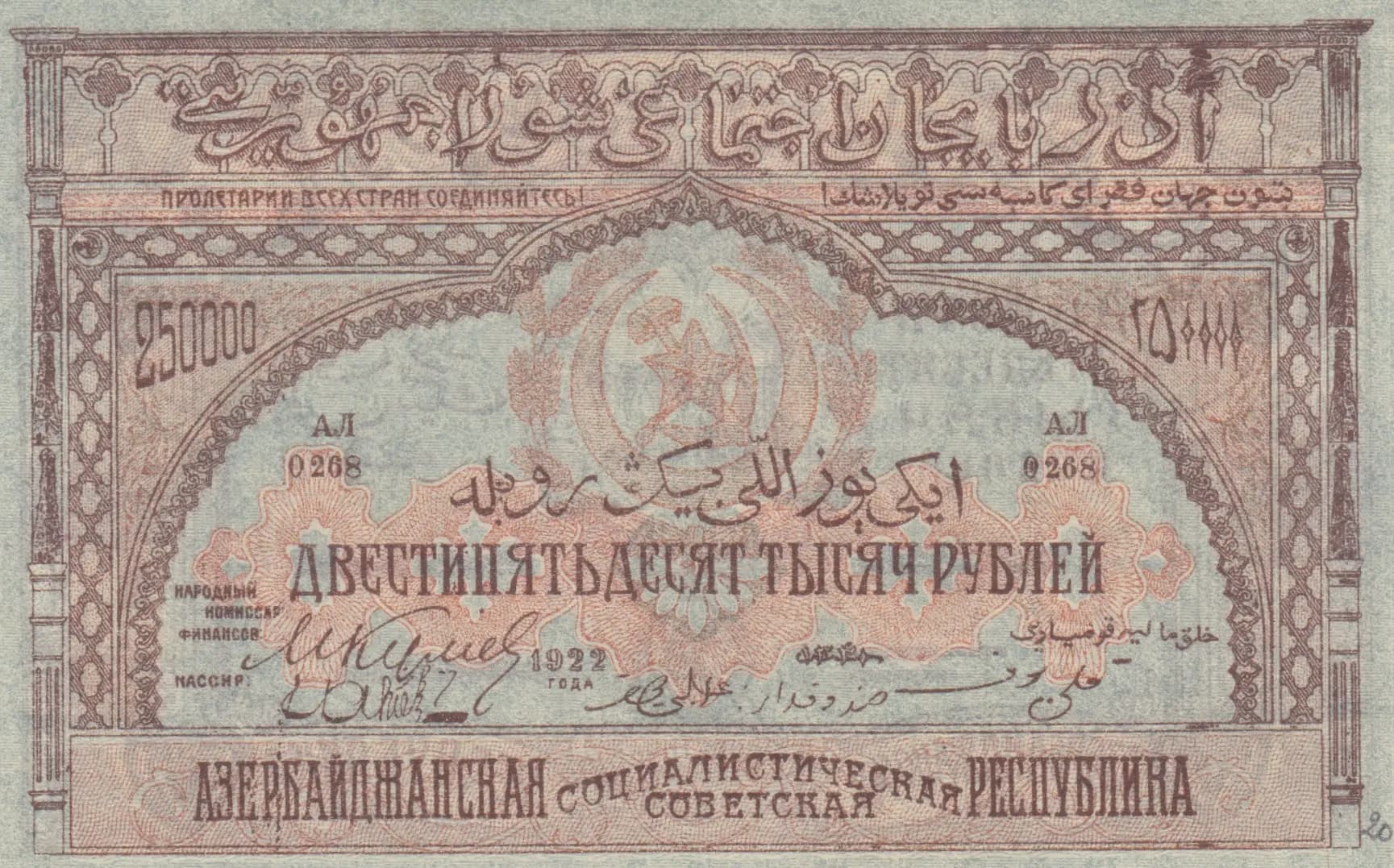
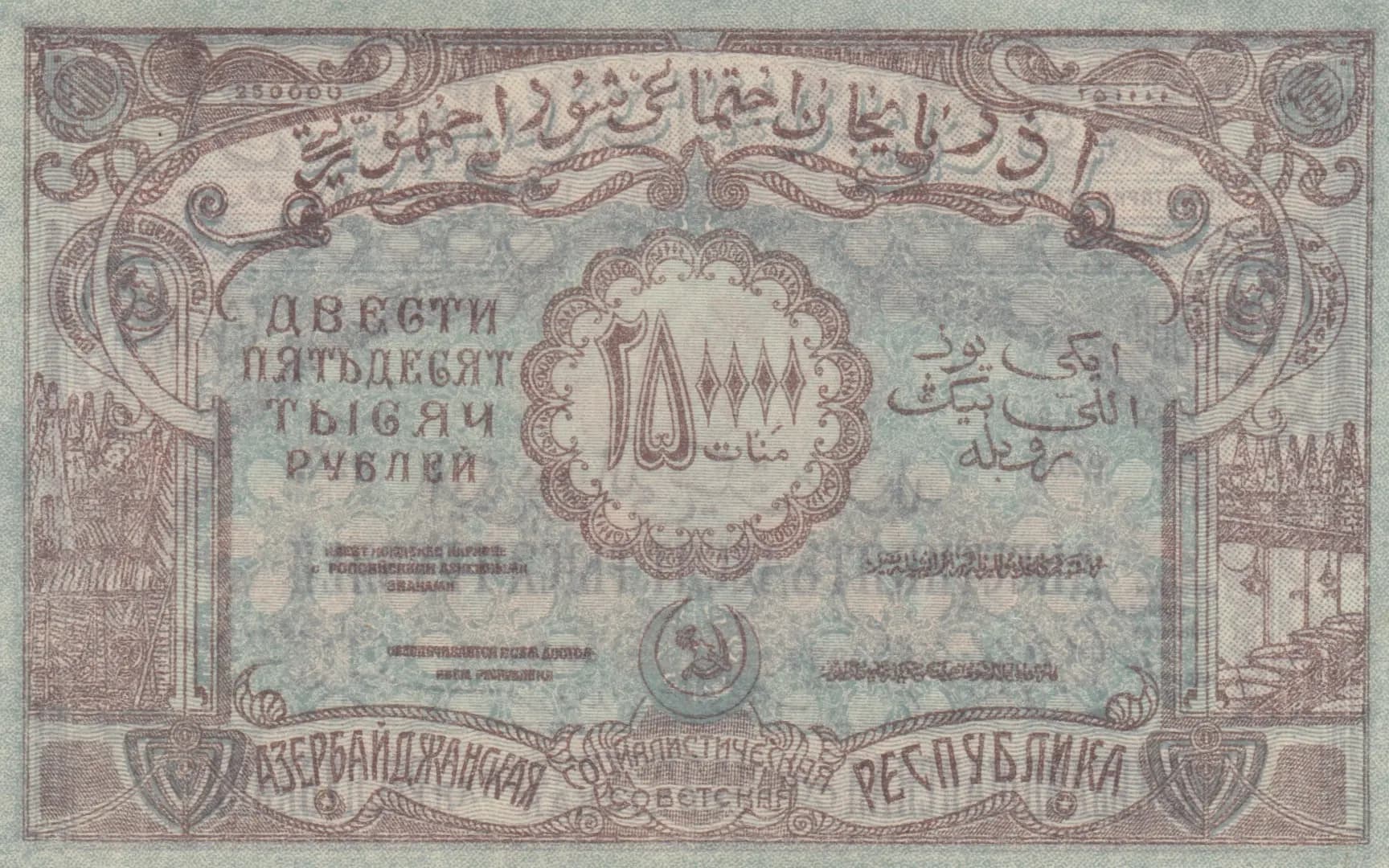
This is an exceptional example of the Azerbaijan S.S.R. 250,000 rublei from 1922 (Pick S718), graded UNC and displaying remarkable preservation for an early Soviet-era banknote from the hyperinflationary period. The note features striking ornate Islamic/Eastern geometric patterns with bilingual Cyrillic and Arabic script inscriptions, reflecting Azerbaijan's cultural identity within the Soviet framework. The UNC condition, combined with the historical significance of this short-lived denomination during the monetary crisis of 1922, makes this a notable piece of Soviet numismatic history.
Uncommon. While the Pick S718 is not exceptionally rare, the 250,000 rublei denomination from 1922 represents a short-lived, high-denomination note issued during an acute phase of Soviet hyperinflation. Print runs for such denominations were substantial but significantly smaller than lower-denomination notes that circulated more widely and were more heavily destroyed through use. The UNC condition grade substantially elevates the rarity and value of this specific example, as most surviving specimens show considerable wear from circulation. The survival of notes in pristine condition from this chaotic period is notably uncommon, making this particular piece of above-average collector interest.
This banknote was issued during the turbulent early years of the Azerbaijan Socialist Soviet Republic, when hyperinflation forced the issuance of increasingly large denominations. The 1922 date marks the period immediately following the incorporation of Azerbaijan into the Soviet Union (1921), and the prominence of both Cyrillic and Arabic scripts reflects the deliberate Soviet policy of promoting local languages and cultural elements while establishing communist authority. The inscription 'Workers of all countries, unite!' (from the Communist Manifesto) and the references to the People's Commissariat of Finance emphasize the revolutionary ideological nature of the early Soviet state during the transition from War Communism to the New Economic Policy.
The banknote exhibits a sophisticated dual-culture design reflecting the early Soviet approach to minority republics. The front features a large circular emblem with radiating lines (likely representing the sun or a stylized state emblem) centered within an ornate rectangular frame with Islamic geometric borders at top and bottom. The back displays classical architectural structures flanking a central decorative cartouche containing Arabic/Persian calligraphy, with circular emblems (possibly state seals or medallions) positioned at left and right. The consistent use of brown, tan, beige, and rust tones throughout creates visual harmony, while the bilateral script presentation—Cyrillic for Soviet authority and Arabic for Azerbaijani identity—demonstrates the USSR's early policy of cultural inclusion within the framework of communist ideology. No portraits appear on either side, consistent with early Soviet design principles that favored symbolic and architectural imagery over individual representation.
FRONT SIDE: 'ПРОЛЕТАРИИ ВСЕХ СТРАН СОЕДИНЯЙТЕСЬ!' (Proletarii vsekh stran soediniaytes!) - 'Workers of all countries, unite!'; 'ДВЕСТИ ПЯТЬДЕСЯТ ТЫСЯЧ РУБЛЕЙ' - 'Two hundred fifty thousand rubles'; 'АЗЕРБАЙДЖАНСКАЯ СОЦИАЛИСТИЧЕСКАЯ СОВЕТСКАЯ РЕСПУБЛИКА' - 'Azerbaijan Socialist Soviet Republic'; '1922' - date; 'АЛ 0268' - serial number (appears twice); '250000' - denomination in numerals; 'НАРОДНЫЙ КОМИССАР ФИНАНСОВ' - 'People's Commissar of Finance'; 'ПРЕДСЕДАТЕЛЬ' - 'Chairman'. BACK SIDE: 'ДВЕСТИ ПЯТЬДЕСЯТ ТЫСЯЧ РУБЛЕЙ' - 'Two hundred fifty thousand rubles'; '250000' - denomination; '50000' - corner denomination (appearing at corners); 'АЗЕРБАЙДЖАНСКАЯ СОЦИАЛИСТИЧЕСКАЯ СОВЕТСКАЯ РЕСПУБЛИКА' - 'Azerbaijan Socialist Soviet Republic'; Central Arabic/Persian calligraphic text (precise transliteration not possible from image resolution).
This banknote was produced using intaglio (engraved) printing, evidenced by the fine, intricate line work visible in the decorative borders, the detailed geometric patterns, and the precision of the circular emblems and calligraphic cartouche. The ornate scrollwork and floral patterns characteristic of anti-counterfeiting design of the period are typical of high-quality intaglio production. The printer for Azerbaijan S.S.R. notes of this era was the State Security Printing Works in Moscow, though some sources indicate involvement of regional facilities. The security features—including the intricate border patterns designed to prevent counterfeiting and the watermark areas visible in lighter regions—are consistent with Soviet-era security printing standards.
Serial number AL 0268 is noted on both obverse and reverse. The prefix 'АЛ' (AL in Cyrillic) represents the series letter designation common to this issue. While multiple series were printed, this specific serial number range does not appear to represent a documented major variety in standard catalogues. No visible overprints, date variations, or signature varieties are apparent in the visual analysis. The note represents the standard design type for Pick S718 without apparent deviations, though comprehensive variety documentation for Azerbaijan S.S.R. issues remains limited in some Western numismatic references.