200 rublei 1920
“R. S. F. S. R.”
About This Note
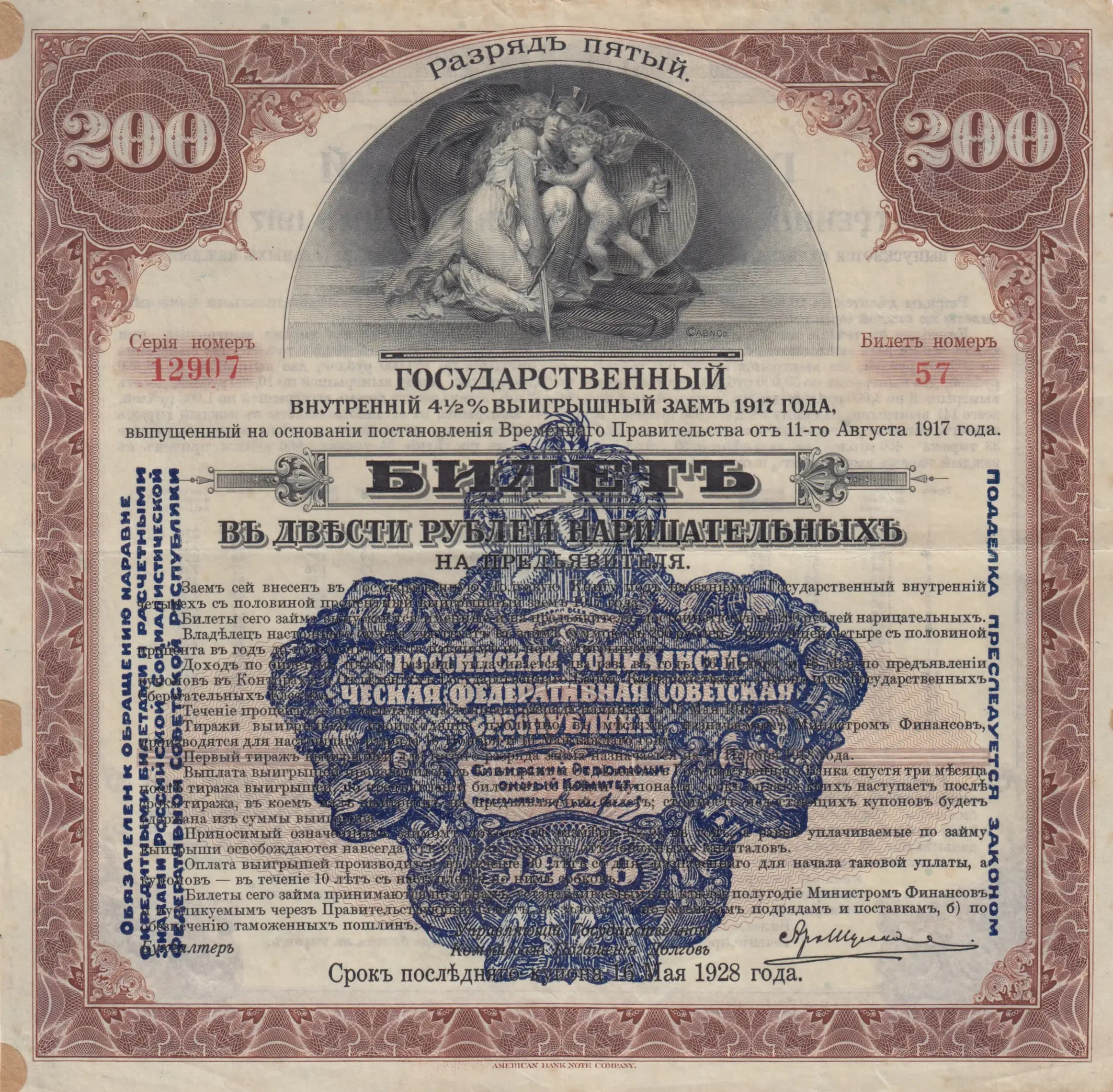
This is a 200 ruble bond note from the Russian Democratic Republic issued in 1920 by the Siberian Revolution Committee, representing a 4½% State Internal Winning Loan originally authorized in 1917. The note displays exceptional Art Nouveau styling with a classical allegorical vignette featuring a reclining female figure and cherubs at the top, framed by ornate burgundy and brown borders with intricate scrollwork. In VF condition, the note shows significant age-related patina with yellowing, spotting, and wear consistent with circulation during the tumultuous Russian Civil War period, but retains excellent visual clarity of its detailed engraved elements and the prominent Imperial Russian double-headed eagle seal at center.
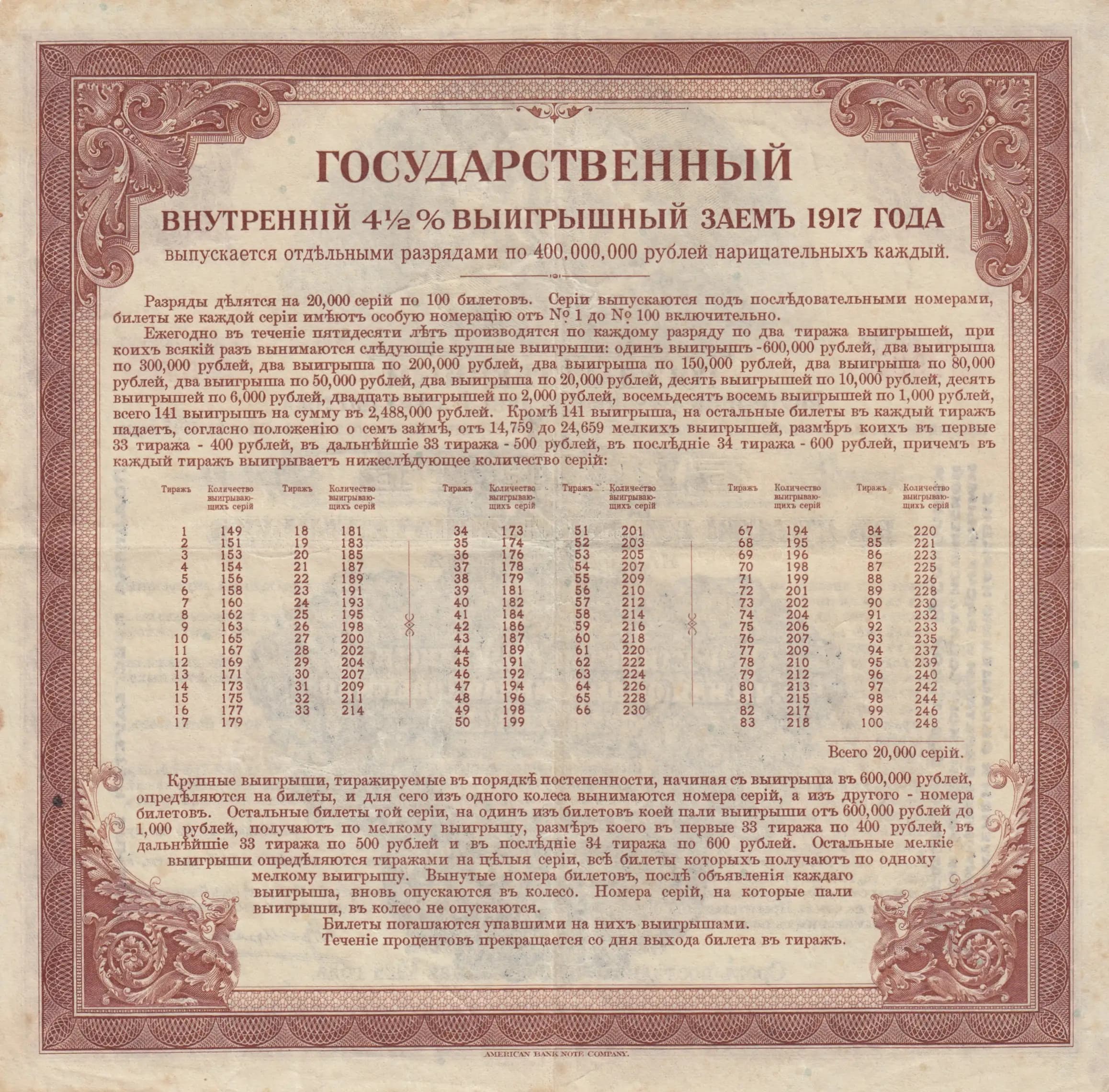
Common. This is a relatively common note from a large-scale state lottery bond issue. The printing specifications on the back indicate 20,000 series of 100 notes each per class, with multiple classes (разряды) totaling 400,000,000 rubles nominal per class, suggesting substantial print runs in the hundreds of millions of rubles across multiple denominations. While the note has historical significance from the Russian Civil War period and the transitional Siberian authority, the large original print run combined with the note's survival rate means examples are readily available to collectors. The VF condition grade and identifiable series/note numbers (12907/57) do not suggest any particular scarcity within the issue.
This bond note reflects the Russian Provisional Government's financial mechanisms during 1917, issued under the August 11, 1917 decree to raise internal funds through a lottery-style winning loan. The Imperial Russian double-headed eagle with wreath, prominently displayed on the note despite the revolutionary context, represents the transitional period between the Tsarist regime and Soviet consolidation of power in Siberia. The note's survival and circulation as a 1920 issue demonstrates how these financial instruments continued circulating in isolated Siberian territories during the Civil War, when the region operated under anti-Bolshevik authority before final Soviet conquest in 1922.
The front of this 200 ruble bond features a sophisticated Art Nouveau composition dominated by a large circular engraved vignette at the top center depicting classical allegorical figures—a reclining female figure in the Grecian style representing Liberty or State fortune, attended by two cherubs (putti) in traditional neoclassical arrangement. The denomination '200' appears in large, bold numerals in both upper corners. The central field contains a prominent decorative oval stamp bearing the Imperial Russian double-headed eagle (Российский герб) surrounded by an ornate wreath, serving as an official seal of authority. The entire design is framed by elaborate ornamental borders featuring interlocking scrollwork, floral motifs, and geometric patterns characteristic of late 19th-century security printing. The back side continues the design language with extensive body text describing the loan terms organized in tabular format for lottery drawing information, maintaining symmetrical ornamental corner elements and borders throughout. The color palette of brown, burgundy, and cream creates strong contrast and visual distinction typical of Tsarist-era bond certificates.
FRONT SIDE: Denomination: '200' (upper corners). Classification: 'РАЗРЯДЬ ПЯТЫЙ' (Fifth Class). Series and Note Numbers: 'Серія номер' (Series number) 12907; 'Билет номер' (Note number) 57. Main Title: 'ГОСУДАРСТВЕННЫЙ ВНУТРЕННИЙ 4½% ВЫИГРЫШНЫЙ ЗАЕМЬ 1917 ГОДА' (State Internal 4½% Winning Loan of 1917). Authorization: 'выщещенный на основании постановления Временного Правительства от 11-го Августа 1917 года' (issued on the basis of Provisional Government resolution of August 11, 1917). Denomination Text: 'БИЛЕТ ВЕ ДВЕСТИ РУБЛЕЙ НАРИЦАТЕЛЬНЫХ НА ПРЕДЪЯВИТЕЛЯ' (Note for Two Hundred Rubles nominal To Bearer). Issuer: 'РОССИЙСКОЙ ДЕМОКРАТИЧЕСКОЙ РЕСПУБЛИКИ' (Russian Democratic Republic). Drawing Schedule: 'Срок последнего тиража 1928 года' (Date of last drawing 1928). BACK SIDE: Loan Structure: 'ГОСУДАРСТВЕННЫЙ ВНУТРЕННИЙ 4½% ВЫИГРЫШНЫЙ ЗАЕМЬ 1917 ГОДА' (State Internal 4½% Winning Loan of 1917). Distribution: 'выпускается отдельными разрядами по 400,000,000 рублей нарицательных каждый' (is issued in separate classes of 400,000,000 rubles nominal each). Series Division: 'Разряды дклятся на 20,000 серий по 100 билетов' (Classes are divided into 20,000 series of 100 notes each). Series Total: 'Всего 20,000 серий' (Total 20,000 series). Table Headers: 'Тираж' (Drawing); 'Количество выигрышных серий' (Number of winning series). Printer: 'AMERICAN BANK NOTE COMPANY' (English attribution on back).
This note was produced using traditional intaglio engraving (copperplate printing), as evidenced by the fine line work, detailed shading in the classical vignette, the precise rendering of the double-headed eagle and wreath motif, and the intricate ornamental borders with subtle gradations characteristic of engraved security printing. The American Bank Note Company credit line visible on the back confirms production by this premier security printer, which used advanced engraving techniques to prevent counterfeiting. The multi-color effect appears to be achieved through multiple passes or careful registration of the brown and burgundy inks, a standard practice for high-security financial instruments of the period.
This specific example is identifiable as Series 12907, Note 57 of the Fifth Class (РАЗРЯДЬ ПЯТЫЙ) of the 1917 State Internal 4½% Winning Loan. The series number 12907 falls within the range of the 20,000 total series mentioned on the back. Varieties within this issue would be distinguished by different series numbers, class designations, and potentially different drawing dates (the note indicates final drawing scheduled for 1928). The prominent blue oval stamp/seal visible on the front of this particular example appears to be an official cancellation or validation mark, which may be a common feature of distributed copies or a specific marking applied during circulation. No known major varieties (such as different signatures, significantly different serial number ranges, or notable overprints beyond this seal) have been recorded for Pick S-899 in standard catalogs.