200 rublei 1917
“Irkutsk”
About This Note
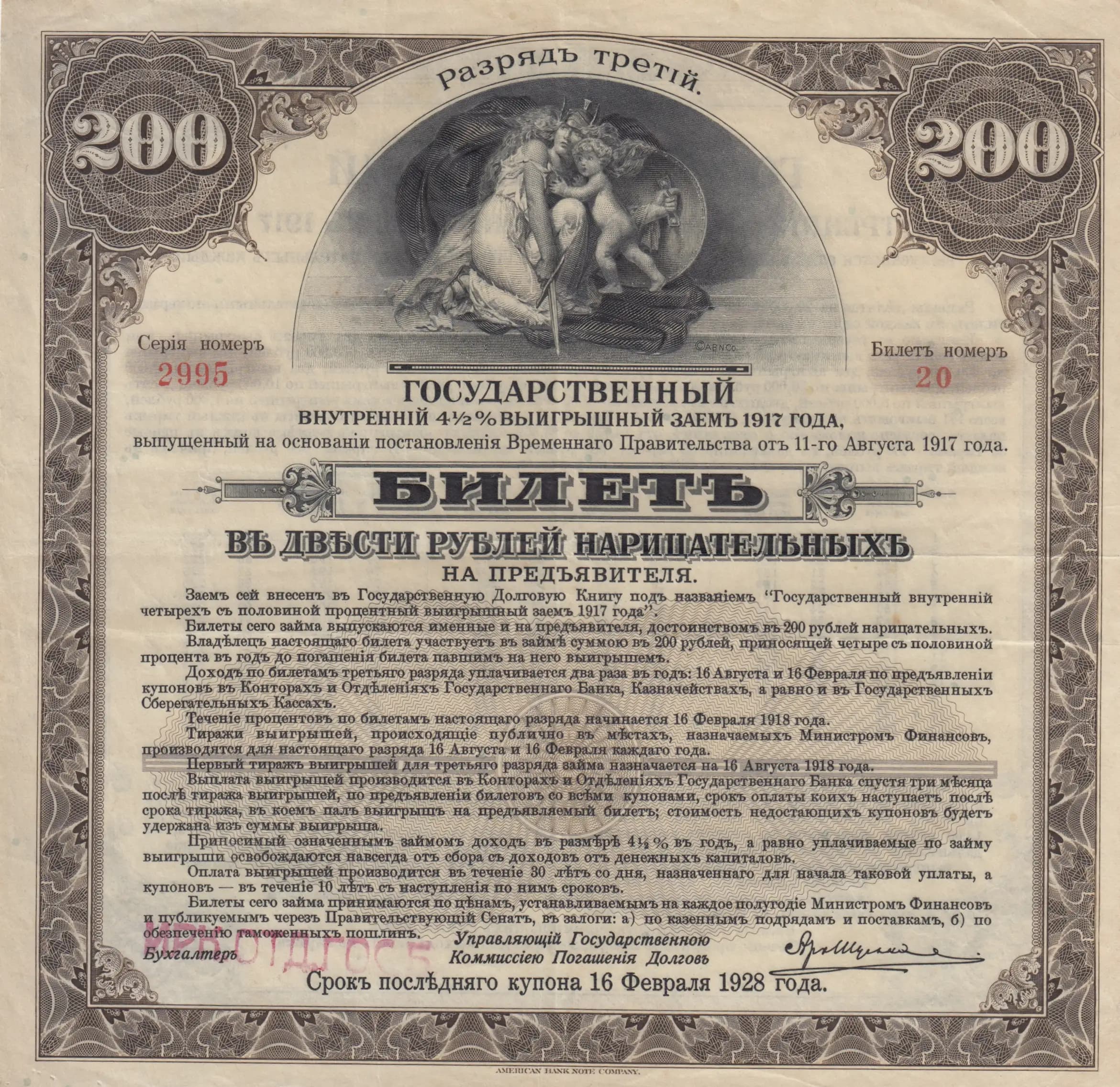
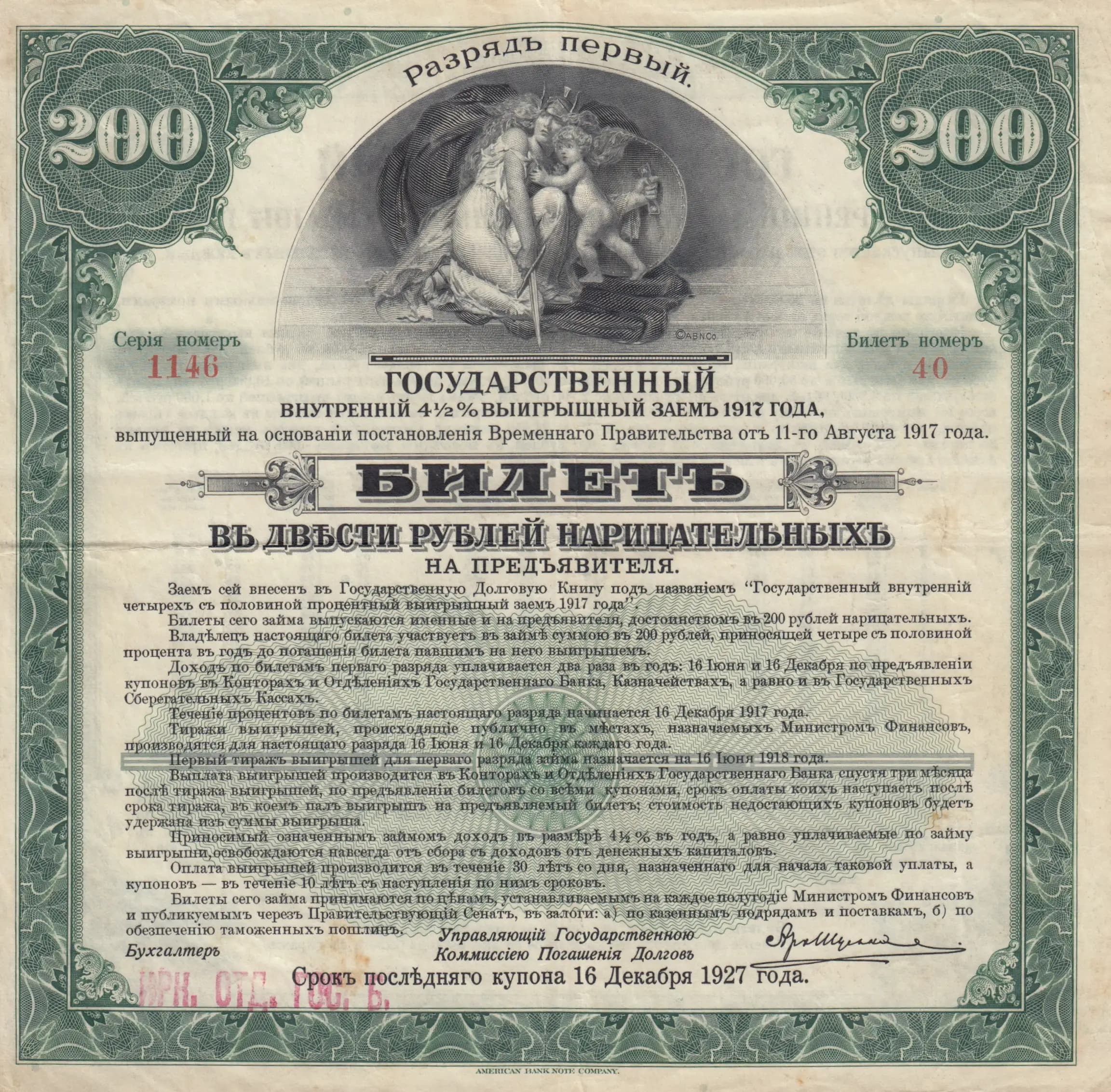
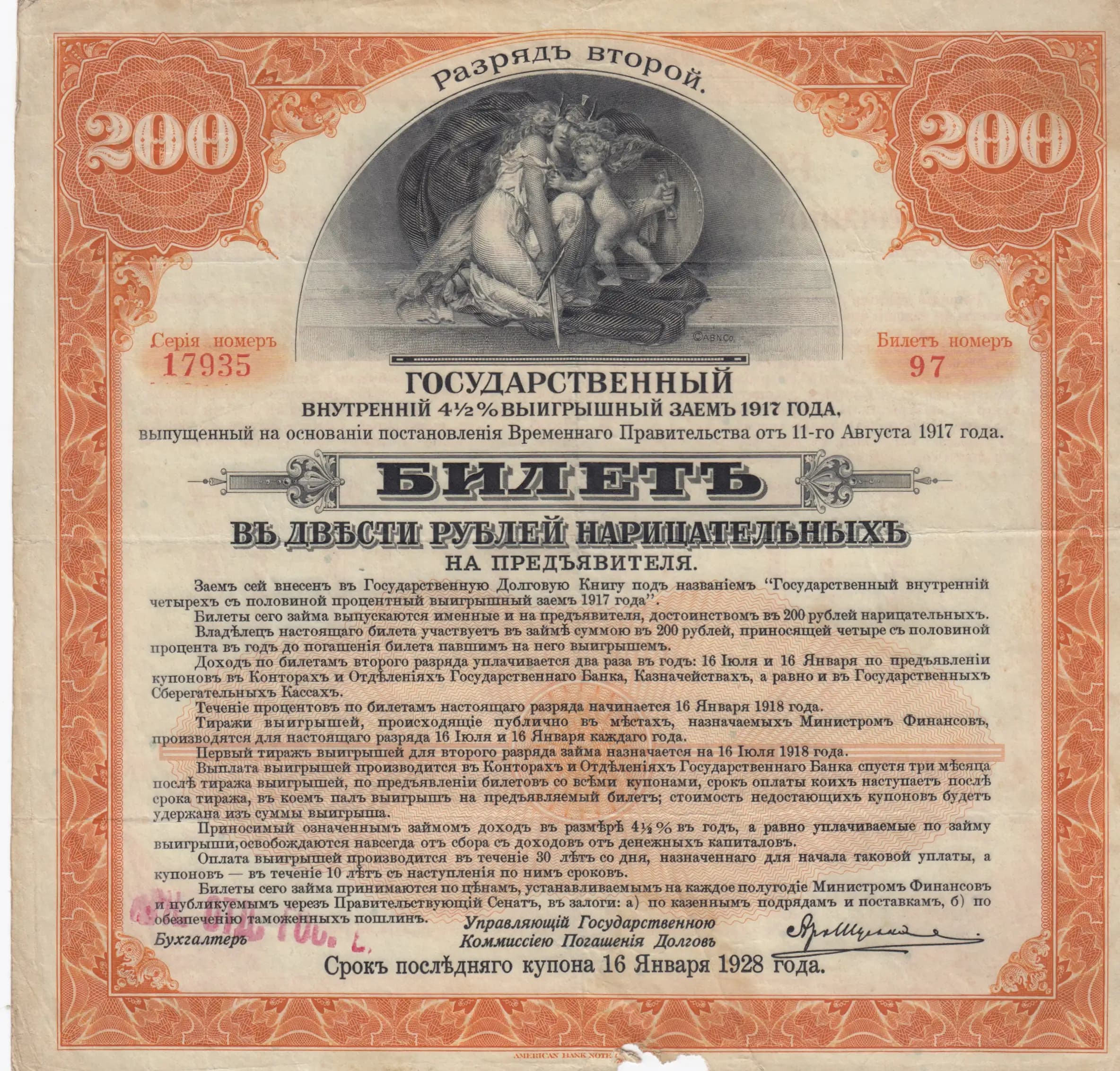
This is a Russian State Internal 4½% Loan bond certificate (State Bond) issued in 1917 by the Provisional Government, denominated at 200 rubles. The note features an ornamental orange and black design with a classical allegorical vignette of cherubs and harvest symbolism in the center, printed on aged cream paper showing expected foxing and creasing consistent with its over 100-year history. In VF condition, this piece represents an important artifact of Russia's turbulent 1917 transition period, issued under the short-lived Provisional Government before the Bolshevik Revolution.
Common. This is a State Internal Loan bond from a mass-issued series authorized by the Provisional Government in 1917. The loan was structured in multiple sections totaling 400,000,000 rubles each, with 20,000 series per section and 100 tickets per series, indicating extremely large print runs in the millions of individual certificates. While Pick P-S890 refers to this denomination and issuer combination, numerous series and individual serial numbers exist from this issue. The Provisional Government's brief nine-month existence (March-October 1917) did create a historical cutoff, but most bonds from this issue survive as these were financial instruments retained by collectors and archives rather than actively circulated to destruction. VF condition examples are not exceptionally scarce in the market. The historical significance outweighs rarity value.
This bond was issued on August 11, 1917, by the Russian Provisional Government—the brief democratic administration that ruled between the February and October revolutions. The allegorical harvest imagery and imperial ornamentation reflect the traditional Russian state bond aesthetic, maintaining continuity with Tsarist-era financial instruments even as the nation descended into revolutionary chaos. The 50-year term with annual lottery drawings (ending January 1928) and 4½% interest rate represented an attempt by the Provisional Government to finance the war effort and stabilize the economy during its nine-month existence, though most such bonds became worthless after the Bolshevik seizure of power.
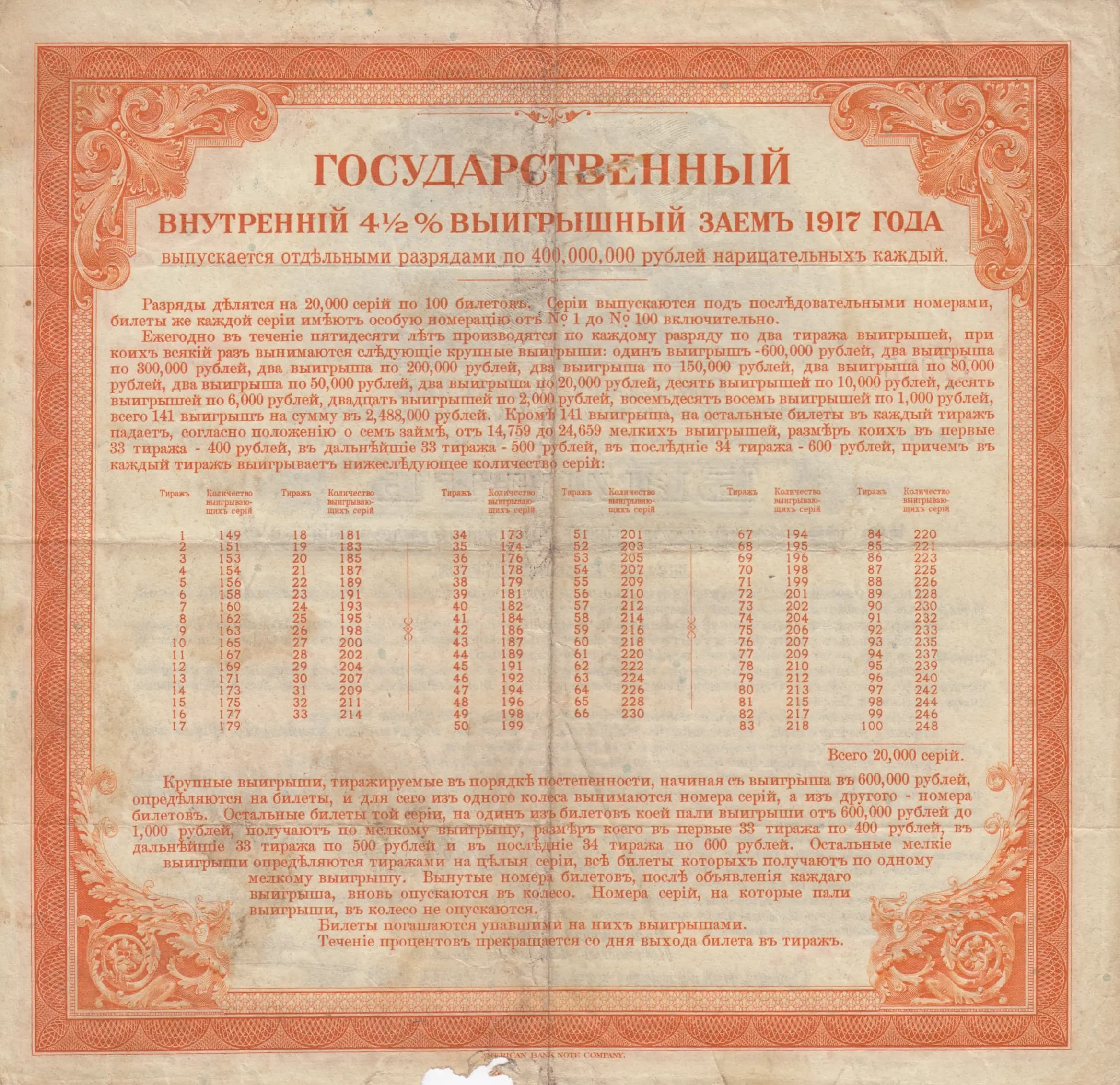
This bond certificate exemplifies early 20th-century Russian imperial financial document design. The front features a symmetrical layout dominated by an intricately engraved central vignette depicting allegorical cherubs (putti) surrounding a cornucopia overflowing with harvest produce—a classical symbol of abundance, fertility, and state prosperity commonly used in imperial Russian bonds. The denomination '200' appears in large ornamental numerals in opposing corners. An ornamental border of coral/orange color frames the entire document with fine decorative patterns typical of imperial-era security printing. The reverse side maintains the matching border and presents comprehensive legal and financial terms in Russian, including a detailed tabular schedule of lottery drawings with series numbers and prize distributions. The color scheme of orange/coral and black on aged cream paper represents the standard aesthetic for Tsarist and Provisional Government-era bonds, with the multi-color printing providing both security and visual distinction from ordinary currency.
{"front":{"title":"STATE INTERNAL 4½% WINNING LOAN OF 1917","denomination":"TICKETS OF TWO HUNDRED RUBLES NOMINAL VALUE TO THE BEARER","authorization":"Issued on the basis of a decree of the Provisional Government dated August 11, 1917","section":"SECOND SECTION (Раздрядь Второй)","serialization":"Series number 17935 (Серия номерь 17935), Ticket number 97 (Билет номерь 97)","signatures":"Accountant (Буххалтеръ) and Director of the State Treasury for the Management of Debts (Управляющий Государственной Кассою Положения Долгов)","couponDate":"Date of last coupon January 16, 1928 (Срок последнего купона 16 Января 1928 года)"},"back":{"structure":"Issued in separate sections of 400,000,000 rubles nominal value each (выпускается отдельными разрядами по 400,000,000 рублей нарицательных каждый). Sections are divided into 20,000 series of 100 tickets each (Разряды делятся на 20,000 серий по 100 билетов). Series issued with consecutive numbers; tickets numbered 1-100 within each series (Серии выпускаются под последовательными номерами, билеты же каждой серии имеют особую нумерацию-от № 1 до № 100 включительно).","drawings":"Annually for fifty years, two lottery drawings held for each section (Ежегодно в течение пятидесяти лет производится по каждому разряду по два тиража выигрышей)","prizeStructure":"Prize scale included: one prize of 900,000 rubles, two of 300,000 rubles, two of 200,000 rubles, two of 150,000 rubles, two of 80,000 rubles, two of 50,000 rubles, four of 20,000 rubles, nine of 6,000 rubles, twenty of 2,000 rubles, eighty-eight of 1,000 rubles (total 141 major prizes per section), with 14,759-24,059 smaller prizes valued at 400 rubles (first 33 drawings), 600 rubles (next 33 drawings), and 800 rubles (final 34 drawings)","redemption":"Tickets redeemed with indicated winning amounts (Билеты погашаются указанным на них выигрышами). Interest accrual ceases from date ticket is drawn (Течение процентов прекращается от дня выхода билета в тираж).","tabularData":"Detailed lottery drawing table with series numbers and prize quantities for each drawing"}}
This bond was produced using traditional intaglio engraving combined with letterpress printing techniques, standard for high-security financial documents of the Russian imperial period. The fine-line decorative borders, the detailed allegorical central vignette (rendered in black and white engraving), and the crisp rendering of numerals and text all indicate skilled engraving work typical of imperial Russian state printing operations. The dual-color printing (orange/coral and black) was applied through sequential printing passes. While the specific printer is not identified in the visible inscriptions, such bonds for the Provisional Government were typically produced by Russia's established state security printers, likely under contract to the State Treasury. The aged appearance and paper deterioration are consistent with period-appropriate materials and storage conditions over approximately 106 years.
This example represents Series 17935, Ticket Number 97, Second Section (Раздрядь Второй) of the 1917 State Internal 4½% Winning Loan. The series numbering (up to 20,000 series per section as indicated in the reverse text) provides clear variety distinctions. Multiple sections of this loan are documented, with section designation visible on the front. Different series numbers and ticket numbers within the 1-100 range for each series constitute distinct collector varieties. No overprints or date variations are evident on this specimen. The specific combination of series 17935 and ticket 97 creates a unique serial variety, though other examples with different series numbers from this same loan issue are likely to exist in similar quantities.