200 rublei 1919
“South Russia”
About This Note
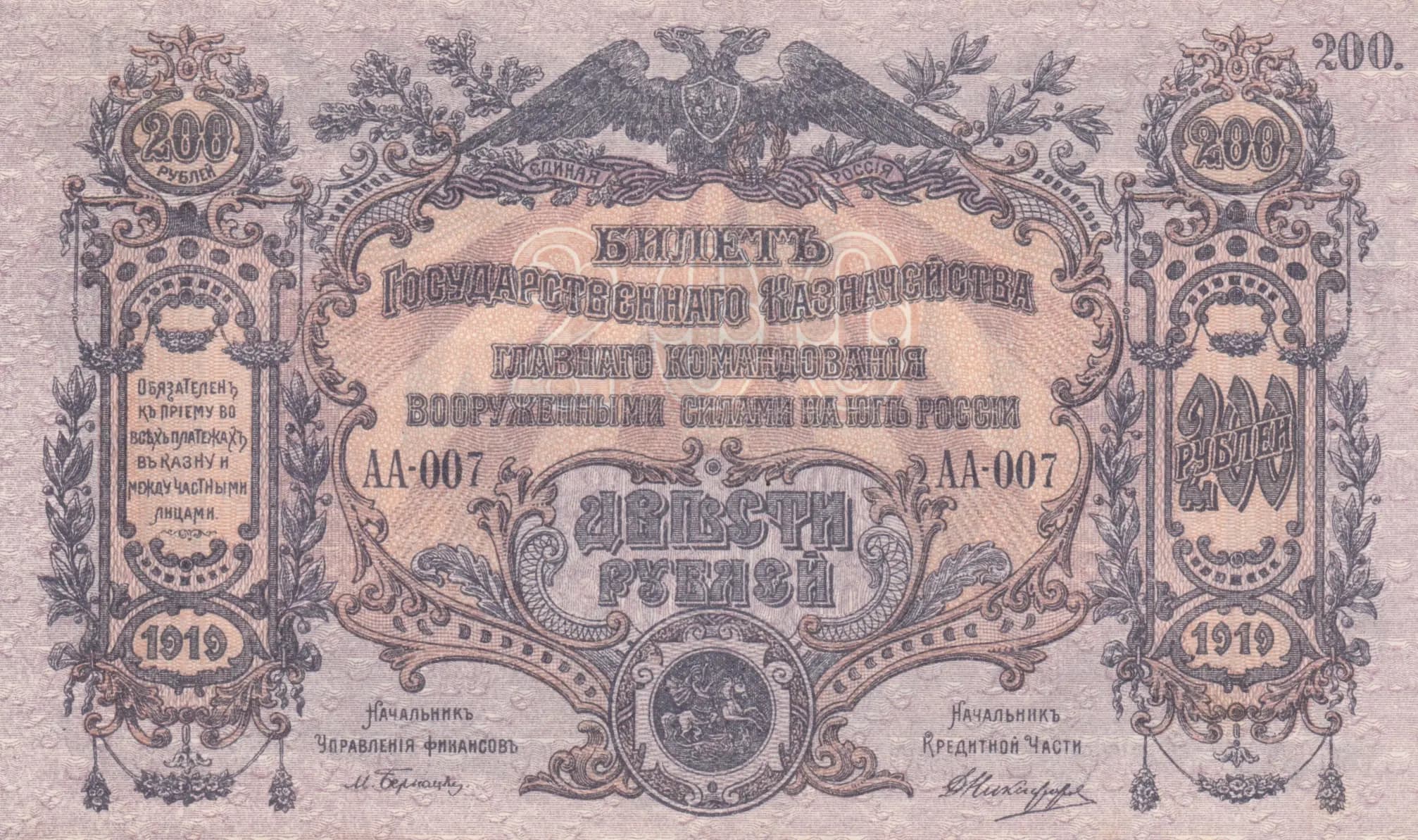
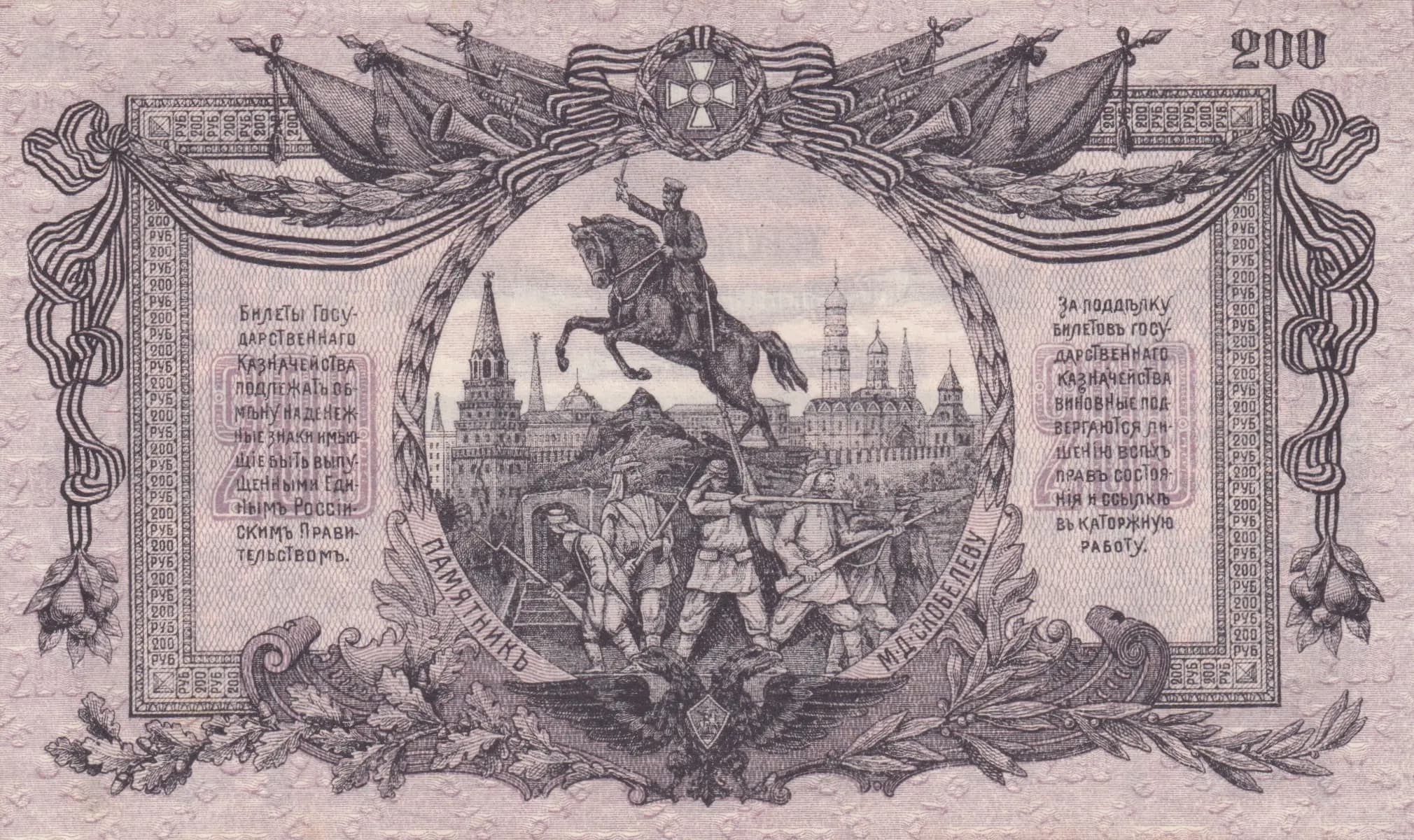
This is an exceptional example of a 200 Ruble note issued by the State Treasury of the High Command of the Armed Forces in South Russia in 1919, graded AU. The note features superb baroque engraving with an ornate front design anchored by a double-headed eagle and circular medallions, while the reverse showcases a striking allegorical vignette of a mounted warrior on a rearing horse with the Kremlin and Orthodox churches visible in the background—powerfully capturing the military and patriotic themes of the Russian Civil War era. The uniform tan-beige coloring, crisp detail retention, and minimal aging effects are consistent with careful preservation of this historically significant Denikin-era currency.
Common. While South Russian Civil War currency is historically significant and increasingly collected, the 200 Ruble denomination from this issuing authority appears to have been produced in quantities sufficient to make individual examples readily available in the numismatic market. AU examples are not scarce. The note's historical interest is high, but scarcity is not a defining characteristic of this Pick number. Denikin-era notes are sought primarily by Civil War specialists and Russian currency collectors rather than commanding premium prices for rarity alone.
This note was issued during the Russian Civil War by the White Army's South Russian territorial authority under General Denikin's command, representing one of the anti-Bolshevik governments that controlled portions of southern Russia from 1918-1920. The reverse vignette depicting a mounted warrior overlooking the Kremlin and Orthodox churches symbolizes the White movement's ideology of restoring Russian imperial and religious authority against Bolshevik rule. The inscription warning of confiscation of rights and hard labor for counterfeiting reflects the desperate financial circumstances and severe measures of the combatant factions during this turbulent period.
The front features a classically ornate rectangular design with baroque scrollwork and floral arabesques framing the entire note. The double-headed eagle (символ русской империи—symbol of the Russian Empire) is prominently centered at the top, flanked by decorative laurel wreaths. The denomination '200' appears in circular medallions at all four corners. The reverse showcases an elaborate allegorical vignette as its dominant feature: a mounted cavalry officer or Cossack warrior on a rearing horse is positioned in the center-left, depicted in military dress; below and to the right stand several additional uniformed military figures representing the fighting forces. The architectural background depicts the Kremlin fortress walls and a cluster of Russian Orthodox churches with characteristic onion domes and crosses, representing Moscow and Russian imperial authority. This cityscape symbolizes the White Army's ideological mission to restore imperial Russia. Shield emblems and further ornamental cartouches populate the corners. The color palette throughout is monochromatic in tan, beige, dark brown, and black—typical of the era's printing technology and materials.
FRONT SIDE: '200' (denomination in Arabic numerals); 'БИЛЕТЫ ГОСУДАРСТВЕННАГО КАЗНАЧЕЙСТВА ГЛАВНАГО КОМАНДОВАНИЯ ВООРУЖЕННЫМИ СИЛАМИ НА ЮГЕ РОССИИ' = 'Ticket of the State Treasury of the Main Command of the Armed Forces in the South of Russia'; 'ДВЕСТИ РУБЛЕЙ' = 'Two Hundred Rubles'; '1919' (year); 'АА-007' (serial number); 'Начальник Управления Финансов' = 'Chief of Financial Administration'; 'Начальник Кредитной Части' = 'Chief of Credit Department'; 'Обязатель к приему во всех платежах как в казну и между частными лицами' = 'Obligatory for acceptance in all payments both to the treasury and between private individuals'. REVERSE SIDE: '200' and 'РУБ' (denomination); 'БИЛЕТЫ ГОСУДАРСТВЕННАГО КАЗНАЧЕЙСТВА ГЛАВНАГО КОМАНДОВАНИЯ ВООРУЖЕННЫМИ СИЛАМИ НА ЮГЕ РОССИИ' = 'Tickets of the State Treasury of the Main Command of the Armed Forces in the South of Russia'; 'ЗА ПОДДЕРЖКУ ВЫПУСКОВ ГОСУДАРСТВЕННАГО КАЗНАЧЕЙСТВА ВИНОВНЫЕ ПОД-ЛЕЖАТ ДЛ-ЖЕННО ВСЕХ ПРАВ СОСДОВ И В КАТОР.НУЮ РАБОТУ' = 'For forgery or support of fraudulent issues of State Treasury, those responsible are subject to deprivation of all rights of citizens and to hard labor'; 'МАГНИТСКОГО' = 'Magnitsky' (likely a signatory or official).
Intaglio engraving (copperplate/steel plate engraving), the standard security printing method for banknotes of this period. The fine line work, depth of detail in the baroque flourishes, complex vignette with multiple figures and architectural elements, and the crisp impression evident in the visual analysis are all characteristic of intaglio production. The repetitive geometric patterns and security features indicate professionally executed banknote engraving by a specialized security printer, though the specific printer for South Russian Treasury notes has not been definitively established in standard catalogs.
Serial number prefix 'АА-007' indicates an early printing from this series. Known variations for South Russian Treasury 200 Ruble notes may exist in signature combinations (different officials signing as Chief of Financial Administration and Chief of Credit Department) and in serial number prefixes reflecting different printing batches. The notation 'МАГНИТСКОГО' on the reverse may indicate either a printer's mark or an official's name. Without access to comprehensive South Russian Civil War currency catalogs detailing all recorded signature and serial varieties, this specific example cannot be precisely identified within a variant hierarchy, but the AA prefix suggests an early emission.