2 kopeiki 1915
Market Prices
15 salesAbout This Note
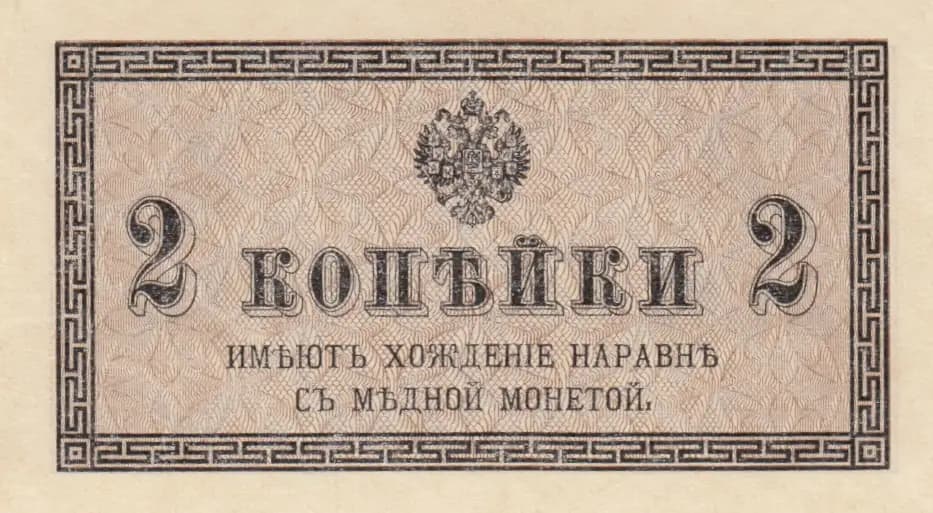
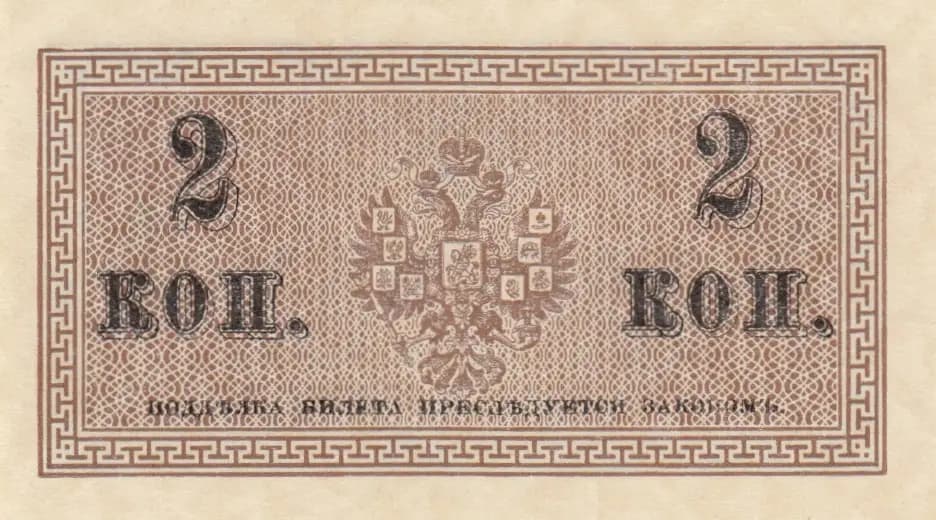
This is a stunning uncirculated example of Russia's 2 kopeck Imperial banknote from 1915, featuring the double-headed eagle of the Russian Empire prominently displayed on both obverse and reverse. The note exhibits the characteristic tan/beige coloration with bold black printing, decorative Greek key borders, and intricate crosshatch security patterns throughout—all preserved in pristine condition with no visible wear, creases, or stains. This denominated emergency currency represents a fascinating piece of late Imperial Russian monetary history issued during World War I.
Common. This is a standard Imperial Russian fractional currency note from a regular wartime issue. The eBay market data shows consistent sales at modest prices ($2-$10 for UNC examples), with even PMG-graded specimens reaching $50-$92, indicating robust availability. The 2016 catalog value of $4 UNC further confirms this is a frequently traded, readily available note. The large print run necessary to supplement copper coinage during WWI, combined with the survival of numerous examples in all grades, establishes this as a common issue.
Issued in 1915 during World War I, this 2 kopeck note was part of the Imperial Russian Treasury's emergency currency measures to supplement copper coin circulation during wartime. The Russian Imperial double-headed eagle with crown, scepter, and orb depicted on both sides symbolized the authority of the Romanov dynasty and the Russian state treasury. The inscriptions referencing 'Kaznaacheystvo' (Treasury) and the note's legal tender status reflect the official government backing of this fractional denomination during a period of significant monetary strain.
The 2 kopeck note features a symmetrical design centered on the Russian Imperial coat of arms—a detailed double-headed eagle holding a scepter and orb, wearing a crown, rendered in intricate heraldic style. This symbol of Imperial sovereignty appears identically on both obverse and reverse, positioned at the top center of the front and at the center of the back. The denomination '2' appears in large numerals in all four corners. The entire design is framed by a sophisticated Greek key pattern border in black, with a dense crosshatch background pattern providing additional security against counterfeiting. The note's color scheme of tan/beige with black printing on light brown underprint creates strong contrast and visual clarity. All text is rendered in serif Cyrillic script, befitting the formal Imperial Russian government documentation style.
FRONT SIDE: '2' (denomination numeral); 'КОПЕЙКИ' (kopecks); 'ИМѢЮТЪ ХОЖДЕНIЕ НАРАВНѢ СЪ МѢДНОЙ МОНЕТОЙ.' (These have currency at par with copper coins). BACK SIDE: '2' (denomination numeral); 'КОП.' (kop. — kopeck abbreviated); 'КАЗНАЧЕЙСТВО' (Treasury); 'КАЗНАЧЕЙСТВА ВЫПЛАЧИВАЕТ ЗАКОННО' (The Treasury pays out [this note] lawfully).
This note was produced using letterpress printing (relief printing), evidenced by the sharp, crisp registration of the black Cyrillic text and the well-defined borders. The detailed crosshatch background pattern and ornamental Greek key borders demonstrate the capability of Imperial Russian security printers to produce fine-line security features characteristic of high-quality banknote production of the period. The uniform impression and precise alignment visible throughout suggest production by the Russian state printing works.
The visual analysis does not reveal specific signature varieties, serial number prefixes, or dated overprints that would distinguish multiple issues or printings of this Pick-25 denomination. This appears to be a standard variety of the 1915 issue. Collectors should note that Russian Imperial fractional notes of this period exist with various printer marks and potential state printing variations, though these would require detailed examination to document definitively.