15 kopeeks 1918
“Baku”
About This Note
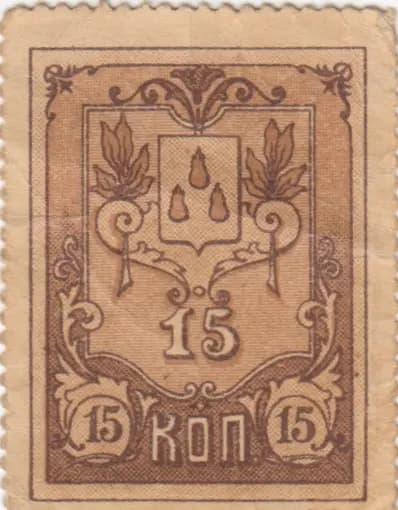
This is a 15 kopeks banknote issued by the Baku City Government in 1918, graded VF, displaying the characteristic heraldic design typical of Russian municipal emergency currency from the Civil War period. The note features a ornate shield with three teardrop motifs flanked by palm branches on both sides, with brown printing on aged tan/beige paper showing significant foxing and browning consistent with its over a century of age. The fragile paper and visible wear around the margins, combined with the scalloped upper edge, confirm this as an authentic example of this scarce Caucasian regional issue.
scarce. Baku City Government notes from 1918 are regional emergency currency from a short-lived issuing authority operating during the Russian Civil War in the Caucasus region. The combination of specific issuer (municipal government with limited territorial control), denomination (15 kopeks), and the Pick catalog designation (P-S727) indicate this was issued in limited quantities compared to major Russian government issues. VF condition examples represent survivorship bias from an era when most paper currency was either spent into oblivion or destroyed. The fragile paper and visible aging suggest not all examples survived in collectible condition.
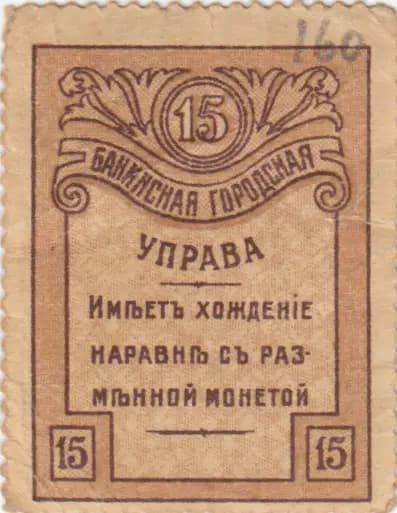
This banknote was issued during the Russian Civil War when the Baku City Government exercised local monetary authority, a common occurrence as central authority collapsed across the former Russian Empire. The heraldic shield design with its three teardrop or water drop motifs likely references Baku's historical significance as a center of oil production and trade, with the water drops possibly symbolizing the region's petroleum wealth or the Caspian Sea. The inscription 'Городская Управа' (City Administration) and declaration that the note 'has circulation equal to exchangeable coin' reflect the municipal government's attempt to maintain economic function during the chaotic period of 1918-1920.
The banknote features a classical heraldic composition centered around an ornate shield containing three vertically-arranged teardrop or water drop motifs, which may represent Baku's oil resources or maritime connections to the Caspian Sea. The shield is flanked symmetrically by stylized palm or laurel branches, suggesting prosperity and civic pride. The design incorporates ornamental scrollwork and flourishes in all four corners with decorative frame lines creating a formal, official appearance. The denomination '15' is prominently displayed in the center below the coat of arms and repeated in corner boxes. The reverse maintains the same formal aesthetic with a large circular ornament containing '15' at the top, symmetrical decorative scrollwork, and centered Russian text describing the note's legal status. No portraits or specific landmarks are depicted; instead, the design relies entirely on heraldic symbolism and ornamental engraving.
Front side: '15' (denomination), 'КОП' (Kopeks). Back side: '15' (denomination in circular ornament), 'БАНКНОТА ГОРОДСКАЯ' (City Banknote), 'УПРАВА' (Administration/Board), 'ИМЕЕТ ХОЖДЕНИЕ' (Is in Circulation), 'НАРАВНЬ С РАЗ-' (Equal to), 'МѢННОЙ МОНЕТОЙ' (Exchangeable Coin). The full text translates to: 'City Banknote of the Administration. Has circulation [status] equal to exchangeable coin.' The archaic Cyrillic spelling (МѢННОЙ with yat character) confirms pre-Soviet printing conventions.
Intaglio (engraved) printing on paper, evidenced by the fine ornate line work, decorative flourishes, and the dimensional quality of the printed design visible in the aging patterns. The consistent brown ink application and precision of the heraldic details indicate professional security printing, likely by a Russian imperial printing facility, though the specific printer for Baku municipal notes of 1918 is not definitively documented. The scalloped or perforated margin visible on the top edge suggests this was printed in a sheet format typical of the period.
This specific note is cataloged as Pick P-S727 for the Baku City Government 1918 15 kopeks issue. No visible signature, date overprints, or serial numbers are apparent in the visual analysis that would indicate a distinct variety within the Pick number. The scalloped upper margin appears consistent with the standard printing format. Without additional serial number or date information visible, this appears to be a standard example of the main variety for this denomination and issuer.