1000 rublei 1918
“North Russia”
About This Note
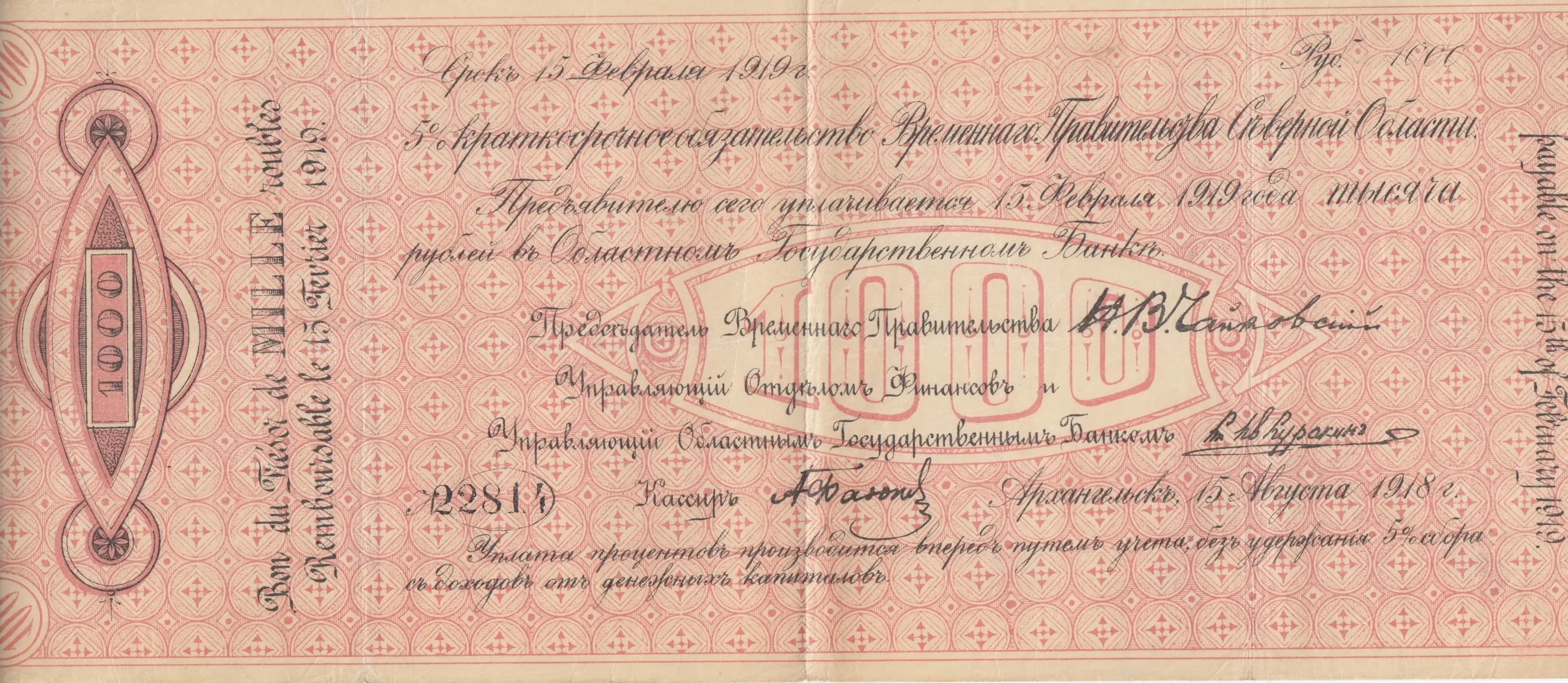
This 1000 Rublei note from 1918 issued by the Provisional Government of the North Region represents a fascinating example of Russian Civil War-era currency with significant historical and numismatic interest. The note exhibits VF condition with moderate aging, visible creasing, and foxing typical of pre-1920s Russian paper money, enhanced by multiple handwritten annotations in dark ink that overlay the original printed design. The elaborate ornamental border patterns in pale pink and cream tones, combined with the circular seal impression and administrative handwriting dating to February 1919, provide compelling evidence of this note's use during the chaotic final years of the Russian Revolution.
Uncommon. Notes issued by the Provisional Government of the North Region represent a historically significant but geographically limited emission from a White Russian authority that controlled territory for approximately 4-5 years during the Civil War period. While not exceptionally rare, these notes have more limited collector availability compared to notes from the larger Russian RSFSR or Imperial Russian issues. The specific combination of VF condition, clear dating to 1919, and the visible administrative documentation adds collector value. Pick catalog recognition and the note's association with a short-lived regional government (rather than a major central issuer) places it above 'common' status in the market.
This banknote was issued during the period of the Russian Civil War (1918-1922) by the Provisional Government of the North Region, a White Russian authority that controlled portions of northern Russia and Siberia. The handwritten annotations visible on the note, including the date of February 15, 1919, and references to the Regional State Bank (Областным Государственным Банком), document its circulation and administrative processing during this turbulent period when multiple competing governments issued currency. The ornamental geometric and religious architectural elements in the decorative border reflect traditional Russian design principles adapted for emergency wartime currency production.
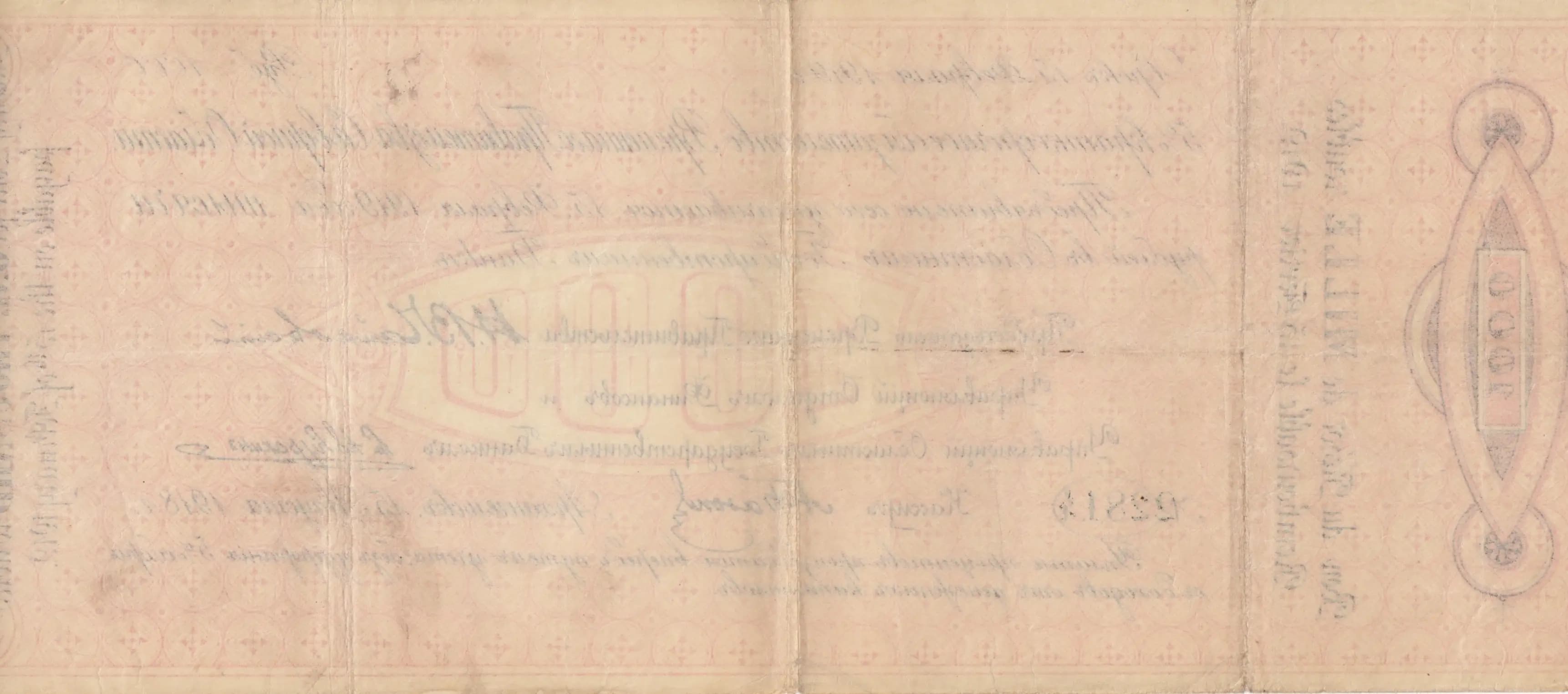
The banknote features an elaborate Art Nouveau-influenced ornamental design with a nested geometric and floral border pattern in contrasting pink and cream tones. The left side contains an intricate decorative architectural element featuring traditional Russian geometric patterns arranged in concentric formations, characteristic of Russian Empire-era currency design. The center and right portions are dedicated to administrative text and official signatures typical of government financial instruments. A large circular seal or stamp impression dominates the center-right area, serving as an official validation mark. The pale pink background with darker pink printing creates a distinctive visual hierarchy, while the faint watermark-like impressions visible on the reverse indicate the ornamental patterns were printed on both sides of the note, a security feature common to the period.
FRONT SIDE: Principal inscriptions include: '15 февраля 1919' (February 15, 1919) - date annotation; 'Управляющий Областным Государственным Банком' (Manager of the Regional State Bank); 'Председатель' (Chairman) - signature line; 'Управляющий Столовым Финансов' (Manager of Financial Affairs); Serial number '2281'; and handwritten administrative notation dated '15 Ноября 1918' (November 15, 1918). BACK SIDE: Multiple handwritten signatures and stamp impressions are present but largely illegible due to age-related fading and deterioration. The back contains faint reverse-printed impressions corresponding to the front's ornamental border pattern.
This note was produced using letterpress printing, evidenced by the crisp impression of the geometric border patterns and the deep registration of the ornamental elements visible in the visual analysis. The multi-color capability (pale pink and cream base with darker pink overprinting) suggests the use of multiple printing passes or plates. The administrative handwritten annotations in dark ink were applied post-printing, typical of the rapid, improvised currency production methods employed by White Russian authorities during the Civil War. The watermark-like reverse impressions suggest a single-pass double-sided printing approach rather than separate front and back plate runs.
This specific note is cataloged as Pick S129a, with the 'a' designation indicating it is a specific variety within the 1000 Rublei emission by this issuer. Varieties for this pick number typically relate to signature combinations, date variations, and overprint differences. The observable features on this example include: handwritten date of February 15, 1919 (post-issue administrative dating); circular seal impression in center area; serial number 2281; and signatures corresponding to the positions of Chairman and Manager of Regional State Bank. These administrative annotations and the visible seal impression may distinguish this as a specific documented variety used in official banking transactions during the transitional period from White Russian to Soviet control in northern Russia.