100 rublei 1919
“Rostov”
About This Note
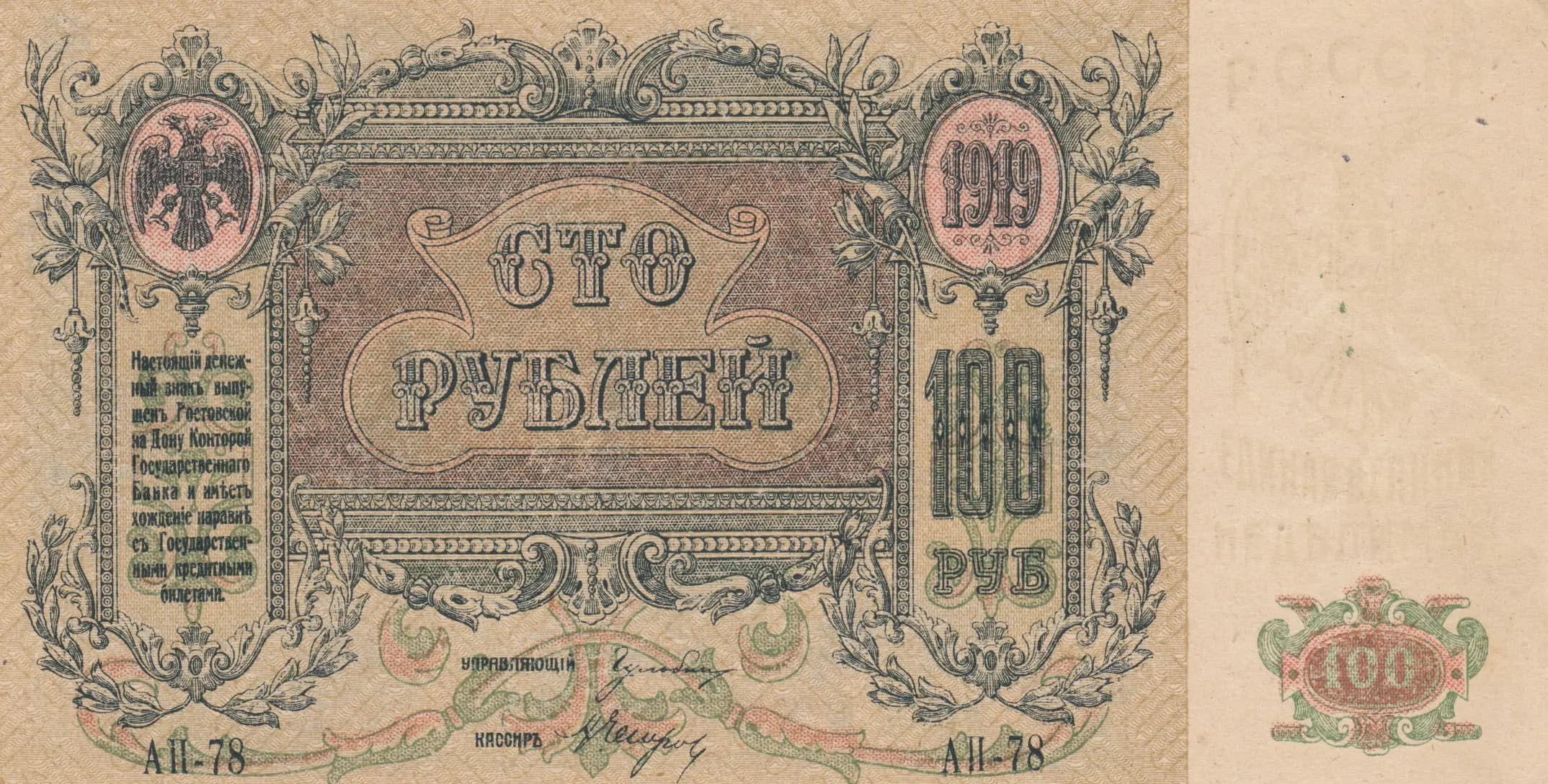
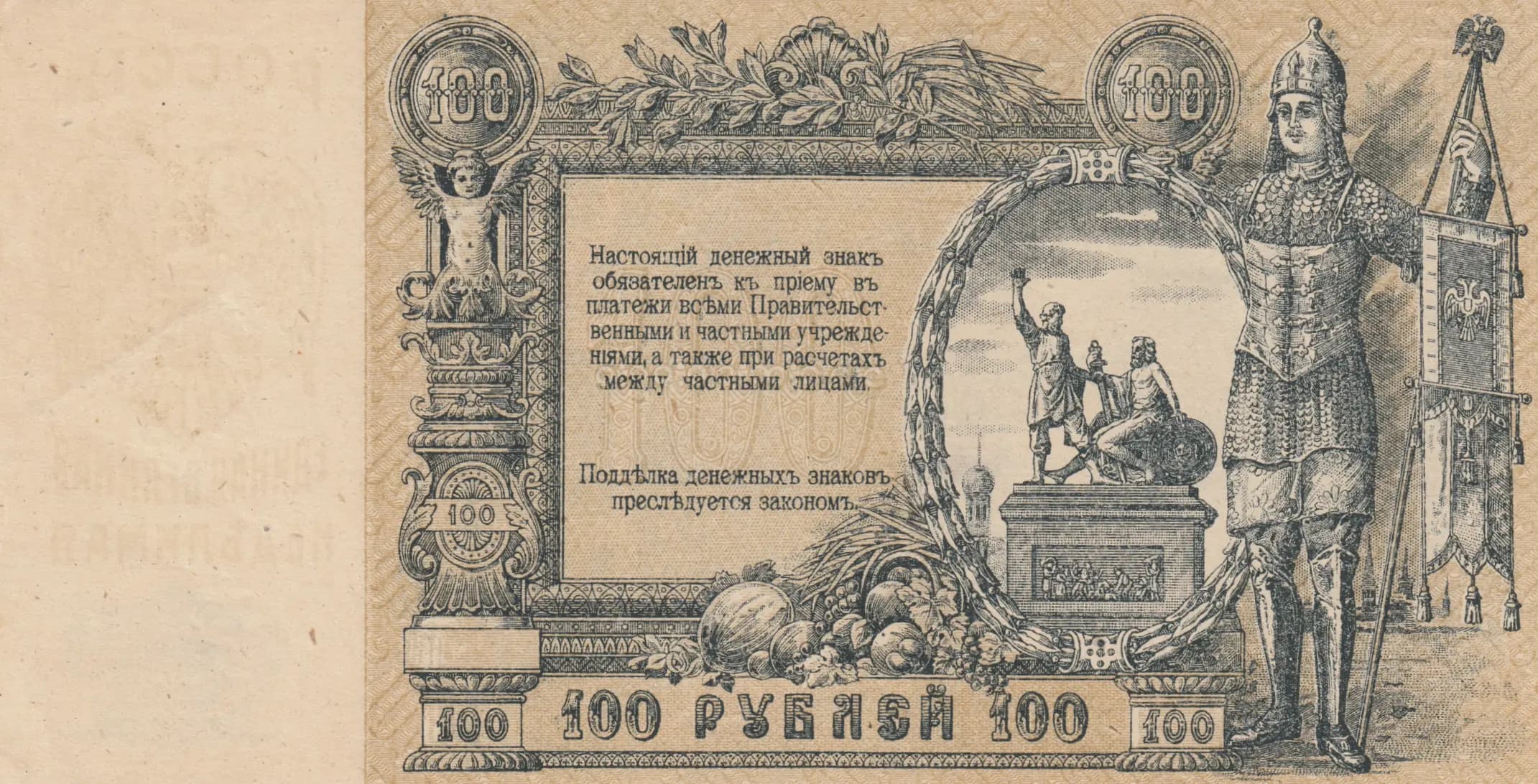
This is an AU-graded 100 Rubles banknote from 1919, issued by the Rostov State Bank Branch during the Russian Civil War period. The note displays excellent preservation with minimal wear, retaining its original beige/tan paper color and crisp black engraving with pink/red accents. The front features ornate imperial heraldic designs with double-headed eagles, while the reverse showcases elaborate allegorical imagery including a classical monument and a figure in ornate Russian imperial armor—making this a visually striking example of post-Imperial Russian emergency currency.
Common. The 100 Rublei denomination from the Rostov State Bank Branch (P-S417b) was issued in significant quantities during 1919 to facilitate regional commerce in White-controlled territory. While notes from this period and issuer appear regularly in collector markets and auction houses, specimens in AU condition command modest premiums over lower grades. The absence of extreme scarcity indicators—such as very limited documented examples, major recall events, or extreme condition rarity—combined with regular market availability supports a common classification. AU examples typically trade in the $15-35 range depending on eye appeal and provenance.
This note was issued during the Russian Civil War (1918-1922) when the Rostov-on-Don region, a White Army stronghold, required its own currency independent of Bolshevik control. The retention of Imperial symbolism—particularly the double-headed eagles and Orthodox/Imperial iconography—reflects the White movement's ideological opposition to Bolshevism and their attempt to maintain continuity with Tsarist legitimacy. The elaborate classical allegorical imagery on the reverse, depicting monumental and military themes, emphasizes authority and stability during a period of profound political chaos.
The front of this note features a symmetrical design with the denomination '100' displayed in ornamental pink/red ovals in the upper corners, each flanked by a double-headed Imperial eagle symbol. The central text '100 РУБЛЕЙ' is enclosed within an elaborate ornamental frame with scrollwork and floral motifs characteristic of Imperial Russian currency design. The back presents an allegorical composition centered on a classical monument or statue group featuring multiple seated and standing figures, symbolizing Imperial authority and stability. To the right stands a warrior or guardian figure depicted in full ornate Russian Imperial military dress, wearing a tall ceremonial helmet and holding a staff or scepter. On the left, a classical Corinthian column with decorative capital provides architectural framing. Double-headed eagles in circular frames appear in the upper corners of the reverse as well. The entire design employs beige/tan stock with black engraving and pink/red accent printing, typical of high-security currency design of the era.
FRONT SIDE: '100 РУБЛЕЙ' (100 RUBLES) — main denomination text. '1919' — year of issue. 'АП-78' — serial number designation. 'Настоящий денежный знак выпущен по Приказу Главного Управления Государственного Банка и имеет хождение наравне с государственными кредитными бумагами.' (This monetary note is issued by order of the Main Administration of the State Bank and circulates equally with state credit papers.) BACK SIDE: '100 РУБЛЕЙ' (100 RUBLES) — denomination repeated. 'Настоящий денежный знак обязателен к приему в платежи всеми Правительственными и частными учреждениями, а также при расчетах между частными лицами.' (This monetary note is mandatory for acceptance in payment by all Government and private institutions, as well as in settlements between private individuals.) 'Подделка денежных знаков преследуется законом.' (Counterfeiting of monetary notes is prosecuted by law.)
This note was produced using traditional steel plate engraving combined with multi-color letterpress printing. The fine line work visible in the ornamental borders, the detailed allegorical figures, and the complexity of the design elements are characteristic of intaglio engraving. The color separation into black primary engraving with pink/red and green accent colors indicates multiple passes through a printing press with careful registration. This multi-pass color printing technique was standard for Russian Imperial and early Soviet currency security and aesthetic purposes. The printer details for P-S417b specifically are consistent with Rostov-area emergency currency production during the White Army period, likely produced on available equipment in Rostov-on-Don.
This specific example bears the serial number designation 'АП-78,' with the Cyrillic letters 'АП' indicating the series or printing batch. The 1919 date and Rostov issuer attribution align with Pick catalog number P-S417b. No overprints or significant alterations are evident. Varieties for this issue typically relate to different signature combinations and serial number prefixes; this note's signature and serial prefix should be documented as part of any formal cataloging to distinguish it from related varieties within the P-S417 series.