10 kopeek 1918
About This Note
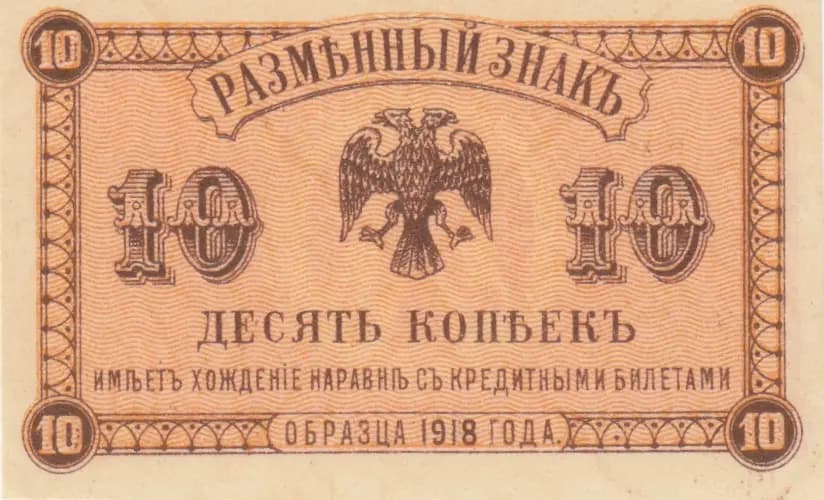
This is an exceptional example of a 10 kopek note issued by the Far East Provisional Government in 1918, graded UNC. The note features a striking double-headed eagle as its central motif, rendered in tan and brown tones with ornamental borders and continuous wavy line background patterns. As a fractional currency from Russia's civil war period, this piece represents a fascinating chapter in numismatic history when regional governments issued their own emergency currency.
Common. The Far East Provisional Government issued fractional notes in multiple denominations during 1918-1920 in substantial quantities to facilitate commerce in a region with severe currency shortages. While specific print runs for this Pick number are not definitively documented, the denomination and widespread issuance by a regional government during the civil war period resulted in numerous surviving examples. UNC examples are more desirable than circulated pieces, but the note itself is not scarce in the broader numismatic market.
This note was issued during the Russian Civil War by the Far East Provisional Government, a regional authority that controlled parts of eastern Russia from 1918-1922. The double-headed eagle depicted on both sides was the traditional symbol of Russian imperial authority, which the Provisional Government retained to legitimize its governance and maintain continuity with pre-revolutionary currency standards. The inscription stating the note 'has circulation equal to credit notes' reflects the emergency nature of fractional currency during this period of monetary chaos and hyperinflation.
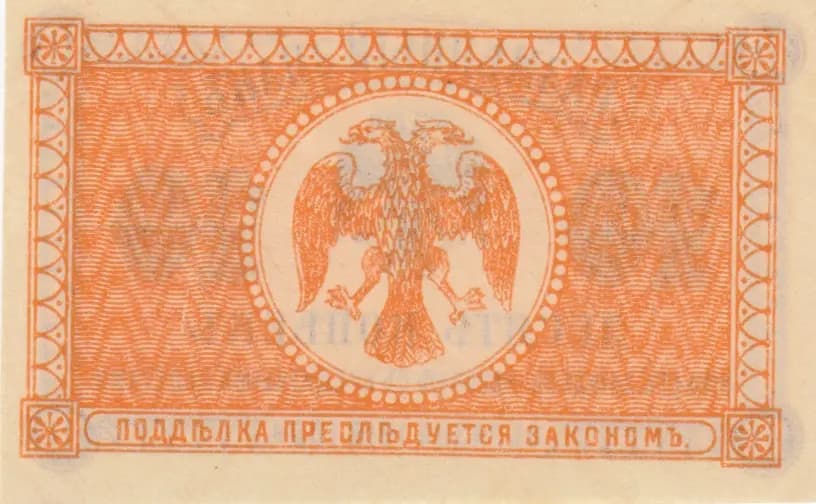
The obverse features a heraldic double-headed eagle with spread wings positioned centrally, flanked by ornamental border work. The denomination '10' appears in all four corners in a symmetrical layout. The reverse presents the same double-headed eagle but enclosed within an ornate circular medallion or wreath, creating a more formal, seal-like presentation. Both sides employ a continuous wavy line pattern as background security ornamentation, with geometric decorative elements in the corners. The eagle itself represents the Imperial Russian coat of arms, deliberately chosen by the Far East Provisional Government to assert legitimacy and continuity.
FRONT: 'РАЗМЕННЫЙ ЗНАК' (Exchange Token/Fractional Note); '10' (numeric denomination); 'ДЕСЯТЬ КОПЬЕК' (Ten Kopeks); 'ИМЕТЬ ХОЖДЕНИЕ НАРАВНЕ С КРЕДИТНЫМИ БИЛЕТАМИ' (To have circulation equal to credit notes/banknotes); 'ОБРАЗЦА 1918 ГОДА' (Model/Issue of 1918). BACK: 'ПОДДЕЛКА ПРЕСЛЕДУЕТСЯ ЗАКОНОМ' (Counterfeiting is prosecuted by law).
Letterpress printing (relief printing), characteristic of emergency wartime currency production. The crisp impression of the denomination numerals, ornamental borders, and eagle imagery, combined with the uniform application of the wavy line background pattern, indicates traditional typographic printing methods. The quality and consistency suggest printing by a capable security printer, likely in Vladivostok or another Far East regional center.
No specific varieties (signature variants, date variations, or serial number prefixes) are apparent from the visual analysis provided. This note type may exist in multiple printings or from different regional presses, but without access to detailed serial number or printer mark information, specific variety classification cannot be determined. Collectors should examine serial numbers and any printer marks on the margins to identify potential varieties within this Pick number.